
This analysis synthesizes 10 sources published the week ending Apr 28, 2026. Editorial analysis by the PhysEmp Editorial Team.
The physician burnout crisis appears to be inflecting—but not uniformly. New AMA data shows national burnout rates declining while specialty-specific gaps persist, and nearly 40% of physicians still report high moral distress. Against this backdrop, AI-powered documentation tools are rapidly proliferating across health systems, promising to reclaim hours lost to electronic health records. Yet emerging evidence reveals a critical tension: the same ambient AI scribes reducing administrative burden are producing lower-quality clinical notes than human-generated documentation. For physicians evaluating opportunities and health systems deploying these tools, the implications extend far beyond workflow efficiency into compensation structures, malpractice exposure, and the fundamental nature of clinical practice. This structural shift sits at the center of AI in Physician Employment & Clinical Practice—where technology adoption intersects directly with physician labor dynamics.
The Documentation Time Dividend: Real But Modest
Walter Reed National Military Medical Center’s deployment of AI scribe technology exemplifies the measurable gains now being documented across health systems. Physicians report reduced note-taking burden and increased face time with patients—a shift from documentation-centered encounters to patient-centered care. Similar implementations in dermatology practices demonstrate how specialty-specific workflows can be optimized when AI handles the administrative capture of clinical encounters.
However, the magnitude of these gains warrants scrutiny. Recent research shows AI scribes are linked to “modest reductions” in EHR use and clinical documentation time—not the transformative liberation from administrative work that vendor marketing often implies. For physicians negotiating employment contracts, this distinction matters: productivity expectations tied to AI-enabled efficiency gains should reflect actual time savings, not aspirational projections.
Health systems deploying AI scribes should calibrate productivity expectations to documented time savings—typically 15-30 minutes daily—rather than assuming wholesale elimination of documentation burden. Compensation models built on inflated efficiency assumptions risk creating unsustainable workload expectations.
Quality Trade-Offs: The Underreported Risk
The most significant finding emerging from recent evidence challenges the prevailing narrative around AI documentation tools. Research presented at ACP 2026 reveals lower quality scores for AI-generated visit notes compared to human-generated documentation. This quality gap has direct implications that mainstream coverage of healthcare AI consistently overlooks: clinical documentation drives billing, supports malpractice defense, enables care coordination, and increasingly influences value-based compensation calculations.
For physicians, the question becomes whether time saved on documentation creates downstream liability or revenue exposure. A note that captures an encounter faster but less completely may satisfy immediate workflow needs while undermining the physician’s position in a coding audit, quality metric calculation, or malpractice proceeding. Health systems rushing to deploy ambient AI without robust quality assurance protocols may be trading short-term burnout relief for long-term institutional risk.
Specialty-Specific Implementation Considerations
The burnout landscape varies dramatically by specialty, which suggests AI documentation tools will deliver uneven value across physician populations. Specialties with high documentation-to-patient-contact ratios—primary care, psychiatry, complex chronic disease management—may see proportionally greater benefit than procedure-heavy specialties where documentation represents a smaller fraction of total work burden.
Dermatology’s early adoption success reflects this dynamic: the specialty’s visual-diagnostic workflow and relatively standardized encounter types align well with current AI capabilities. Primary care physicians facing moral distress from impossible patient volumes may find AI scribes necessary but insufficient—addressing documentation burden while leaving the underlying volume pressures intact.
Compensation Model Implications
The integration of ambient AI into clinical workflows creates pressure points in existing compensation structures that few health systems have adequately addressed. If AI documentation genuinely increases physician capacity, how should that capacity be valued? Three models are emerging:
Volume absorption: Physicians see more patients in the same time, with compensation tied to increased RVU production. This model risks accelerating burnout by converting documentation time savings into additional clinical encounters.
Quality reinvestment: Time savings flow into longer patient encounters, care coordination, or complex case management. This approach may improve outcomes and patient satisfaction but requires compensation models that reward quality over volume.
Work-life reallocation: Physicians maintain current volumes while reducing total work hours. This model addresses burnout directly but challenges traditional productivity-based compensation.
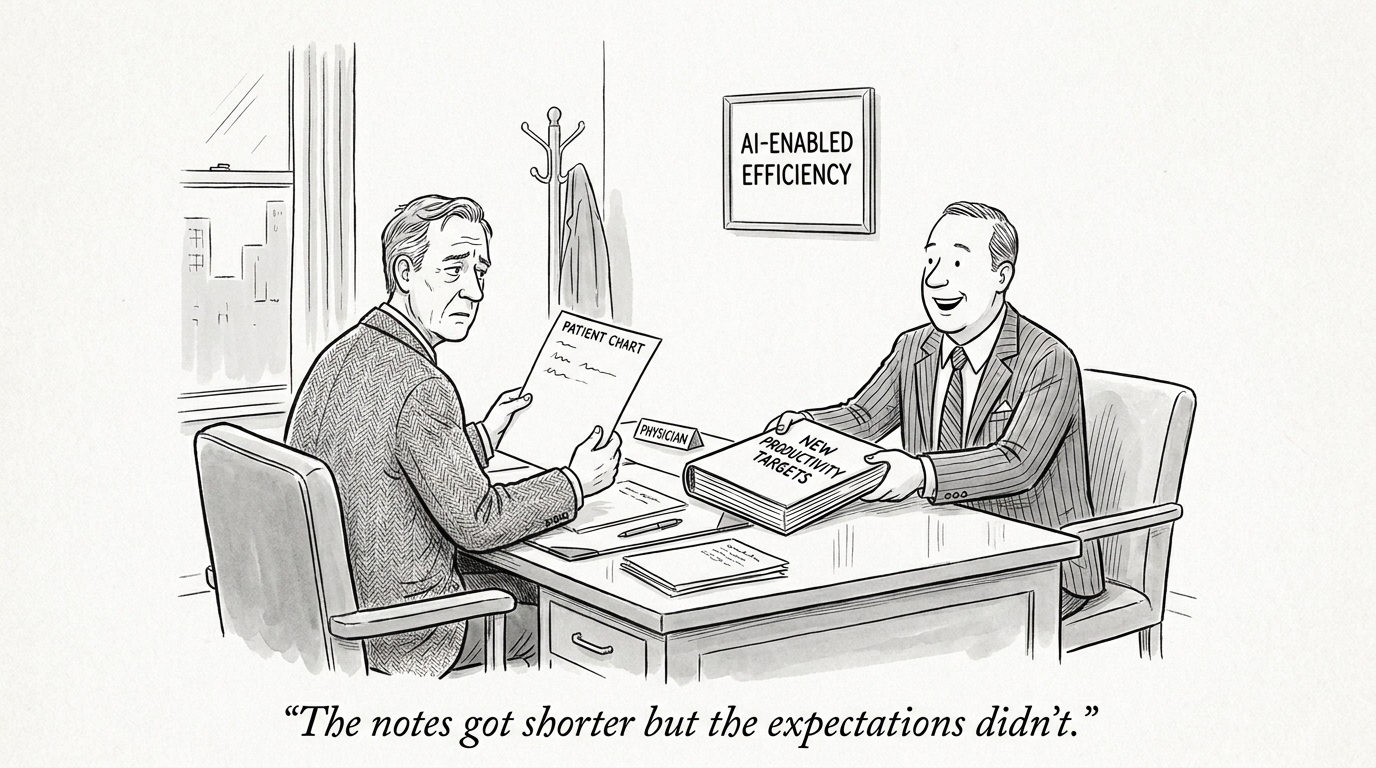
Physicians negotiating contracts at AI-enabled health systems should clarify how documentation time savings will be allocated—to additional volume, quality improvement, or work-life balance—before accepting productivity targets that assume AI-driven efficiency gains.
Recruitment and Retention Dynamics
For hospital executives and physician recruiters, AI documentation capabilities are becoming a competitive differentiator in talent acquisition. Physicians experiencing high moral distress—now approaching 40% according to recent surveys—are actively seeking practice environments that address administrative burden. Health systems that can credibly demonstrate reduced documentation load gain recruiting leverage, particularly for high-burnout specialties.
However, this advantage depends on implementation maturity. Early-stage AI deployments with quality concerns, workflow friction, or unclear liability frameworks may actually deter sophisticated physician candidates who recognize the risks. The recruiting advantage accrues to systems with proven, well-integrated AI documentation that demonstrably improves physician experience without creating new problems.
The Incomplete Narrative in Healthcare AI Coverage
Media coverage of AI scribes and documentation assistants consistently frames these tools as burnout solutions without examining the labor market restructuring they enable. When a health system reduces documentation burden by 20%, the strategic question is not simply whether physicians are happier—it is whether that efficiency gain translates into headcount reduction, volume increase, or genuine workload improvement. The physician employment implications of AI documentation tools remain largely unexamined in mainstream reporting, which tends to focus on technology capabilities rather than organizational deployment decisions that determine physician impact.
Similarly, the quality trade-offs now emerging in research receive minimal attention compared to efficiency gains. A balanced assessment requires acknowledging that AI documentation tools currently occupy an intermediate position: meaningfully helpful but not yet equivalent to skilled human documentation, with implications for billing accuracy, legal protection, and quality measurement that physicians must understand.
Strategic Positioning for an AI-Augmented Future
The trajectory is clear: AI documentation tools will become standard infrastructure in physician practice environments within the next several years. The current period represents a transition phase where implementation quality varies dramatically across health systems, creating both opportunities and risks for physicians and organizations.
Physicians evaluating career moves should assess not just whether a health system has deployed AI documentation, but how that deployment has been structured—including quality assurance protocols, liability frameworks, and compensation model adjustments. Health systems that have thoughtfully integrated these tools while protecting physician interests will attract talent; those that have used AI primarily to increase productivity expectations may face retention challenges.
For recruiters and health system executives, the competitive landscape now includes AI documentation capability as a baseline expectation for many physician candidates. The differentiating factor is not technology adoption but implementation philosophy: whether AI serves physician well-being or primarily organizational efficiency. As burnout remains a defining challenge in physician employment, the systems that get this balance right will hold significant advantages in physician recruitment and retention.
Sources
AI scribe technology for medical professionals reduces notetaking, provides more face time with patients – DVIDS
AI scribe technology for medical professionals reduces note-taking, provides more time for patient care – Walter Reed National Military Medical Center
Virtual Medical Scribes in 2026: How AI-Assisted Documentation Is Ending Physician Burnout – Charleston Gazette-Mail
How AI Is Solving Physician Burnout in Dermatology – HCPLive
ACP: Lower-quality scores seen for AI- versus human-generated visit notes – Renal & Urology News
AI scribes linked to modest reductions in electronic health record use and clinical documentation time – MSN
Physician burnout declines nationally, specialty gaps persist, says AMA – Healthcare IT News
Nearly 40% of physicians report high moral distress, which significantly increases burnout – Healio
ACP 2026 Recap for Primary Care: Mammography, AI, Scribes and Obesity Medications – Patient Care
Ambient AI supports provider care and payments – Healthcare IT News