
Why this theme matters now
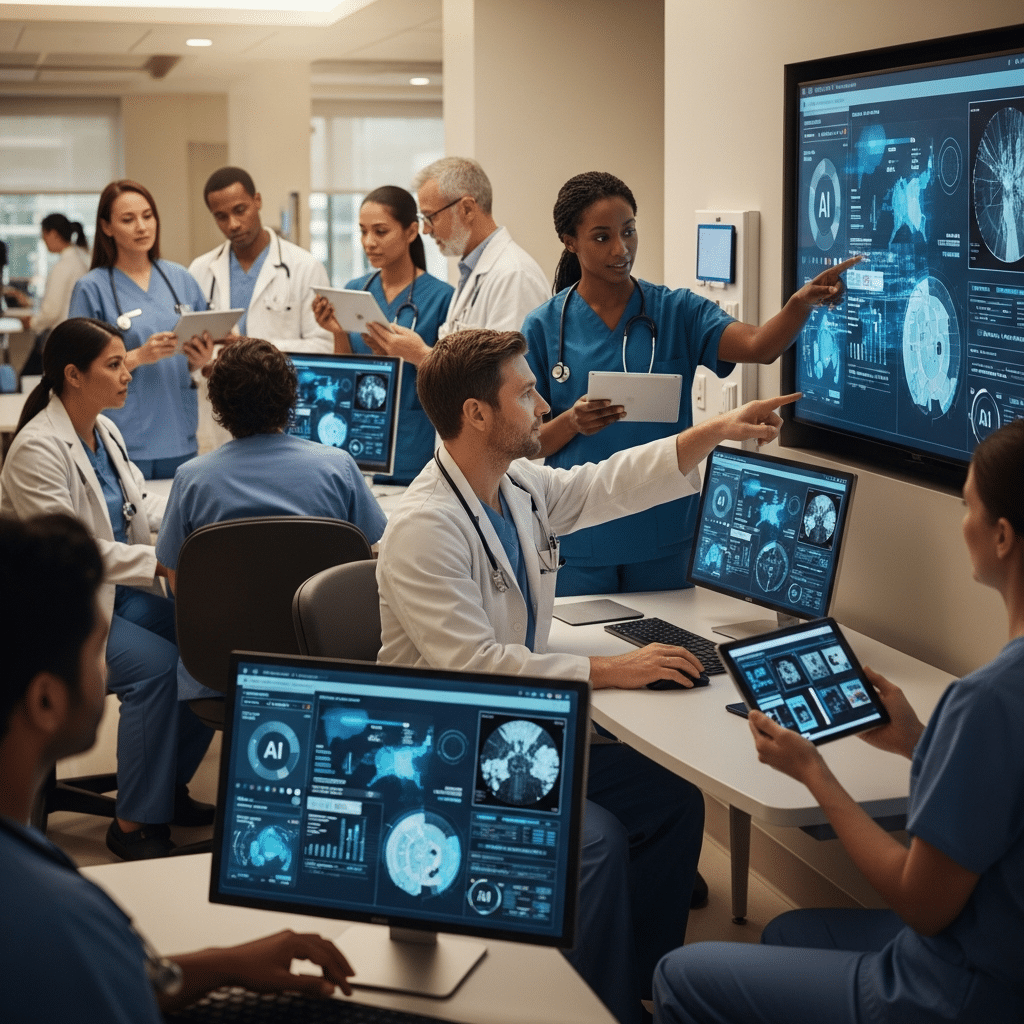
Healthcare delivery is at an inflection point: rising clinician burnout, accelerating consumer expectations, and maturing generative AI capabilities are converging on the electronic health record—the central operational system for care. Vendors and innovators are no longer adding bolt-on chatbots or isolated analytics; they are embedding AI in healthcare directly into the EHR itself to automate routine tasks, surface contextually relevant recommendations, and channel patient communication into clinician workflows. Those shifts promise productivity gains and tighter care continuity, but they also raise new questions about governance, workload design, and the skills health systems must hire for and develop.
From documentation burden to decision augmentation
One of the clearest use cases for in-EHR AI is the heavy lift of documentation and information synthesis. AI copilots can summarize encounters, tag problem lists, and suggest coding, converting unstructured notes into structured data that downstream tools can use. The net effect—when implemented well—is a reduction in time spent on clerical tasks and faster access to decision-relevant information during encounters.
But augmentation versus automation is a crucial distinction. Fully automated actions (auto-charting, autonomous order entry) can introduce safety and legal concerns if models err. Practical deployments today lean toward human-in-the-loop designs: AI generates candidate summaries or suggestions that clinicians confirm. Operational leaders should instrument these flows with explicit feedback loops and performance metrics to detect drift, bias, or error rates that could erode trust.
Embedding patient communication inside the EHR
Integrating direct-to-consumer channels into the EHR collapses the traditional divide between patient messaging platforms and clinical systems. When patient messages, questionnaires, and intake data live natively in the chart, clinicians gain richer context and teams can route inquiries according to clinical priority—reducing fragmentation and loss of information seen with third-party apps.
Integration also shifts the nature of the inbox. Instead of isolated messages, clinicians and care teams receive a continuous stream of structured and unstructured inputs that need triage, interpretation, and documentation. AI can help triage by classifying message urgency, summarizing patient intent, and suggesting standardized responses or care pathways. Yet without careful workflow redesign, added volume can simply relocate burden rather than eliminate it.
Call Out: Embedding patient channels into the EHR improves contextual continuity but demands new triage rules and staffing models; AI can screen and summarize, yet human oversight remains essential to manage complexity and liability.
Interoperability and model governance
The efficacy of embedded AI depends on data availability and quality. Models require timely access to longitudinal records, medications, lab values, and clinical notes. That dependency elevates interoperability and API readiness as prerequisites—not optional enhancements. Standards like FHIR and modular integration patterns matter because they allow AI components to be provisioned, audited, and updated without wholesale EHR replacement.
Governance is equally important. Health systems need model registries, performance monitoring dashboards, and clinical validation pathways to ensure safety and equitable outcomes. Vendors may ship capabilities, but buyers must demand transparency around training data, benchmark performance, and error cases. Clinician involvement in validating and tuning models is a non-negotiable part of successful adoption.
Operational and workforce implications
AI-embedded EHRs alter the skills profile organizations must recruit for. Roles that bridge clinical knowledge and technical fluency—clinical informaticists, EHR AI specialists, prompt engineers and data governance leads—move from niche to mainstream. Recruiting strategies should prioritize experience with EHR optimization, model evaluation, and cross-functional change management.
From a staffing perspective, workflows will likely shift rather than shrink. Some tasks will move from physicians to allied health professionals supported by AI triage; other tasks will require higher-level cognitive oversight. Talent pipelines must reflect these changes: hiring for adaptability, evidence of quality improvement work, and comfort with human-AI teaming.
Call Out: The rise of AI-native EHR features creates demand for hybrid roles—clinician-plus-technology experts—making strategic recruiting and upskilling central to capturing productivity gains.
Implications for healthcare organizations and recruiting
For health systems, successful adoption is not just a technical project; it is an organizational change program. Actionable priorities include (1) defining measurable clinical and operational outcomes tied to AI features, (2) building model governance and clinician feedback loops, (3) redesigning triage and staffing to account for new message and task flows, and (4) updating procurement criteria to evaluate integration, transparency, and total cost of ownership.
For recruiters and workforce planners, the shift signals a sustained demand for professionals who can operationalize AI inside clinical systems. Job descriptions should emphasize cross-discipline experience—clinical care plus informatics, quality improvement, or data governance—and recruiters should assess candidates for practical experience with EHR implementations, API-driven integrations, and change management.
Embedding AI into EHRs is not a novelty; it is becoming a core modality for improving clinician productivity and patient engagement. The promise is real—faster documentation, smarter triage, and more seamless patient-provider communication—but the path to value requires disciplined governance, workflow redesign, and targeted hiring. Health systems that approach AI-EHR integration as a socio-technical transformation rather than a software upgrade will realize both clinical and operational dividends.
Sources
Zebra Mednex Named 2026 Edison Award Nominee for Its AI-Powered EHR Innovation – Florida Today
Instep Health unveils Patient Inbox, a new DTC channel built inside the EHR – Florida Today
Weekly Roundup — February 14, 2026 – Healthcare IT Today