
This analysis synthesizes 10 sources published the week ending Jul 21, 2026. Editorial analysis by the PhysEmp Editorial Team.
A convergence of research this week exposes a basic tension in clinical AI deployment: physicians are demonstrably susceptible to AI-induced errors even when contradictory evidence exists, yet liability frameworks for these tools remain dangerously undefined. This structural gap—where technology outpaces governance—is becoming a defining issue in AI in Physician Employment & Clinical Practice, with direct implications for how physicians negotiate employment terms, how health systems structure clinical oversight, and how malpractice risk gets allocated across the care delivery chain.
The Over-Reliance Problem: Evidence From Multiple Specialties
Research published this week shows that AI errors systematically shape physician judgment in ways that persist despite contradicting clinical evidence. Studies of radiologists found that some clinicians accept AI recommendations even when those recommendations are clearly wrong. That challenges the assumption behind many deployments: that physicians will reliably catch algorithmic mistakes.
The pattern appears beyond radiology. Across settings, AI tools seem to create a new category of diagnostic error—one where clinician judgment becomes anchored to flawed algorithmic suggestions instead of independent reasoning. For physicians weighing jobs at AI-integrated health systems, this should factor into questions about workflow design, documentation expectations, and whether employers have put safeguards in place against automation bias.
Physicians entering AI-heavy practice environments should scrutinize what tools are deployed and what governance structures exist to protect clinical autonomy when algorithmic recommendations conflict with independent judgment. The absence of those frameworks is both a patient-safety problem and a career-liability issue.
Safety Variability Across AI Platforms
A Stanford–Harvard study ranking 24 AI tools for patient safety found wide performance variability, with Doximity’s clinical AI outranking OpenEvidence and some frontier models on safety metrics. That difference matters for employment decisions: physicians working with lower-ranked tools face a materially different risk profile than those using better-validated platforms.
Mainstream coverage of healthcare AI still focuses on capability and efficiency gains while largely skipping the employment angle. Tool selection affects physician liability, should inform contract negotiations, and creates stratified risk across practice settings—but reporters and job-seeking clinicians often lack the comparative safety data they need to evaluate offers.
At the same time, studies of AI speech-to-text systems—the ambient documentation tools now central to many workflows—found significant oversight gaps. When AI scribes introduce errors into the record, the legal chain of responsibility is murky.
The Liability Vacuum: Who Bears the Risk?
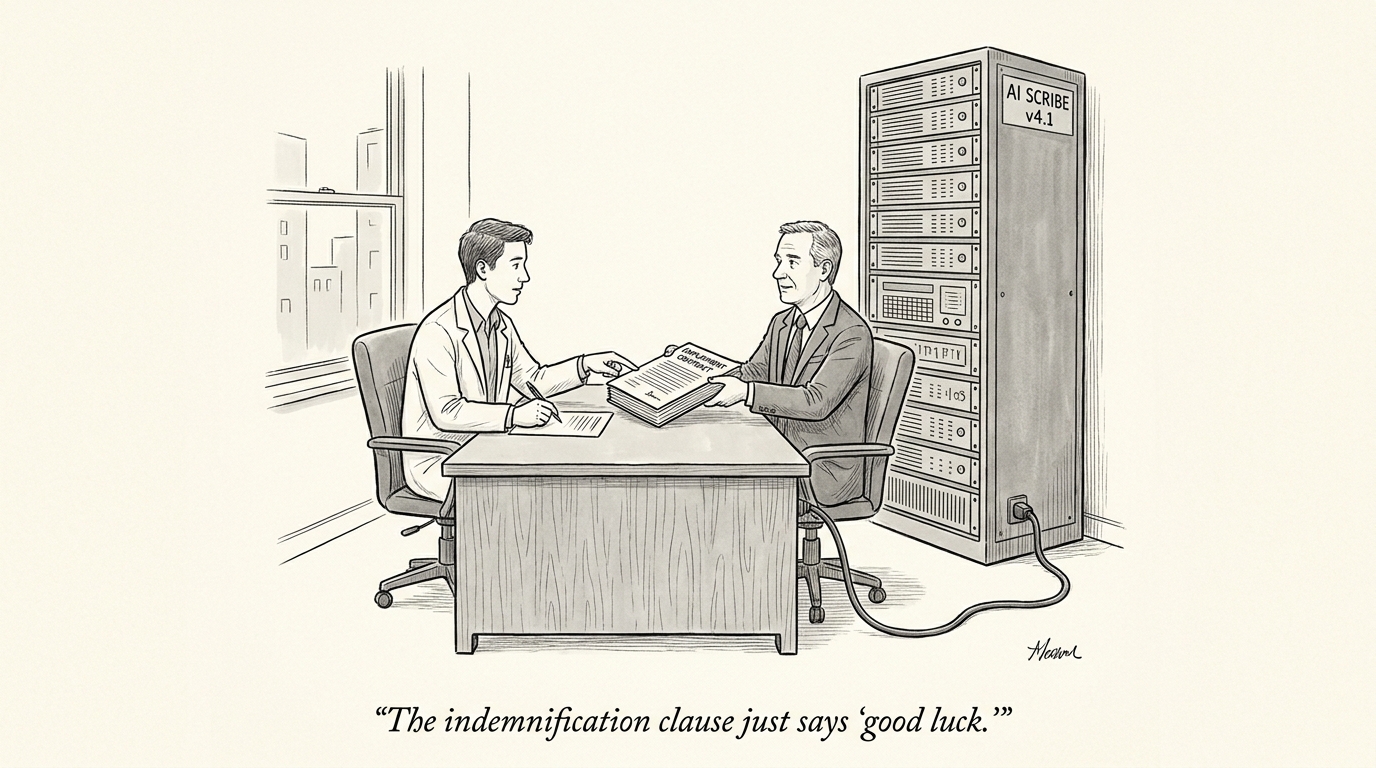
Liability for mistakes made by AI scribes is becoming an employment issue. Existing legal frameworks offer no clear answer, which can leave physicians exposed to malpractice claims for errors generated by systems they didn’t design and don’t control. That has compensation implications: physicians taking on AI-related liability should be paid for it, yet few contracts name that risk explicitly.
Quality leaders warn that “bad data at AI speed is still bad data.” When AI-generated notes contain errors, they can propagate rapidly through the medical record and affect downstream care decisions, billing, and legal defensibility. Physicians in AI-scribe environments face a new category of documentation risk that traditional malpractice frameworks weren’t built to handle.
Hospital executives and recruiters should recognize that AI liability ambiguity is becoming part of recruitment conversations. Candidates are asking about governance frameworks, error-correction protocols, and indemnification provisions. Health systems that spell out policies gain an edge in hiring.
Clinical Authorship: A Framework for Governance
Commentary this week proposed “clinical authorship” as a missing principle in medical AI governance. The idea: physicians need meaningful control over AI-assisted clinical decisions—not a rubber-stamp role, but real authority to accept, modify, or reject algorithmic recommendations without productivity penalties or workflow friction.
That design choice changes practice. Systems that build workflows around clinical authorship preserve professional judgment and can limit liability exposure. Systems that prioritize throughput may implicitly pressure clinicians to accept AI output without proper review.
The partnership between OpenEvidence and Boston Children’s Hospital to study AI’s impact on clinical care is one way to build the evidence base. But that research will take time, and physicians are practicing in AI-integrated environments right now, often without mature evidence or legal precedent to guide them.
Strategic Implications for Employment Decisions
For physicians weighing career moves, these developments point to concrete considerations. AI tool choice varies across systems, and safety rankings should be part of the evaluation. Liability frameworks are unresolved, so contract language about AI-related malpractice exposure matters. Workflow design—whether the system preserves clinical authorship or optimizes for AI-driven efficiency—affects both autonomy and risk.
For health system leaders and recruiters, the lesson is similar. Organizations that create clear AI governance policies, pick well-validated tools, and address liability openly will be more competitive in hiring. Systems that rush to deploy AI without corresponding governance may face recruitment problems and legal exposure down the line.
Expect AI safety and governance to become standard items at the bargaining table alongside compensation, call schedules, and productivity expectations. And expect those negotiations to feel unsettled: a residency candidate asking about indemnity during a hospital tour, an HR rep flipping to the indemnification clause and shrugging, an IT director promising a rollback button that may not exist yet. That’s where we are.
Sources
AI errors shaped doctors’ judgments despite contradictory evidence – News-Medical.net
AI shows promise in clinical reasoning, but human oversight remains critical – TechTarget – HealthTech Analytics
Downside of AI: Some Rads Accept Recommendations Even When They’re Incorrect – Radiology Business
24 AI tools ranked for patient safety, Stanford-Harvard study – Becker’s Hospital Review
AI speech-to-text needs stronger oversight in healthcare, study finds – News-Medical.net
Doximity Outranks OpenEvidence, Frontier Models in Independent Stanford-Harvard Study of Clinical AI Safety – Business Wire
Who’s Really Liable When Your AI Scribe Makes a Mistake? – Medical Economics
Clinical Authorship — The Missing Principle in Medical AI – KevinMD
Quality leaders warn: bad data at AI speed is still bad data – Healthcare IT News
OpenEvidence, Boston Children’s partner on study of AI’s impact on clinical care – MobiHealthNews