
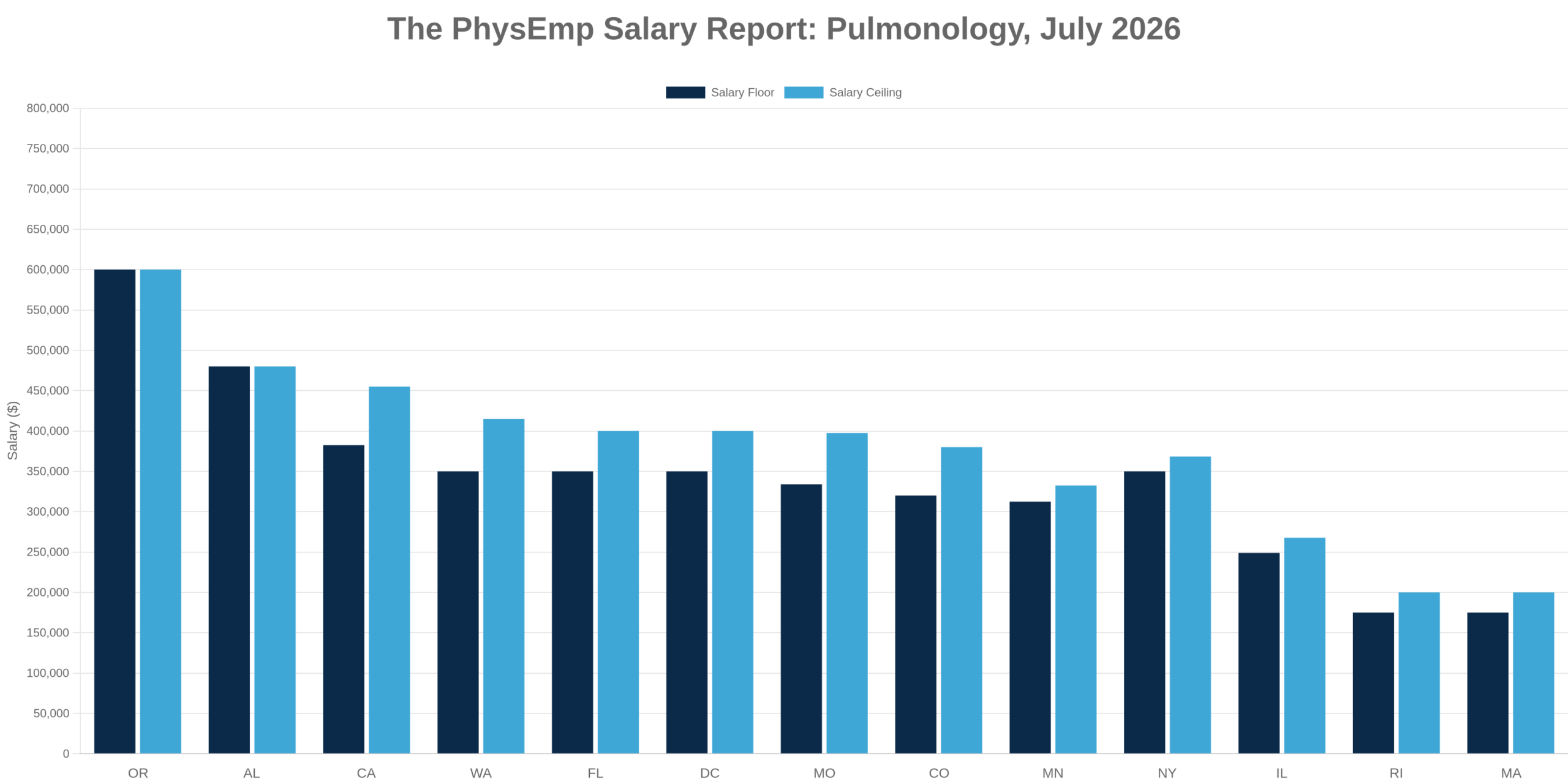
Somewhere in Oregon, a single Pulmonology listing is quietly offering $600,000 a year to keep other people’s lungs functional. Meanwhile, in Coventry, Rhode Island, a part-time role is posted at $175,000 — a spread wide enough to drive a ventilator through. The Pulmonology market, as of July 2026, contains 89 total listings across 29 states, with 30 of those disclosing salary. The takeaway is straightforward: this is a specialty where the ceiling is generous, the floor is part-time, and the middle is where most of the honest work actually gets done.
👉 Explore Pulmonology job market insights and trends
The Pulmonology Job Market at a Glance
Total listings: 89
Listings with salary data: 30
Full salary range: $175,000 – $600,000
National average range: $314,600 – $349,000
The spread here is the story. A $425,000 delta between floor and ceiling is not a rounding error — it is a structural feature of a market where full-time hospitalist-style Pulmonology roles compete for airspace with part-time contract work posted by staffing outfits like Medrina. Average it all together and you land in the low-$300s, which flatters no one and misrepresents almost everyone.
States represented: Rhode Island, California, Illinois, New York, Massachusetts, Washington D.C., Minnesota, Florida, Colorado, Missouri, Washington, Louisiana, Tennessee, Georgia, Kansas, Texas, Arizona, Indiana, Iowa, Alabama, North Carolina, Mississippi, Wisconsin, Idaho, New Jersey, Ohio, Oregon, Pennsylvania, and North Dakota.
Twenty-nine states. Twelve with salary data. The rest are flying blind.
👉 Browse Pulmonology physician job opportunities
How States Stack Up
Overperformers:
- Oregon posts the single highest number in the dataset at $600,000 (one listing, but it counts).
- Alabama comes in at a flat $480,000 on its one disclosed role — a rural premium, presumably.
- California averages $382,500 – $455,000, anchored by Fremont and Fresno.
- Washington posts $350,000 – $415,000 on a single listing.
- New York clocks in at $350,000 – $368,333 across three disclosed roles.
- Washington D.C. and Florida both land at $350,000 – $400,000.
Near-average:
- Missouri: $334,000 – $397,500, solidly mid-market.
- Colorado: $320,000 – $380,000, respectable for the geography.
- Minnesota: $312,500 – $332,500, including a Fergus Falls role that punches above its zip code.
Underperformers:
- Illinois averages $248,889 – $267,778 despite nine listings — the highest volume in the country pulls the lowest disclosed average of any multi-listing state.
- Massachusetts: $175,000 – $200,000 (part-time contract work).
- Rhode Island: $175,000 – $200,000 (same story, same staffing firm).
Volume leaders: Illinois (9), followed by a four-way tie at seven listings between Florida, Texas, Arizona, and Indiana. Three of those four disclosed nothing. Florida is the only high-volume state that also pays like it means it.
👉 Compare Pulmonology compensation and opportunities by region
What This Means If You’re a Physician
If your priority is maximum compensation: Look at Oregon’s $600,000 outlier first, then the Fremont, CA CompHealth listing at $350,000 – $500,000 (the highest full-time range with a named employer and market), followed by Fresno at $430,000 – $470,000 and Fergus Falls, MN at $450,000 – $465,000. Alabama’s $480,000 flat is real, but it’s one listing in a state with rural-heavy geography.
If your priority is maximum optionality: Illinois, Florida, Texas, Arizona, and Indiana carry the volume. Only Florida pays competitively on paper. The other four require you to negotiate without a benchmark.
If your priority is balance: Missouri, Minnesota, and Colorado deliver mid-$300s compensation without the coastal cost-of-living tax. California pays well but charges rent accordingly — Fremont is not cheap, and the $500,000 ceiling starts to feel less heroic once you price a mortgage.
👉 Search Pulmonology jobs by location and compensation
What This Means If You’re a Recruiter
Salary transparency rate: 30 of 89 listings, or 33.7%. Two-thirds of the market is asking physicians to apply blind.
That is a candidate pipeline problem. Pulmonologists are in demand, mobile, and increasingly unwilling to spend a discovery call extracting a number that should have been in the posting. Texas, Arizona, and Indiana each posted seven roles with zero salary disclosure — a combined 21 listings competing for attention against Florida and California, both of which showed their cards.
Illinois is the sharpest misalignment: nine listings, all disclosed, averaging under $270,000. Recruiters filling those roles cannot lead with money. They will need to lead with schedule flexibility, part-time structure, or metro access to Chicago — because the compensation number will not carry the pitch on its own.
👉 Post Pulmonology positions on PhysEmp
What’s Driving the Numbers
Scope and setting command a premium, but geography commands more. The top three disclosed ranges sit in California and rural Minnesota — a coastal metro and a town most physicians could not find on a map. Both pay because both are hard to staff, for opposite reasons. Pulmonology rewards the willingness to go somewhere inconvenient, whether that inconvenience is cost of living or literal distance from a Trader Joe’s.
Part-time roles are distorting the floor in a measurable way. Medrina’s contract postings in Rhode Island, Massachusetts, and Illinois all cluster at $175,000 – $200,000, which drags the national average into misleading territory. Strip those out and the real full-time Pulmonology floor sits closer to $300,000.
Underserved markets are pricing in scarcity, quietly. Oregon at $600,000, Alabama at $480,000, and Fergus Falls, MN at $465,000 are not accidents — they are the market paying a premium for physicians willing to work outside the top-30 metros. The scarcity tax is real and it is generous.
The volume-pay relationship is broken here. Illinois leads on volume and trails on pay. Oregon has two total listings and one of them is the highest number in the dataset. High-volume states in this specialty are, more often than not, high-volume because they cannot fill the roles at the price they are offering.
The Bottom Line
Pulmonology in 2026 is a bifurcated market: a full-time tier where $400,000 to $600,000 is genuinely on the table for physicians willing to move, and a part-time contract tier where $175,000 is the going rate for shift-based work. The average of those two realities describes neither. Physicians should ignore the mean and read the listings; recruiters should disclose the number and stop hiding behind “competitive compensation.”
The lungs pay well, but only if you are willing to breathe someone else’s air.
👉 Browse all Pulmonology physician jobs
👉 Upload your CV to get matched with opportunities
👉 Set alerts for new Pulmonology roles
Salary data based on 30 listings with disclosed compensation. Figures may reflect part-time or specialized roles. This report is informational and should not replace professional judgment or financial planning.