
We pulled this piece from what residents have been saying online this week—Reddit and the other corners where people speak freely. AI helped us notice the repeated themes amid all the chatter. Then a human editor chose what was actually worth bringing to you, and that became this article.
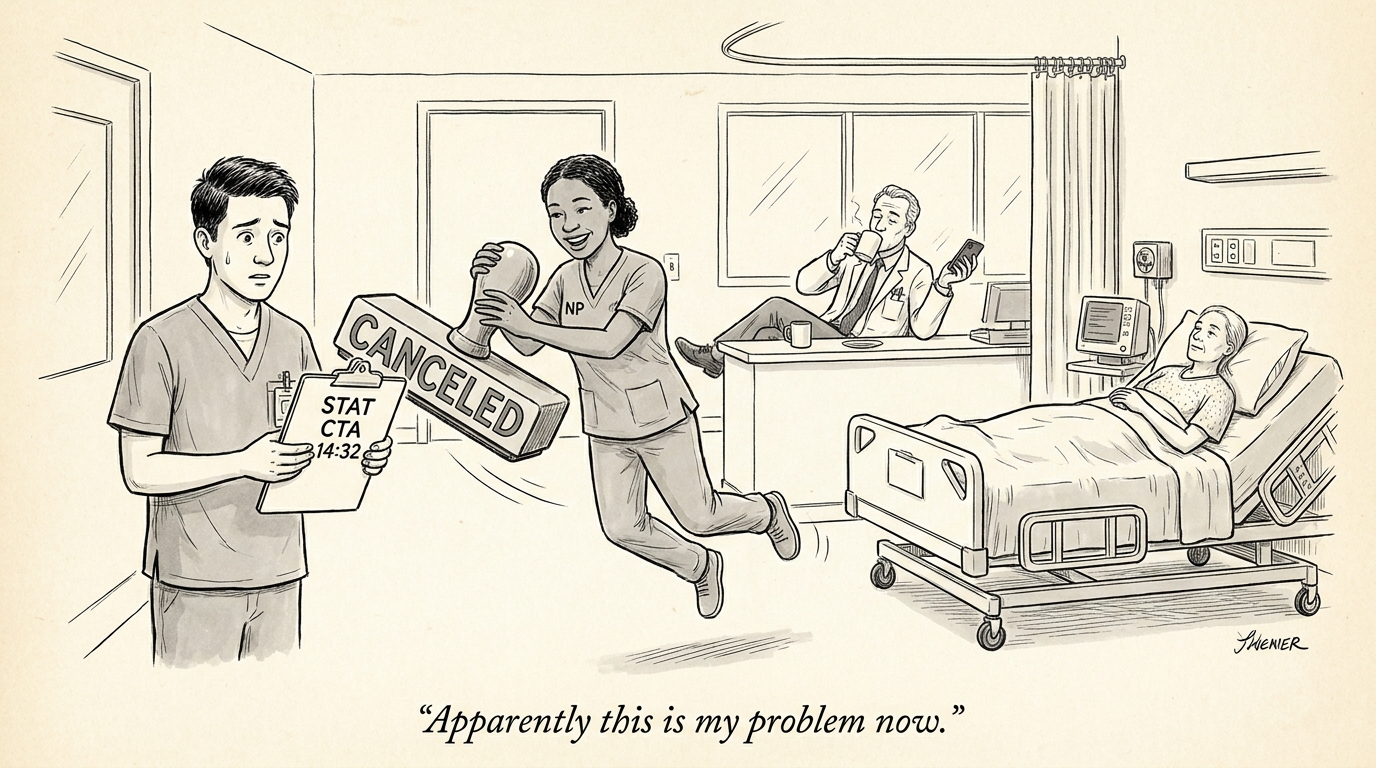
You order a STAT CTA for a patient you’re worried has a PE. Twenty minutes later, you learn the floor NP canceled it because the patient looks fine and we should wait for D-dimer results first. You escalate to your attending, who says something like just work it out with the team. Now you are stuck: the order is gone, the patient is waiting, and you are the one who will be named in the chart if something goes wrong. Welcome to the unwritten curriculum of residency—managing scope conflicts when the people who should have your back don’t.
This isn’t about whether NPs or PAs are good or bad clinicians. It’s about what happens when clinical authority gets murky, attendings don’t intervene, and you’re left managing the fallout. Here’s a framework for handling it.
Understand What’s Actually Happening
Scope creep conflicts aren’t really about the individual NP or nurse who canceled your order. They’re about institutional ambiguity. Hospitals increasingly hire midlevels to fill gaps, but rarely define clear authority structures. The result: parallel workflows where residents and midlevels both think they’re running the show, and nobody explicitly says who has final say.
When your attending shrugs, they’re often not being lazy— they’re avoiding a political fight they don’t want to have with nursing leadership or hospital administration. That doesn’t make it acceptable, but it explains why simply talking to your attending often doesn’t solve the problem.
The practical reality: you have responsibility without authority. That’s the core tension, and pretending it doesn’t exist won’t help you manage it.
Document Like You’re Building a Legal Record (Because You Are)
When someone overrides your clinical decision, your first job is to create a paper trail. Not because you’re trying to get anyone in trouble, but because if something goes wrong, the chart is what matters.
Here’s what to document:
- Your original order and clinical reasoning. STAT CTA chest ordered at 14:32 for clinical concern for PE given tachycardia, hypoxia, and recent immobilization.
- The fact that it was canceled and by whom. Order discontinued at 14:47 by [Name], NP. Keep it factual, not editorial.
- Your response. Discussed with attending Dr. [Name] at 14:55. Attending deferred to floor team’s judgment.
- What happened next. D-dimer ordered per NP recommendation. Will reassess based on results.
This isn’t about throwing anyone under the bus. It’s about making sure the record reflects reality. If the patient does have a PE and decompensates, the chart will show that you identified the concern, ordered the appropriate test, and were overridden. That matters—for the patient, for you, and for any future review.
Know Your Escalation Options
When your attending won’t back you up, you have a few paths forward. None of them are perfect.
Option 1: Re-escalate with specificity. Instead of saying the NP canceled my order, try saying: I am concerned this patient has a PE. The CTA was canceled. I need to know if you want me to re-order it or if you are taking responsibility for the decision to wait. This forces a clearer answer. Most attendings, when directly asked to own a clinical decision, will either back you or take explicit responsibility.
Option 2: Go up the physician chain. If your attending won’t engage, consider whether there’s a chief resident, fellow, or department attending who can help. This is politically risky—you’re essentially going over your attending’s head—but sometimes it’s necessary for patient safety.
Option 3: Use the formal incident reporting system. Most hospitals have a way to report patient safety concerns. Filing a report creates a record outside the chart and may trigger review. This is a bigger step, and you should use it judiciously, but it exists for situations where normal channels fail.
Option 4: Document and move on. Sometimes, especially when the clinical stakes are lower, the right move is to document thoroughly and accept that you can’t win every battle. This isn’t defeat—it’s triage.
Build Relationships Before You Need Them
The residents who have the fewest scope conflicts aren’t necessarily the most assertive—they’re often the ones who’ve built working relationships with the nursing staff and midlevels on their units. When people know you, trust your judgment, and see you as a colleague rather than a hierarchy threat, they’re less likely to override you without discussion.
This doesn’t mean being a pushover. It means being someone who communicates clearly, explains your reasoning, and treats other team members as professionals. When you do have to push back, you’ll have more credibility.
Think About What This Teaches You for Practice
Here’s the uncomfortable truth: these dynamics don’t disappear when you become an attending. They just change shape. You’ll still work in systems where administrators make clinical decisions, where insurance companies override your judgment, where you have to advocate for your patients against institutional inertia.
Learning to document defensively, escalate strategically, and pick your battles isn’t just residency survival—it’s practice for the rest of your career. The physicians who burn out fastest are often the ones who fight every battle at full intensity. The ones who last learn to distinguish between this is worth escalating and this is worth documenting and letting go.
When you’re evaluating future jobs, pay attention to how scope of practice works. Ask about team structures. Watch how attendings interact with midlevels during your interview. A practice where physicians have clear clinical authority and administrators back them up is worth more than a few extra thousand in salary—because the alternative is spending your career fighting battles that shouldn’t exist.
You can’t fix healthcare’s scope creep problem from inside residency. But you can protect yourself, protect your patients, and learn the skills you’ll need to handle these dynamics for the next thirty years.