
This analysis synthesizes 12 sources published the week ending Jun 23, 2026. Editorial analysis by the PhysEmp Editorial Team.
Health systems are scaling ambient AI from pilot programs to enterprise infrastructure just as benchmark studies reveal a troubling inversion: general-purpose chatbots like ChatGPT and Claude are outperforming FDA-cleared clinical decision support tools in diagnostic accuracy. This paradox sits at the center of AI in Physician Employment & Clinical Practice, where physician adoption has doubled over three years while liability frameworks remain anchored to individual clinicians rather than the vendors deploying these systems. For physicians weighing employment offers and for executives building AI-enabled clinics, the stakes extend beyond efficiency—compensation logic, malpractice exposure, and the physician-employer relationship are all on the table.
The Adoption Surge Meets the Performance Gap
The AMA’s latest survey confirms that physician AI adoption has doubled since 2023, with ambient documentation tools leading the expansion. Houston Methodist has moved ambient AI scribes from pilot to enterprise-wide deployment, a sign the technology is maturing inside large systems.
At the same time, studies complicate the story health systems are telling boards and medical staffs. In head-to-head tests, ChatGPT, Gemini, and Claude beat several FDA-cleared clinical AI tools. Another benchmark found that systems scoring well on medical exams stumble when confronted with real patient complexity. Google’s AMIE showed autonomous AI outperforming physicians in simulated EHR cases, but simulation success has not yet translated into dependable, safe deployment.
The gap between benchmark performance and clinical reality creates a hidden liability shift: health systems capture productivity gains while physicians keep diagnostic responsibility for tools they neither selected nor validated.
Liability Architecture Favors Institutions Over Physicians
Most coverage focuses on outcomes and efficiency while skipping the employment-contract implications of who gets blamed when AI errs. Research on diagnostic errors shows hospitals face less blame when physicians remain “deeply involved” in AI-assisted decisions—so systems are already translating that into documentation rules and oversight protocols.
The KevinMD piece puts it plainly: clinical AI liability lands on physicians, not vendors. That creates an asymmetric risk picture—health systems get productivity benefits, physicians shoulder malpractice exposure for a black box. Few standard employment agreements spell out protections for that gap.
Contract Implications for Physician Employment
Expect negotiations to change. Tail coverage may need expanding to catch AI-assisted claims. Indemnification language should say whether employer-mandated AI use shifts any protection to the physician. And performance metrics must acknowledge the time it takes to validate algorithmic outputs.
Recruiters and executives should prepare for candidates to ask for explicit AI liability language in offer letters. Institutions that do so up front will have an edge in hiring; those that hide AI risk in standard malpractice assumptions will lose talent as awareness grows.
The Burnout Paradox: Automation Without Autonomy
Ambient AI scribes sold themselves as a fix for documentation-driven burnout. But several recent analyses challenge whether current deployments actually reduce strain. Cedars-Sinai calls AI a “double-edged scalpel” for burnout, and MedCity News argues that loss of autonomy, not the mechanics of note-taking, is the deeper problem.
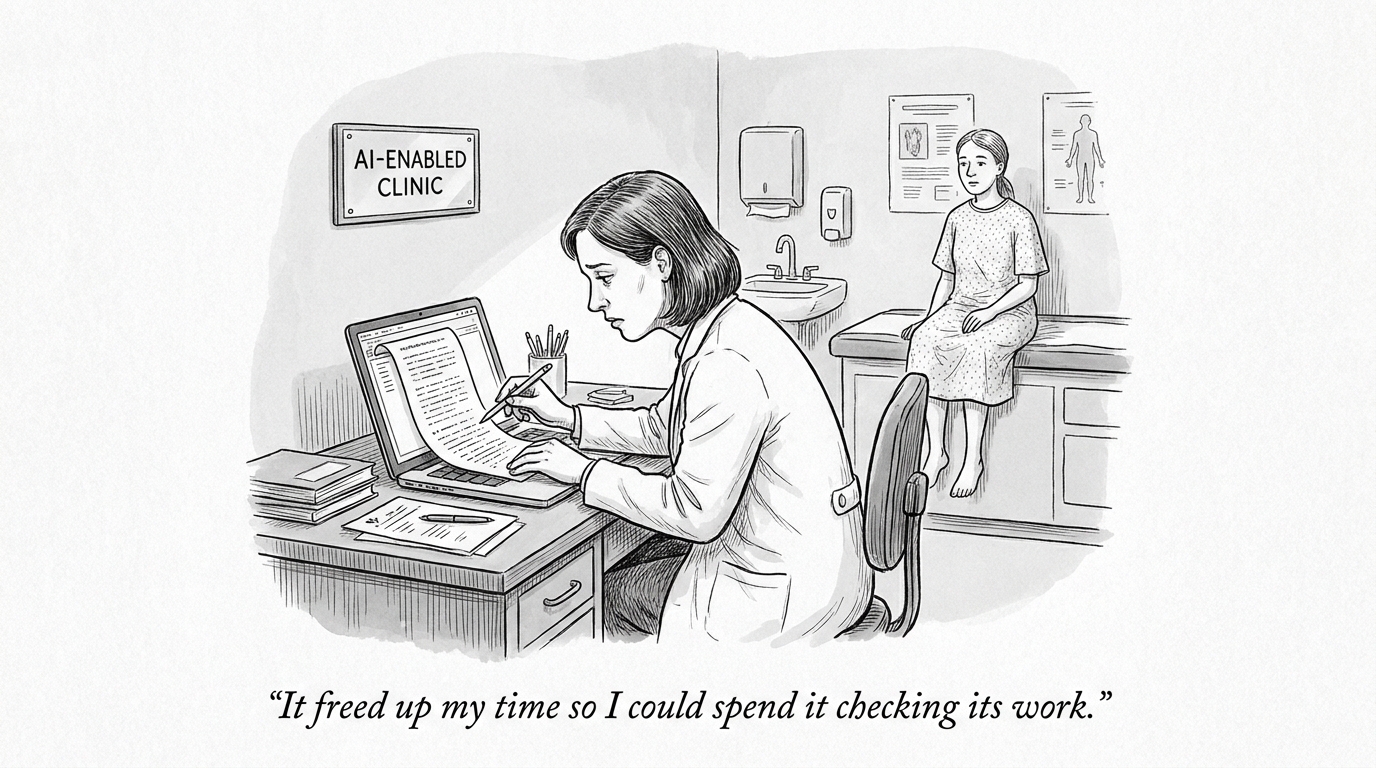
The “ambient AI scribe illusion” flagged by American Bazaar Online captures a practical worry: if physicians must watch AI-generated notes closely to catch errors and satisfy liability, the time spared from typing turns into time spent supervising. Documentation becomes surveillance—different work, not necessarily less work.
Health systems promoting AI as an anti-burnout solution risk retention problems if the promised relief never shows up, especially when productivity expectations rise alongside deployment.
Compensation Model Disruption Ahead
Enterprise AI that reduces time per encounter forces choices: raise patient volume expectations, cut FTEs, or accept better margins. Each path reshapes compensation.
RVU-based pay is likely to come under pressure. If AI lets a physician see 25% more patients, will pay rise, or will quotas simply increase? Physicians assessing offers should press for clarity on how AI-driven productivity changes will affect pay and targets.
Longer term, if AI handles structured diagnostic tasks well, the physician role may tilt toward complex case management and relationships that resist automation. Compensation systems will need to value those human contributions rather than only encounter counts.
Strategic Positioning for Physicians and Employers
Physicians moving into AI-integrated systems should ask which tools are mandatory, how malpractice coverage handles AI-related claims, and whether productivity targets allow time for AI validation. Those answers separate informed decisions from reactive ones.
For executives and recruiters, the hiring market is shifting toward transparency. Institutions that explain their AI deployment approach, liability protections, and any changes to compensation will attract doctors who see AI as a practice tool rather than an imposed risk. Those that use AI mainly to cut costs while glossing over liability shifts should expect pushback.
This paradox—fast adoption amid unresolved performance and liability questions—won’t sort itself out soon. Expect messy contract addenda, awkward town halls, a few headline malpractice cases, and lots of bargaining over what AI use means for work, pay, and risk.
Sources
AMA Survey: More Doctors Are Embracing AI-Based Tools – Medscape
AI adoption among physicians doubles over 3 years — 6 notes – Becker’s Hospital Review
Houston Methodist turns ambient AI into enterprise tool not just pilot – Healthcare IT News
ChatGPT Gemini Claude beat clinical AI tools in study – Becker’s Hospital Review
Medical AI Scores High on Exams but Stumbles on Real Patient Care New Benchmark Finds – Medical Economics
AI diagnostic errors raise hospital blame unless doctors stay deeply involved – News-Medical.net
Clinical AI Liability Lands on You — Not the Vendor – KevinMD
AI Won’t Fix Physician Burnout — Giving Them More Autonomy Will – MedCity News
World Psychiatry: AI and the Problem of Physician Burnout — A Double-Edged Scalpel – Cedars-Sinai
The Ambient AI Scribe Illusion: Doctors Need to Pay Attention – American Bazaar Online
Autonomous medical AI outperforms doctors in simulated EHR cases – News-Medical.net
AMIE for disease management in Nature – Google Blog