
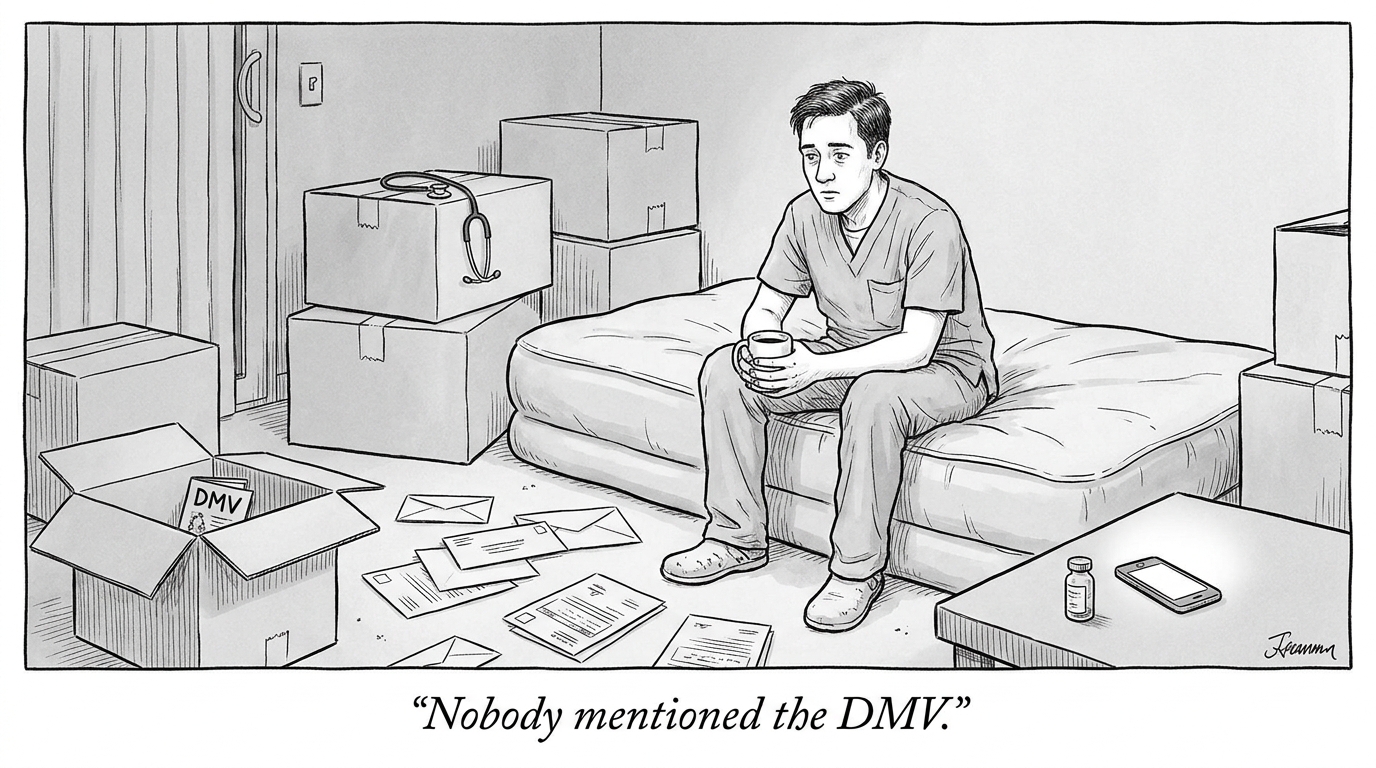
It’s the night before July 1st. You’ve moved to a new city, signed a lease on an apartment you’ve barely seen, and somewhere around 2 AM you’ll lie awake convinced you’ve forgotten every piece of medical knowledge you’ve ever learned. That feeling of starting residency completely unprepared? It’s universal. Every intern before you has felt it, and every intern after you will too.
Here’s what nobody tells you: the first week isn’t really about medicine. It’s about logistics, adjusting to a new routine, and the gap between what you expected and what actually happens. Here’s what you need to handle.
The Logistics Nobody Warned You About
Medical school trained you for pathophysiology, not the DMV. If you’ve moved for residency—and most of you have—there’s a stack of bureaucratic tasks that will eat your free time if you don’t tackle them early.
Driver’s license and registration: Most states give you 30-60 days to update your license after establishing residency. Don’t wait until week three when you’re post-call and wiped out. Budget 2-3 hours for this, minimum. Some states require appointments; others are walk-in chaos. Check before you show up.
Car insurance: Your rates will change when you move states. Call your insurer before July 1st. Depending on where you’re going, you might save $50/month—or pay $100 more. Either way, you need to know.
TB testing: Your program will require this, often within a specific window. Some programs cover it; others expect you to pay $75-150 out of pocket and submit receipts. Find out which one you’re dealing with before you’re scrambling to find an urgent care that does QuantiFERON testing.
Health insurance gap: Your medical school coverage likely ends June 30th. Your residency coverage might not kick in until July 1st—or later. If you have any prescriptions, planned procedures, or just want to avoid being uninsured during a pandemic, figure out the gap now. COBRA is expensive but exists. Some programs offer bridge coverage. Ask HR directly.
The Emotional Reality of Week One
You will feel like a fraud. This is not a personality flaw; it’s a feature of the transition. You went from being a fourth-year medical student who knew the system, the attendings, and where the good coffee was, to being the person everyone looks at when something needs to get done—and you don’t even know where the supply closet is.
The panic about “forgetting everything” is real but misleading. You haven’t forgotten it. You just can’t access it quickly under pressure yet. That comes with repetition, not with cramming the night before. The intern who looks confident on day three isn’t smarter than you— they’re just better at faking it, or they happened to get an easier first patient.
What matters in week one is showing up on time, admitting when you don’t know something, and not repeating the same mistake. No one expects you to be perfect yet—teachable is the point.
Your First Rotation: Tactical Advice
Find your senior resident right away. Not the attending—the senior. They know which shortcuts actually work, which nurses will help you, and which orders the attending tends to forget to mention but will want you to know. Your senior resident becomes your lifeline for the first month.
Write everything down. In the first hour you’ll get a torrent of information, and you’ll remember only a fraction. Carry a notebook or use your phone—whatever fits. The intern who asks the same question twice is annoying; the one who asks once, notes it, and never asks again is valuable.
Learn the EMR before you need it. If your program offers EMR training, take it. If not, find a senior resident and ask them to walk you through the five things you’ll do most often: placing orders, writing notes, checking labs, finding imaging, and sending messages. Twenty minutes of prep saves hours of frustration.
Identify one meal strategy. You won’t have time to plan meals. Pick one reliable option—meal prepping on Sundays, choosing a fast cafeteria station, or accepting that protein bars will be a regular part of your routine. Hunger makes everything harder.
The Social Stuff Nobody Talks About
There will be an intern welcome party or happy hour. Go, even if you’re exhausted. You don’t have to stay long, but showing up matters. These are the people you’ll be in the trenches with for the next three to seven years. The relationships you build now become your support system later.
That said, don’t force it. You don’t need to be best friends with everyone by Friday. Some of your closest residency friendships will form over shared misery at 3 AM six months from now, not over awkward small talk at orientation.
What Actually Matters
Your first week isn’t a preview of the whole residency. It’s a test of how you function under uncertainty, which is the default for intern year. The goal isn’t to impress anyone; it’s to survive, learn, and avoid harm.
Logistics matter because they distract you if you don’t handle them. Emotional preparation matters because residency is as much a mental challenge as a clinical one. And tactical routines matter because small efficiencies multiply over 80-hour weeks.
You won’t feel ready. Nobody does. But showing up is the bar.