
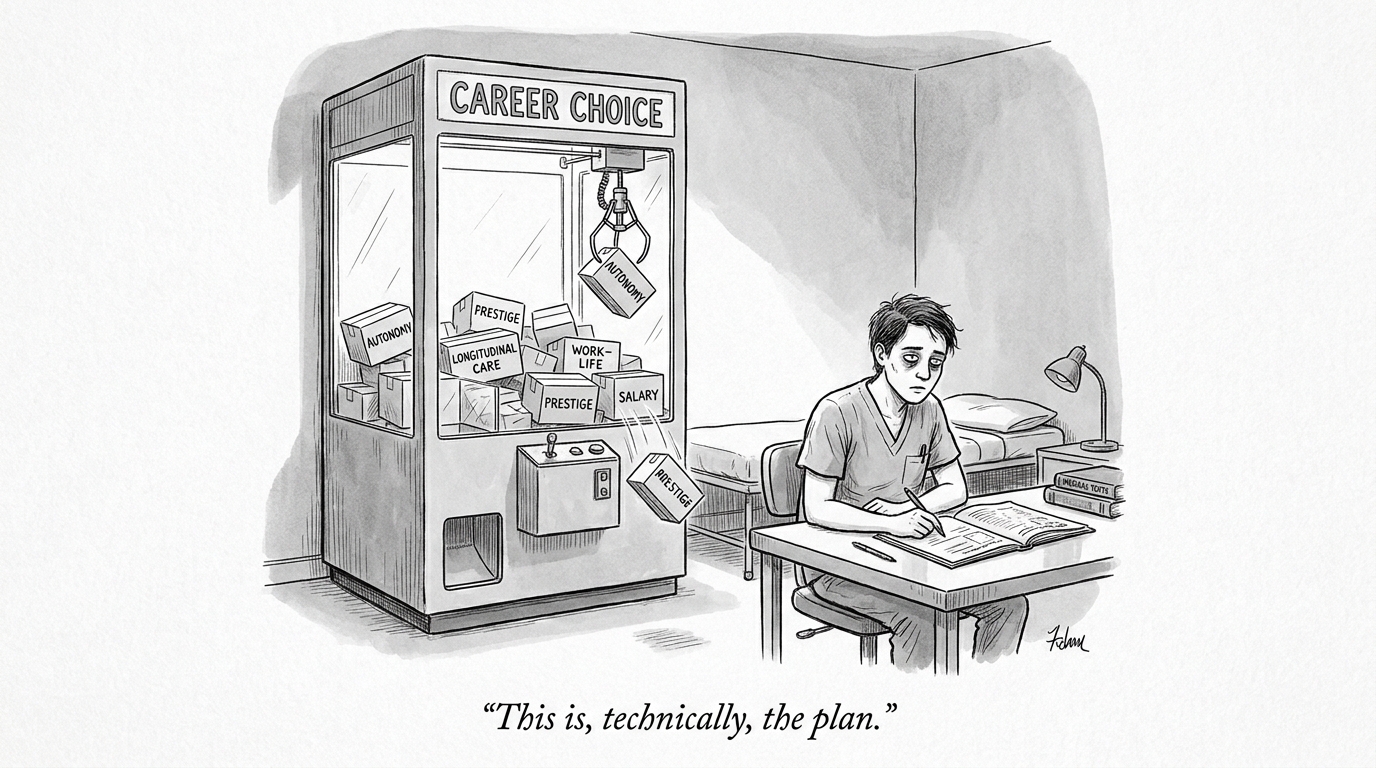
You’re two years into a seven-year neurosurgery residency, and the thought crosses your mind at 2 AM while charting: Would I do this again? It’s a question that haunts residents across every specialty, usually surfacing during the worst rotations or after watching a colleague in a different field leave at 5 PM. The answer matters more than you’d think—not because you can easily change course, but because understanding what drives specialty satisfaction can help you make better decisions about subspecialty training, practice settings, and the career moves still ahead of you.
What the Data Actually Shows About Specialty Regret
Surveys consistently show that about 20-25% of physicians would choose a different specialty if they could start over. But here’s what’s interesting: the specialties with the highest regret rates aren’t the ones you’d expect. It’s not the brutal surgical subspecialties or the lowest-paying primary care fields. The highest regret tends to cluster in specialties where the gap between expectations and reality is largest—where what you thought the job would be doesn’t match what it actually is.
Neurosurgery, for instance, has lower regret rates than you might assume given the training demands. Why? Because people who choose neurosurgery generally know exactly what they’re signing up for. The 80-hour weeks, the seven-year residency, the high-stakes cases—none of that is a surprise. The physicians who regret their specialty choice most often aren’t the ones who chose hard paths. They’re the ones who chose paths they didn’t fully understand.
Anesthesiology sits in an interesting middle ground. Satisfaction is generally high—controllable lifestyle, strong compensation, intellectually engaging work. But regret creeps in for those who didn’t anticipate the lack of longitudinal patient relationships or the feeling of being perceived as a service to surgeons rather than a primary physician. The work itself isn’t the problem. The mismatch between expectations and reality is.
The Three Factors That Actually Predict Satisfaction
Compensation matters, but not as much as you’d think. The specialties with the highest satisfaction scores aren’t the highest paid. What actually predicts whether you’ll be happy ten years out comes down to three things:
Autonomy over your schedule: Physicians who control when they work—not just how much—report dramatically higher satisfaction. This is why dermatology and psychiatry consistently rank high despite not topping compensation charts. It’s also why hospitalists report lower satisfaction than their compensation might suggest: shift work pays well but removes control over your time in ways that compound over years.
Alignment between daily tasks and what drew you to medicine: If you went into medicine because you wanted to solve complex diagnostic puzzles, ending up in a specialty that’s 80% procedures and 20% thinking will grind you down regardless of pay. If you wanted to work with your hands and ended up in a cognitive specialty, same problem. This sounds obvious, but the matching process and medical school culture push people toward prestige and compensation without enough weight given to what they’ll actually be doing for 40+ years.
Sustainable intensity: High-intensity specialties can be deeply satisfying if the intensity is episodic rather than constant. Emergency medicine works for many people because the intensity is contained—brutal shift, then you’re off. Specialties with relentless, low-grade intensity (heavy administrative burden, constant inbox management, call that never really stops) wear people down faster than periodic high-acuity work.
What This Means for Decisions You Can Still Make
If you’re a medical student still choosing, the lesson is simple: shadow extensively, ask attendings what they actually do all day (not what they tell prospective applicants), and weight lifestyle factors more heavily than prestige. The prestige premium fades fast once you’re practicing.
If you’re already in residency, the question shifts. You probably can’t easily change specialties, but you can make informed decisions about subspecialty training, fellowship, and practice settings. A cardiologist who chooses interventional versus non-invasive is making a lifestyle decision as much as a clinical one. A surgeon choosing academic versus community practice is trading compensation for research time and teaching—know whether that trade works for you.
The job market also matters here. Specialties with more practice setting options give you more ability to course-correct if your first job doesn’t fit. Internal medicine offers flexibility that neurosurgery doesn’t. That flexibility has real value when you’re thinking about long-term satisfaction.
The Honest Calculation
Regret in medicine usually isn’t about picking the wrong specialty. It’s about not asking the right questions before committing. What does a typical Tuesday look like? What’s the call structure in community practice versus academic? What does compensation look like five years out versus fifteen? How do physicians in this specialty talk about their work when they’re not recruiting?
The physicians who report highest satisfaction aren’t in any particular specialty. They’re the ones who understood the tradeoffs before they committed and chose accordingly. They knew that high compensation often comes with high call burden, that lifestyle specialties may mean less clinical variety, that prestige doesn’t pay rent.
If you’re already questioning your choice, that’s not a sign you made a mistake. It’s a sign you’re paying attention. The question isn’t whether you’d choose differently with perfect information—nobody has that. The question is whether you’re making the remaining decisions in your career with clear eyes about what actually matters to you. And when you wake up for the next round of calls, what will you choose to carry forward, and what will you leave behind?