
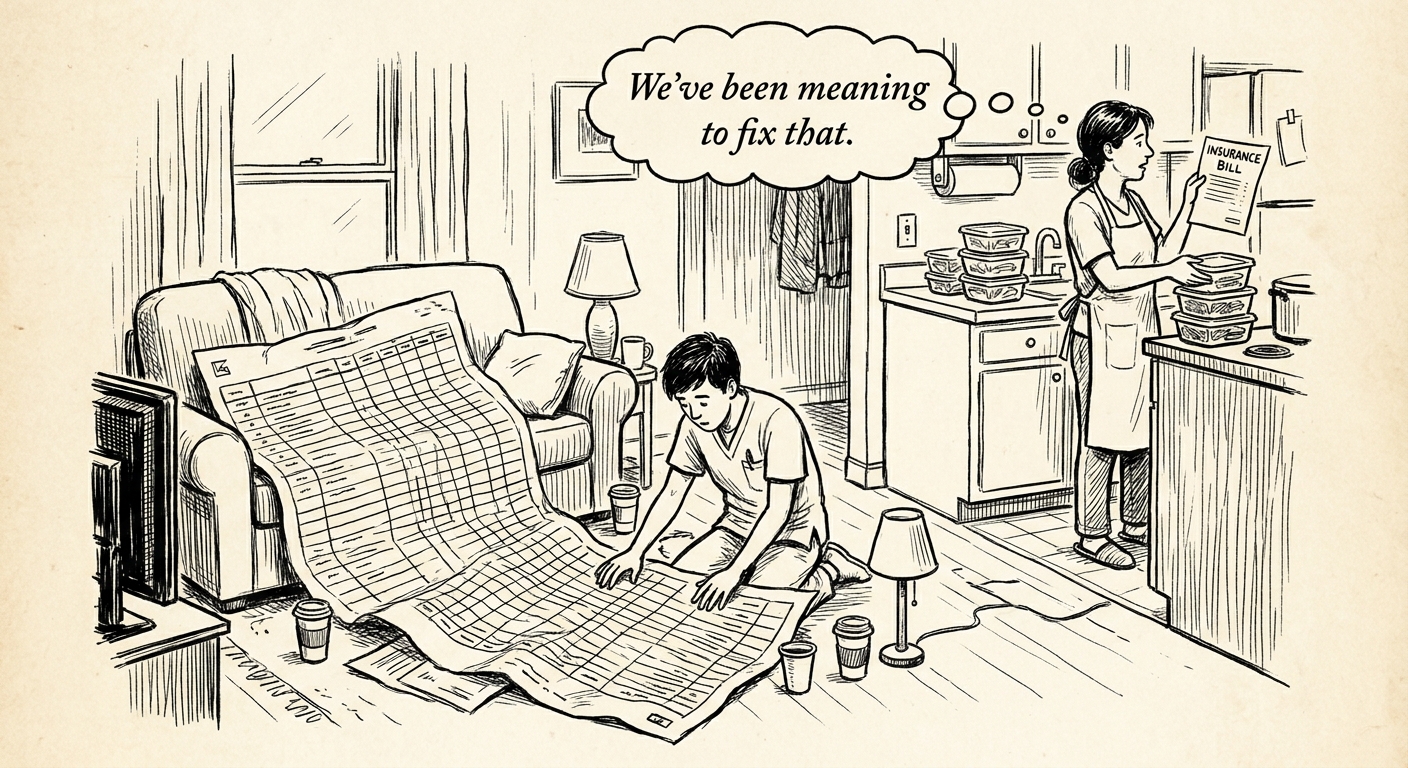
Your partner just told you they need to quit their job. Maybe it’s burnout—watching you work 70-hour weeks while they hold everything together finally broke something. Maybe it’s a health issue, a layoff, or a career pivot that can’t wait. Whatever the reason, you’re now staring at a spreadsheet trying to figure out how a single trainee salary in a VHCOL city is supposed to cover two people, rent that eats half your paycheck, and all the things you were already struggling to afford.
Here’s what nobody tells you: trainee salaries were never designed for this. They were designed for a version of residency that assumed you’d either be single or have a working spouse. When that assumption breaks, you’re left doing financial triage with almost no margin for error.
Run the Numbers First—Then Panic
Before you spiral, get specific about what you’re actually dealing with. A fellowship salary in San Francisco might be $75,000. After taxes, you’re looking at roughly $4,800/month take-home. Now subtract rent for a one-bedroom that’s not actively dangerous—let’s say $2,800. That leaves $2,000 for everything else: food, utilities, transportation, student loan minimums, phone, and whatever you’ve been putting toward retirement.
When your partner was working, maybe you were splitting that rent and had some breathing room. Now you’re covering 100% on a salary that was already stretched. The math isn’t just tight—it’s hostile.
Write down your actual monthly expenses for the last three months. Not what you think you spend—what you actually spend. Most people are shocked by how much goes to food delivery, subscriptions they forgot about, and small purchases that add up to $400/month. This isn’t about judgment; it’s about finding the $300-500 in monthly slack that most budgets contain.
Housing: Your Biggest Lever
In a VHCOL city, housing is typically 40-50% of a trainee’s take-home pay. That’s the first place to look for relief, even though it’s also the most painful.
Options to consider:
- Downsize. If you’re in a one-bedroom, a studio might save $400-600/month. Yes, it’s cramped. But so is being unable to pay your bills.
- Move further out. An extra 20 minutes on your commute might save $500/month. Calculate whether that tradeoff makes sense given your schedule.
- Get a roommate. This works better for some couples than others, but splitting a two-bedroom three ways can cut your housing costs significantly.
- Hospital housing. Some programs offer subsidized housing or have relationships with nearby buildings. Ask your program coordinator—this information isn’t always advertised.
Breaking a lease early usually costs 1-2 months’ rent as a penalty. If moving saves you $600/month, that penalty pays for itself in 3-4 months. Run the numbers before assuming you’re stuck.
Health Insurance: The Hidden Crisis
When your partner loses employer coverage, health insurance becomes an immediate problem. You have a few options, and they all have tradeoffs:
Add them to your plan. Most GME programs allow you to add a spouse or domestic partner during a qualifying life event (job loss counts). Check your benefits portal immediately—you typically have 30-60 days from the coverage loss date. Expect this to add $200-400/month to your premiums, but it’s usually the most cost-effective option for decent coverage.
COBRA. Your partner can continue their employer coverage for up to 18 months, but they’ll pay the full premium plus a 2% administrative fee. This often runs $500-700/month for individual coverage. COBRA makes sense as a short bridge—maybe 1-2 months while you sort out alternatives—but it’s rarely sustainable long-term on a trainee budget.
ACA Marketplace. Depending on your combined income and state, your partner might qualify for subsidized coverage through healthcare.gov. A trainee salary plus zero income from a spouse can actually put you in a favorable subsidy bracket. Silver plans with cost-sharing reductions can be surprisingly affordable—sometimes under $100/month with subsidies.
Don’t let your partner go uninsured to save money. One ER visit or unexpected diagnosis will cost more than a year of premiums.
The Expenses You Can Actually Cut
Beyond housing and insurance, here’s where most trainees find savings:
Food. Meal prepping isn’t glamorous, but switching from $15 takeout lunches to $3 homemade meals saves $240/month. Your partner, now with more time, might be willing to take this on—but have that conversation explicitly, not as an assumption.
Transportation. If you have two cars, consider whether you actually need both. Selling one eliminates a car payment, insurance, and parking costs. In a VHCOL city with decent transit, this can free up $400-600/month.
Subscriptions. Audit every recurring charge. Most people are paying for 2-3 streaming services, a gym membership they don’t use, and at least one app subscription they forgot about. Cutting these typically saves $50-150/month.
Student loans. If you’re on an income-driven repayment plan, your payment should adjust when you recertify income. Some plans allow you to recertify immediately after a significant income change. Call your servicer.
The Conversation You Need to Have
Money stress doesn’t stay in the spreadsheet. It leaks into everything—how you talk to each other, how you feel about your career choices, whether your partner feels guilty for not working.
Have an explicit conversation about the timeline. Is this a 3-month break or an indefinite situation? What’s the plan for your partner to return to work, if that’s the goal? What are they willing to take on at home in exchange for not contributing financially right now?
These conversations are uncomfortable. They’re also necessary. Unspoken resentment about money is one of the fastest ways to destroy a relationship that’s already under pressure from training.
The Harder Truth
Sometimes the math just doesn’t work. If you’ve cut everything cuttable and you’re still short, you have a few options: your partner finds some income (even part-time or gig work), you take out additional loans, or you look for moonlighting opportunities if your program allows it.
None of these are great. But they’re real options, and pretending they don’t exist doesn’t help. Training is temporary. The financial decisions you make now—whether that’s taking on debt or having your partner work a job they’re overqualified for—are about getting through a finite period.
A coffee-stained lease, a receipt for groceries, and a calendar full of reminders—tonight’s decision is just the start of a longer story.