
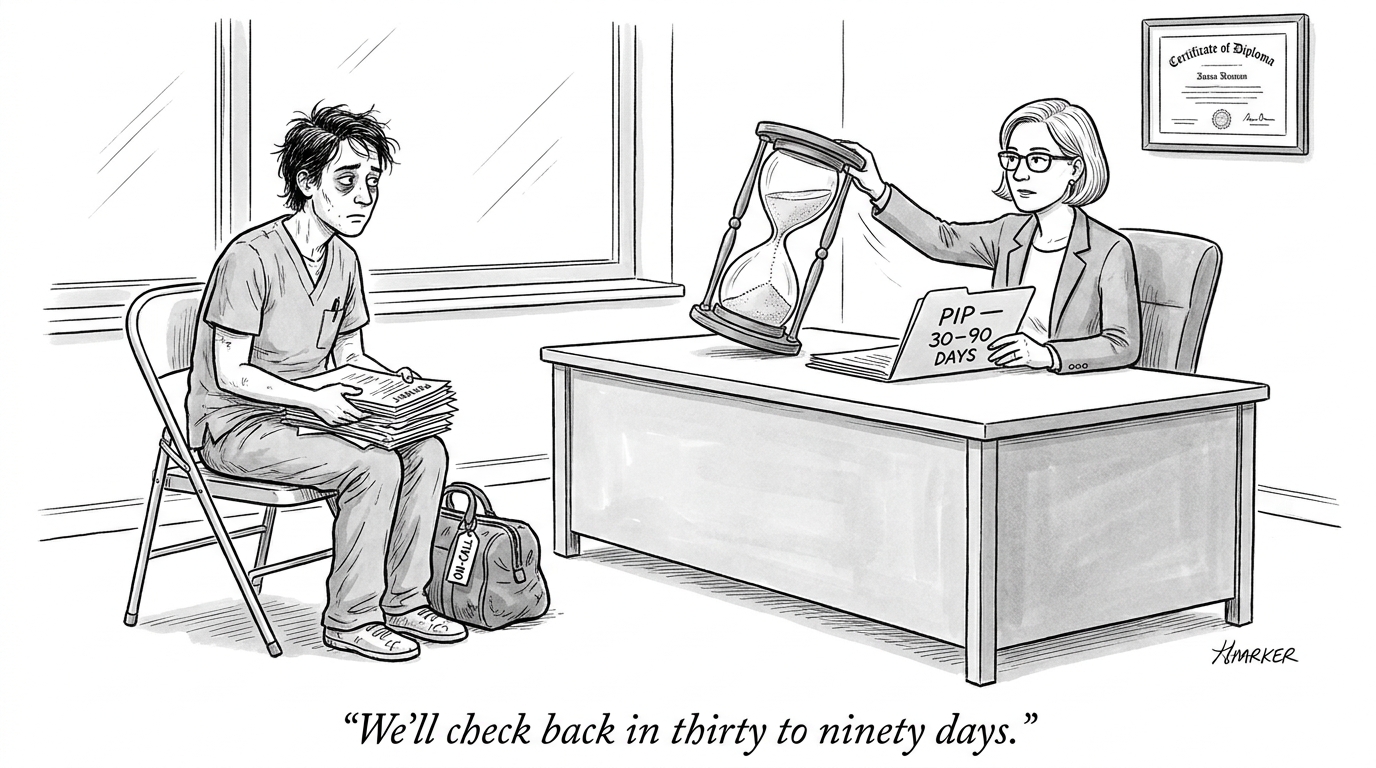
You’re called into the program director’s office for what you thought was routine feedback. Twenty minutes later, you’re signing a Performance Improvement Plan. The demands of residency are already weighing on you—80-hour weeks, constant evaluation, sleep deprivation—and now a formal document suggests you might not make it through. Here’s the truth: the clock is ticking, and most residents who end up terminated didn’t expect a verbal warning to go anywhere.
Understand What You’re Actually Dealing With
First, let’s be clear about the hierarchy. Verbal warnings, written warnings, PIPs, and probation aren’t separate categories—they form a ladder. Each step up makes the next one easier for your program to justify. A ‘verbal warning’ that ends up in your file is functionally a written warning. A PIP isn’t a suggestion for improvement; it’s a formal record that your program has concerns serious enough to document.
Programs don’t put residents on PIPs for fun. The paperwork alone is annoying. If you’re on one, someone decided the documentation burden was worth it. That should tell you something about how seriously they’re taking this.
The timeline matters too. Most PIPs run 30-90 days. That sounds like plenty of time until you realize you’re still working 60+ hours a week, still studying for boards, and now you need to demonstrably fix whatever got you here—while being watched more closely than before.
Step One: Get the Specifics in Writing
Within 24 hours of receiving a PIP, you need to know exactly what’s being measured. ‘Improve communication’ is not a metric. ‘Reduce documentation errors to fewer than two per week as measured by attending review’ is a metric. If your PIP is vague, request a meeting to clarify specific, measurable benchmarks.
Ask these questions directly:
- What specific behaviors or outcomes triggered this PIP?
- What does successful completion look like, in measurable terms?
- Who will be evaluating my progress, and how often?
- What happens if I meet the benchmarks? What happens if I don’t?
Get the answers in writing. Email your program coordinator after the meeting summarizing what was discussed. This isn’t about being adversarial—it’s about making sure everyone’s working from the same playbook.
Step Two: Start Your Own Documentation
From the moment you’re placed on a PIP, keep a contemporaneous log. Date, time, what happened, who was present. This includes positive feedback, not just problems. When an attending says ‘nice job on that presentation,’ write it down with the date and their name.
Why? Memory is unreliable, and if things escalate, you’ll need specifics. If your program later claims you ‘never improved,’ you want timestamped evidence that Dr. Smith said your H&Ps were ‘much better’ on March 15.
Keep this documentation somewhere your program can’t access—personal email, a notebook at home, whatever works. This isn’t paranoia; it’s basic career protection.
Step Three: Identify Your Allies (and Your Risks)
You need to figure out who in your program is actually in your corner. This might be a faculty mentor, a chief resident, or an ombudsperson. Someone who can give you honest feedback about how you’re perceived and whether you’re actually making progress.
Be strategic about who you confide in. Your co-residents might be sympathetic, but they’re also potential witnesses if things go sideways. Your program director is not your ally in this situation—they’re the one who put you on the PIP. That doesn’t mean they’re your enemy, but their job is to protect the program, not you.
If your institution has a GME ombudsperson or resident advocate, use them. They exist specifically for situations like this.
Step Four: Address the Actual Problem
This sounds obvious, but it’s where most residents miss the mark. A PIP isn’t just a bureaucratic hurdle—it’s feedback, even if delivered in the most annoying possible format. Something triggered this. Figure out what it actually was.
Sometimes the stated reason isn’t the real reason. ‘Documentation issues’ might really mean ‘attendings find you difficult to work with.’ ‘Professionalism concerns’ might mean one specific incident that someone won’t let go. If the formal feedback doesn’t match what you’re hearing informally, dig deeper.
If the issue is clinical knowledge, get a tutor or study group. If it’s communication, ask for specific examples and practice differently. If it’s punctuality, set three alarms. Whatever it is, over-correct visibly. You need evaluators to notice the change.
Step Five: Know Your Escalation Options
If you believe the PIP is unfair, retaliatory, or based on discrimination, you have options—but they come with tradeoffs. Filing a grievance through your institution’s GME office creates a formal record, which can protect you but can also make relationships more adversarial. Contacting your state medical board is premature at this stage and likely counterproductive.
The nuclear option—transferring programs—is harder than you think. Other programs will want to know why you’re leaving, and ‘I was on a PIP’ is a red flag. It’s not impossible, especially if you can frame it as a mutual recognition of poor fit, but it’s not a clean escape.
Licensing Question Nobody Mentions
Here’s the part that keeps people up at night: state medical board applications ask about disciplinary actions during training. A PIP that you successfully complete may or may not need to be disclosed, depending on the state and how the question is worded. A PIP that leads to termination or probation almost certainly does.
This is why successful completion matters so much. The difference between ‘I had some early struggles that I addressed’ and ‘I was terminated from residency’ is the difference between a minor licensing headache and a career-altering event.
Acknowledging reality without blowing it up is the goal here—keep your head down, document, and push forward, even if the path isn’t perfectly clear.
What It Means for Your License—and What Might Follow
A PIP is a serious moment, but it isn’t a sentence. Residents handle them all the time. The ones who don’t usually trip up in one of two ways: they ignore it and hope it disappears, or they get defensive and miss the real feedback.
Treat it like a clinical problem. Gather data, make a plan, follow through, and log progress. The same skills that got you into medical school can carry you through this—if you actually use them.
And when the room clears, the question remains: what does progress look like now, with the record on file and the next patient waiting?