
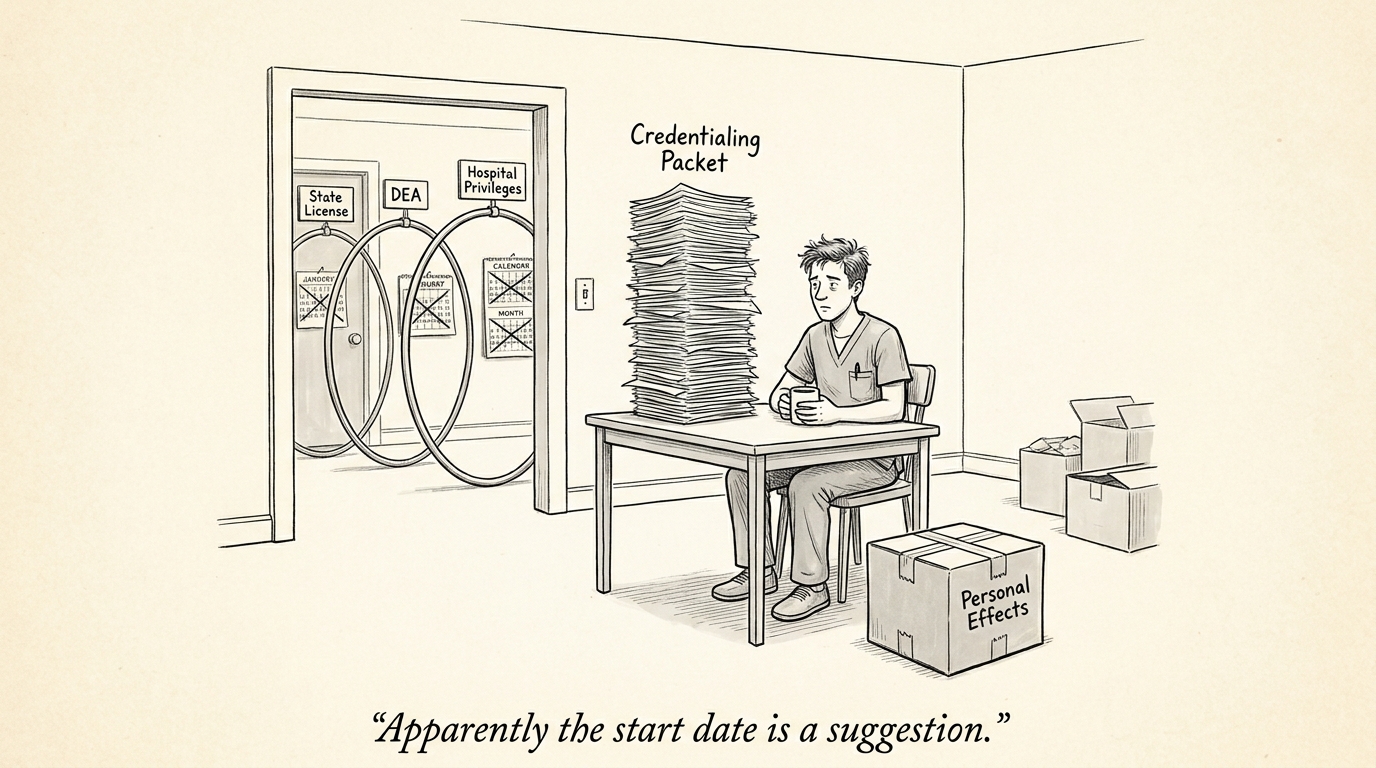
You signed your contract. You found an apartment. You’re ready to finally practice medicine as an attending and start earning real money. And then someone from medical staff services emails you a 47-page credentialing packet, and you realize that the transition out of residency involves a bureaucratic obstacle course nobody adequately prepared you for.
Here’s the uncomfortable truth: the gap between signing your contract and actually seeing patients can stretch 4-6 months if you don’t start the administrative work early. And every week your start date gets pushed back is a week you’re not earning an attending salary while your loans are still accruing interest. This checklist exists because the system won’t hand you one.
Start With State Medical Licensure—Earlier Than You Think
If you’re moving to a new state for your first job, your medical license application should be submitted 4-6 months before your intended start date. This isn’t paranoia—it’s math. State medical boards are notoriously slow, and some states (looking at you, California and New York) can take 3-4 months even when everything goes smoothly.
- Medical school transcripts and diploma verification (request these early—schools are slow too)
- ECFMG certification if you’re an IMG
- USMLE/COMLEX score reports
- Training verification letters from every residency and fellowship program
- Letters of recommendation (usually 2-3)
- Background check and fingerprinting
- Application fee ($300-$1,000 depending on state)
Pro tip: Some states offer expedited processing for an extra fee. If your start date is tight, this $200-$400 expense is worth it compared to losing weeks of attending salary.
Your DEA License: The Fee-Exempt Question
This is where graduating residents consistently get confused. During residency, you likely had a fee-exempt DEA registration tied to your training institution. That registration doesn’t automatically transfer to your new practice—and the rules around transitioning it are messier than they should be.
Here’s what actually happens:
If you’re staying at the same institution for your first job, you may be able to modify your existing registration. But if you’re moving to a new employer or state, you’ll need a new DEA registration entirely.
The fee situation: As a resident, you were fee-exempt. As an attending, you’re not—unless you’re working exclusively at a VA or other federal facility. The current DEA registration fee is $888 for three years. Some employers cover this; many don’t. Ask during contract negotiation, because it’s a reasonable request that often gets overlooked.
Timeline: DEA applications typically process in 4-6 weeks, but don’t submit until you have your state license number—the DEA requires it. This creates a sequential bottleneck that catches people off guard.
Address matters: Your DEA registration is tied to a specific address. If you’re practicing at multiple sites, you may need multiple registrations. Clarify this with your employer’s medical staff office before you apply.
Hospital Credentialing: The Hidden Timeline
Even with your state license and DEA in hand, you can’t see patients until the hospital grants you privileges. Hospital credentialing is its own 60-120 day process that runs parallel to (not after) your licensing applications.
What credentialing involves:
- Primary source verification of your entire training history
- Malpractice history check (even if you’ve never been sued)
- Peer references from physicians who’ve worked with you
- Proof of board eligibility or certification
- Health screening and immunization records
- Privileges delineation (what procedures you’re approved to perform)
The medical staff office will send you forms. Fill them out immediately—not “when you have time.” Every day you delay adds to your total timeline, and credentialing committees often meet only monthly. Miss one meeting cycle and you’ve just added 4 weeks to your start date.
The Parallel Processing Strategy
Here’s what smart graduating residents do: Start everything simultaneously, not sequentially.
6 months before your start date:
- Submit state medical license application
- Begin hospital credentialing paperwork
- Order all transcripts and verification letters
3-4 months out:
- Complete background check and fingerprinting
- Submit any additional documentation requested
- Follow up on pending items weekly
Once state license is issued:
- Apply for DEA registration immediately
- Notify hospital credentialing office
- Apply for NPI if you don’t have one (this is quick, but required)
Don’t forget:
- Controlled substance license (required in some states separately from DEA)
- Malpractice insurance (employer-provided or personal)
- Hospital-specific EMR training and onboarding
What Nobody Tells You About the Money Gap
If your credentialing gets delayed, your paycheck gets delayed. But your rent, loans, and life don’t pause. Some employers offer a signing bonus or relocation allowance that helps bridge this gap—but only if you negotiate for it upfront. Others offer “credentialing pay” at a reduced rate while you wait. Ask about this before you sign, not after.
The residents who struggle most are the ones who assume the administrative stuff will “work itself out” while they focus on finishing training. It won’t. The system is designed for you to chase it, not the other way around.
Start early, follow up relentlessly, and keep a spreadsheet tracking every application, every deadline, and every contact person. It’s not glamorous work, but it’s the difference between starting your attending life on time and watching your start date slip while your student loans keep compounding.
What happens if credentialing drags on longer than you expected? That image—coffee in the break room, a desk stacked with forms, a calendar with start dates that keep slipping—might be you. The question remains: when delays land on your desk, what will you do next?