
PHYSICIAN JOB MARKET ANALYSIS REPORT: NEUROLOGY
(PhysEmp Market Intelligence | physemp.com)
THE HOOK
A neurologist in Sacramento can earn up to $500,000 a year. A neurologist in Melville, New York — roughly 2,900 miles east, and presumably treating the same human nervous system — can start at $235,000. Same brain, same board certification, same diagnostic codes. Different zip code, $265,000 gap. The national Neurology market currently lists 482 open positions, and the spread between the top and bottom of the disclosed pay scale is wider than most specialists’ entire base salary. The data shows a specialty in which geography is not a tiebreaker. It is the entire game.
THE NATIONAL SNAPSHOT
Total listings: 482
Listings with disclosed salary: 67
Full salary range: $220,000 to $500,000
National average range: $333,072 to $364,292
Most listings cluster between $300,000 and $400,000, which is a respectable corridor until you realize the ceiling sits 50% above the floor. That is not a tight market. That is a market where two neurologists with comparable training can have entirely different financial lives based on which interstate they took out of residency.
States represented in the dataset: California, Texas, Florida, New York, Illinois, North Carolina, Washington, New Jersey, Massachusetts, New Hampshire, Maryland, Ohio, Tennessee, Kentucky, Oregon, Nevada, New Mexico, Colorado, Minnesota, Missouri, Nebraska, Arizona, South Carolina, Pennsylvania, Mississippi, Connecticut, Michigan, West Virginia, Wyoming, Virginia, Idaho, Indiana, Wisconsin, South Dakota, Rhode Island, North Dakota, Louisiana, Georgia, Oklahoma, Alabama, Alaska, Arkansas, Maine, Kansas, Iowa, and Vermont.
STATE BY STATE
Overperformers:
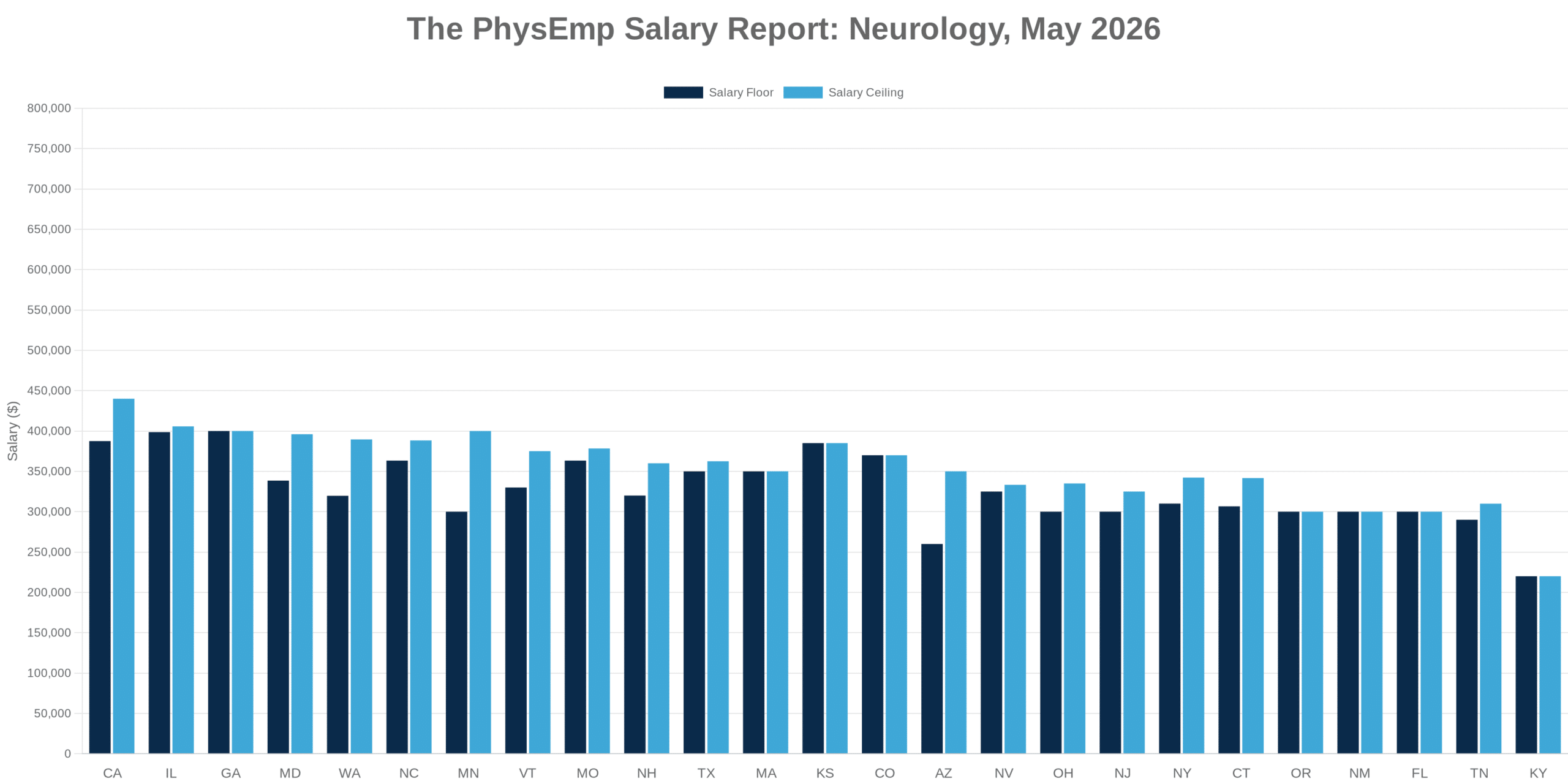
California ($387,500 to $440,000) is the headline act, paying like a coastal tech company that happens to bill insurance.
Illinois ($398,571 to $405,714) delivers the tightest, most consistent premium band in the dataset.
Georgia ($400,000 flat) is small-sample but punching well above its regional weight.
Kansas ($385,000 flat) is a single listing, but a single listing $50,000 over the national average is hard to ignore.
Missouri ($363,333 to $378,333) and North Carolina ($363,333 to $388,333) quietly outperform on both pay and volume.
Colorado ($370,000) clears the average on the strength of one disclosed listing.
Maryland ($338,500 to $396,000) and Washington ($319,728 to $389,555) round out the upper tier with credible ranges.
Near-average:
Massachusetts ($350,000) sits squarely on the line.
Texas ($350,000 to $362,500) clears the average on its two disclosed listings.
New York ($310,067 to $342,273) is just under the midpoint despite 15 disclosing listings — the largest sample in the country.
Connecticut ($306,667 to $341,667) tracks New York almost exactly.
Nevada ($325,000 to $333,333), New Hampshire ($320,000 to $360,000), Vermont ($330,000 to $375,000), Ohio ($300,000 to $335,000), and Minnesota ($300,000 to $400,000) all hover within the benchmark band.
Underperformers:
Kentucky ($220,000 flat) is the floor — more than $113,000 below the national low average.
Arizona ($260,000 to $350,000) drags on the bottom but stretches respectably.
Tennessee ($290,000 to $310,000) underperforms across both disclosed listings.
New Jersey ($300,000 to $325,000), Oregon ($300,000), New Mexico ($300,000), and Florida ($300,000) all sit at the competitive floor.
Volume leaders: Texas (37), North Carolina (35), Florida (27), New York (23), California (21), Illinois and Georgia (20 each). Florida is the cautionary tale of the group: third in volume, last-tier on its one disclosed salary.
FOR PHYSICIANS
If your priority is maximum compensation: Sacramento, California, where a Neurologist listing tops the market at $475,000 to $500,000. California’s statewide average ($387,500 to $440,000) confirms the outlier is not an outlier. (Cost-of-living caveat applies; $500,000 in Sacramento spends differently than $400,000 in Springfield.)
If your priority is maximum optionality: Texas (37 listings) and North Carolina (35) offer the deepest benches. North Carolina is the rare state delivering both volume and above-average pay.
If your priority is balance: Illinois and Missouri. Solid volume, above-average compensation, and none of the West Coast tax brackets.
The compensation gap worth scrutinizing: Florida’s 27 listings and a single disclosed salary at the floor. Either the state is underpaying neurologists or it is hiding the number. Both are informative.
FOR RECRUITERS AND HEALTHCARE EXECUTIVES
Salary transparency rate: 67 of 482 listings, or 13.9%. Roughly one in seven postings discloses what it pays. The other six are asking candidates to invest a phone screen on faith.
Pipeline implication: in a specialty where the disclosed range spans $280,000, opacity is not a negotiation tactic. It is a filter that removes serious candidates before they apply.
Volume-pay misalignment is concentrated in Texas (37 listings, only 2 disclosed) and Florida (27 listings, $300,000 floor). Recruiters in these markets cannot lead with compensation. They will need to lead with case mix, call structure, subspecialty support, and lifestyle — the levers that survive when the salary line does not.
MARKET FORCES
Scope and sample size are doing most of the storytelling. California, Illinois, and Georgia top the rankings on small disclosed samples (4, 7, and 1 listings respectively). The premium is real, but the precision is not. Treat top-tier averages as directional, not gospel.
The floor is being set by part-time and outlier roles. Kentucky’s $220,000 single listing and Melville’s $235,000 starting figure pull the national low average down to $333,072. Strip the bottom three or four outliers and the realistic full-time floor likely sits closer to $300,000.
Underserved markets are not pricing in scarcity. Conventional logic says rural and lower-density states should pay a premium to attract specialists. Kentucky, Tennessee, New Mexico, and Oregon say otherwise. The scarcity premium in Neurology is being captured by metro academic centers, not rural systems — which is the opposite of what most workforce models predict.
The volume-pay relationship breaks at the top and the bottom. Texas leads on volume and pays mid-market. Florida leads on volume and pays at the floor. California trails on volume and pays at the ceiling. High-volume states are not high-pay states, and the markets that need neurologists most are not the markets paying for them.
THE BOTTOM LINE
Neurology in 2026 is a specialty where the floor and ceiling are separated by a quarter-million dollars, transparency hovers at 14%, and the states with the most openings are largely not the states with the highest pay. California pays like a premium product. Kentucky pays like a clearance rack. Texas posts the most jobs and tells you the least about them.
The American neurology market will pay you handsomely to diagnose its dysfunction — provided you do not try to diagnose its compensation structure.
Salary data based on 67 listings with disclosed compensation. Figures may reflect part-time or specialized roles. This report is informational and should not replace professional judgment or financial planning.