
PHYSICIAN JOB MARKET ANALYSIS REPORT: MED PED
(PhysEmp Market Intelligence | physemp.com)
THE HOOK
Arkansas — a state with exactly one Med Ped listing — is currently outpaying every Med Ped job in California and Massachusetts combined. (This is easy, of course, since California and Massachusetts disclosed no salaries at all.) The single Arkansas posting clocks in at a flat $350,000, which is either a generous market correction or a quiet plea for someone, anyone, to please come treat both the children and their parents. Across 76 national listings spanning 23 states, only 15 postings actually tell you what they pay. The thesis: Med Ped is a stable mid-six-figure specialty where the loudest paychecks come from the quietest states.
THE NATIONAL SNAPSHOT
Total listings: 76
Listings with salary data: 15
Full salary range: $195,000 to $350,000
National average range: $242,567 to $283,447
Common clustering band: $215,000 to $285,000
The spread tells a familiar story for dual-trained internists/pediatricians: a stable middle, a soft floor in the rural Midwest, and a few outlier states willing to write a real check. The gap between the national low ($195,000) and high ($350,000) is $155,000 — wide enough to matter, narrow enough to suggest Med Ped hasn’t gone full Anesthesia.
States represented: New York, Illinois, Missouri, Kansas, Wisconsin, Massachusetts, Tennessee, North Carolina, New Hampshire, California, Indiana, Florida, Minnesota, Maryland, Georgia, Oregon, Virginia, Michigan, Alabama, West Virginia, Arkansas, Kentucky, and New Jersey.
Twenty-three states. Fifteen disclosed salaries. The rest are running on vibes.
STATE BY STATE
Overperformers:
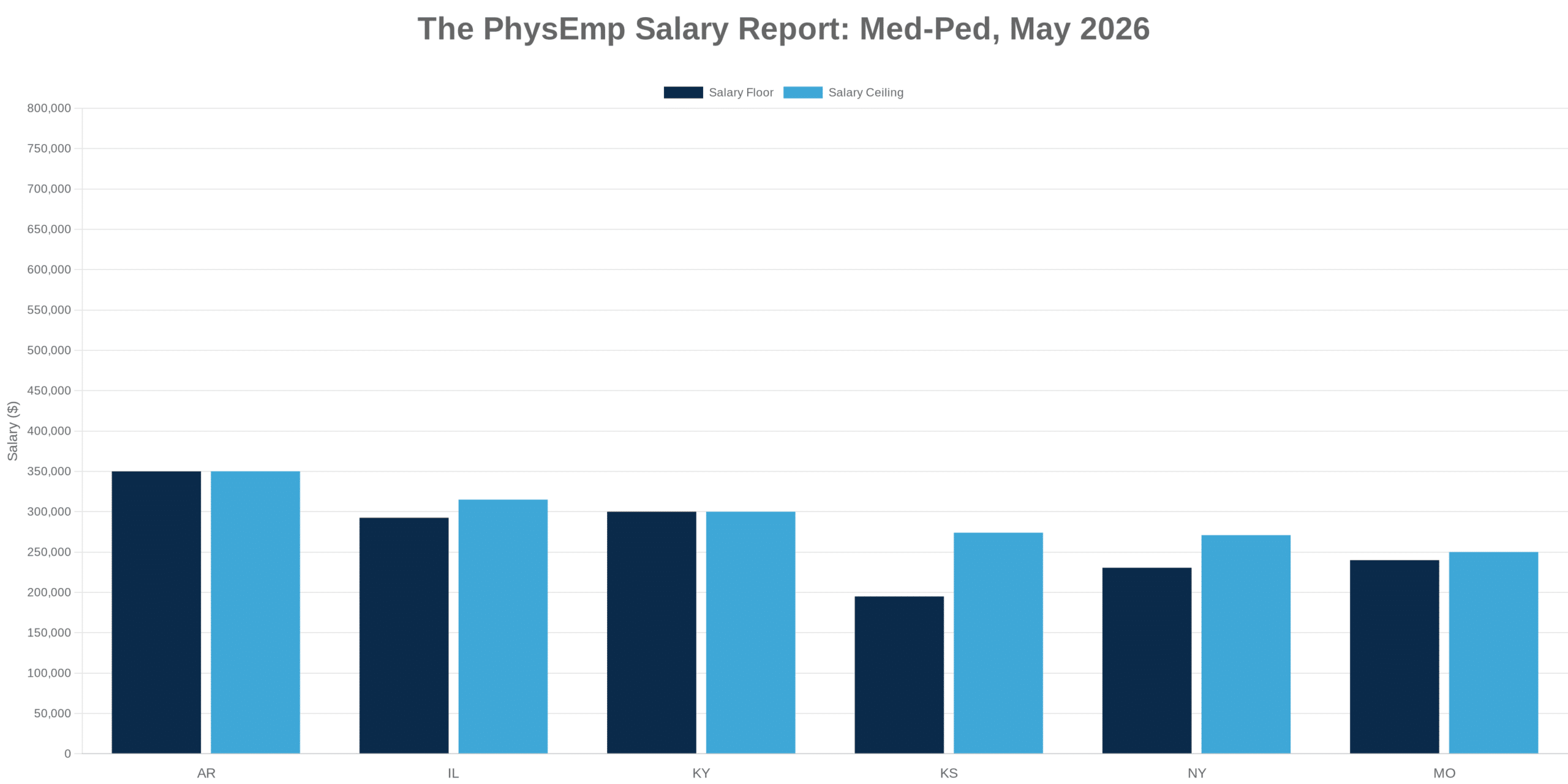
Arkansas — one listing, $350,000 flat, the national ceiling. (One job. One number. One very persuasive recruiter, presumably.)
Kentucky — one listing at $300,000, punching well above its volume.
Illinois — average range of $292,500 to $315,000 across two disclosing listings; the highest-volume overperformer in the dataset.
Near-average:
New York — $230,583 to $270,950 across six disclosing listings; the most statistically reliable benchmark in the country.
Missouri — $240,000 to $250,000 from one listing, sitting comfortably in the middle.
Underperformers:
Kansas — $195,000 to $274,000 across four fully-disclosed listings; the only state whose floor sits $47,500 below the national average low.
Volume leaders: California (10), Massachusetts (10), New York (9), Illinois (6), North Carolina (5), Kansas (4), Michigan (4). California and Massachusetts top the volume charts and disclose nothing. Kansas leads the nation in transparency and trails the nation in pay.
FOR PHYSICIANS
If your priority is maximum compensation: Look at Rockford, Illinois, where Curare Group is listing $300,000 to $325,000 — the highest-paying disclosed listing nationally with a real range attached. Arkansas and Kentucky offer higher single numbers, but each represents a single job. (When the market is one listing deep, your leverage is also one listing deep.)
If your priority is maximum optionality: California and Massachusetts each offer 10 listings. You will, however, need to call and ask what they pay, because nobody wrote it down.
If your priority is balance: New York offers nine listings, six with disclosed salaries, and a range that mirrors the national average almost exactly. It is the closest thing Med Ped has to a known quantity — though New York cost-of-living against a $230K floor deserves a second look before signing.
FOR RECRUITERS AND HEALTHCARE EXECUTIVES
Salary transparency rate: 15 ÷ 76 = 19.7%.
Four out of every five Med Ped postings list no compensation. That is not a pipeline — that is a guessing game. Candidates with dual board certification have options; they will not chase opaque listings when New York, Illinois, and Kansas have already shown their cards.
The volume-pay misalignment is glaring: California and Massachusetts together account for 26% of all listings and 0% of disclosed salaries. Recruiters in those markets will need to lead with culture, schedule, academic affiliation, or geography — because compensation, as a recruiting tool, currently does not exist on the page.
MARKET FORCES
Scarcity prices in the rural premium. Arkansas and Kentucky each have one listing, and each pays at or near the top of the national range. When demand outstrips local supply of dual-trained physicians, employers stop negotiating and start advertising. (The $350,000 Arkansas number is what scarcity looks like with a dollar sign in front of it.)
Salary transparency correlates inversely with prestige markets. The states most likely to disclose pay — Kansas, Missouri, New York, Illinois — are also the states competing hardest for candidates. The states that don’t disclose — California, Massachusetts, North Carolina, Florida — are operating on the assumption that their zip code does the recruiting for them.
The volume-pay relationship is broken. High-volume states pay less or pay invisibly. Low-volume states pay more and say so out loud. Med Ped is currently a market where the smaller the pond, the bigger the fish.
The middle is unusually tight. Most listings cluster between $215,000 and $285,000 — a $70,000 band that suggests Med Ped compensation is converging around a national norm, with outliers driven almost entirely by geography rather than scope or seniority.
THE BOTTOM LINE
Med Ped is a stable, geographically distributed specialty with a tight middle, a soft Kansas floor, and a handful of rural outlier states quietly writing the biggest checks. The volume leaders refuse to disclose, the disclosure leaders pay below average, and the highest single salary belongs to a state with exactly one job. For physicians, the math is straightforward: chase the disclosed numbers, or pick up the phone.
If you want to know what Med Ped actually pays in California, you’ll have to ask — and that, in 2026, is its own kind of red flag.
Salary data based on 15 listings with disclosed compensation. Figures may reflect part-time or specialized roles. This report is informational and should not replace professional judgment or financial planning.