
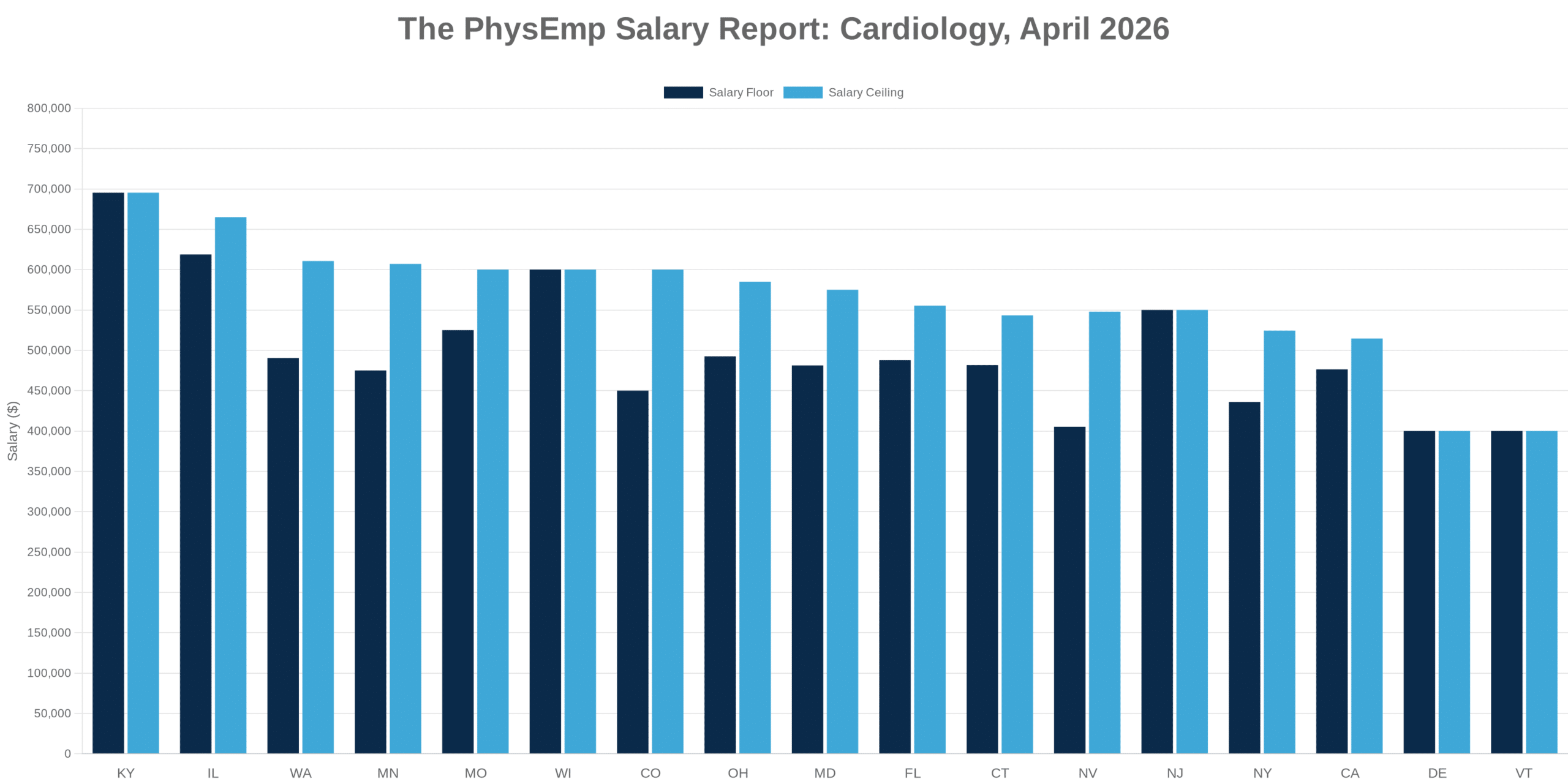
The lowest-paid Cardiology listing in America pays $233,388. The highest pays $835,000. That is a $601,612 difference for doing the same job, which is to say: keeping hearts beating and arteries open. The market has spoken, and it has a stutter. Across 280 Cardiology listings nationwide, only 66 disclosed salary data, but those that did reveal a national average range of $479,404 to $557,185. The thesis is simple: Cardiology compensation is robust, geographically scattered, and utterly dependent on where you plant your stethoscope.
👉 Explore Cardiology job market insights and trends
The Cardiology Job Market at a Glance
Total listings: 280. Listings with salary data: 66. Full salary range: $233,388 to $835,000. National average range: $479,404 to $557,185.
The spread is wide enough to drive an ambulance through. The floor appears artificially low (likely a part-time or niche role), while the ceiling sits comfortably in the rarified air reserved for subspecialists or underserved markets willing to pay a premium. The average range suggests most Cardiologists can expect mid-to-high six figures, but the devil is in the geography. States represented include New York, California, Florida, Texas, Illinois, Washington, Maryland, Connecticut, Wisconsin, North Carolina, Tennessee, Pennsylvania, Massachusetts, Ohio, Minnesota, Colorado, Missouri, Delaware, New Jersey, Vermont, Kentucky, Nevada, Alaska, Indiana, New Mexico, Kansas, Arizona, Idaho, South Carolina, Georgia, South Dakota, Virginia, Utah, Oklahoma, Maine, West Virginia, Michigan, Alabama, Montana, North Dakota, New Hampshire, Iowa, Louisiana, Arkansas, Oregon, and Nebraska. In other words: everywhere.
👉 Browse Cardiology physician job opportunities
How States Stack Up
Overperformers: Kentucky leads the nation with an average range of $695,300 to $695,300 (yes, the same number twice), which suggests either data scarcity or a market that has decided exactly what a heart is worth. Illinois follows at $618,750 to $665,000, making it the rare high-volume, high-pay state. Wisconsin clocks in at $600,000 flat, a single data point that nonetheless commands respect. Washington offers $490,333 to $610,667, and Minnesota rounds out the top tier at $475,000 to $607,044. Colorado, with one listing at $450,000 to $600,000, also overperforms but lacks volume. New Jersey, with one listing at $550,000, punches above its weight. Missouri averages $525,000 to $600,000, a quiet overachiever.
Near-average: Maryland sits at $481,250 to $575,000, nearly textbook average. Connecticut averages $481,667 to $543,333. California, despite its reputation and cost of living, offers $476,400 to $514,625, which is to say: not enough. Ohio lands at $492,500 to $585,000, respectable but unremarkable. Florida, with 16 listings but only 2 with salary data, averages $487,750 to $555,350, a high-volume state that pays in the middle of the pack.
Underperformers: Delaware and Vermont both average $400,000 flat, well below the national average and a reminder that not all markets value hearts equally. Nevada trends low at $405,250 to $547,850. New York, despite leading the nation with 28 listings, averages just $436,045 to $524,417 on the low end, a striking example of volume without premium.
Volume leaders: New York (28 listings), Florida (16), North Carolina (15), California and Wisconsin (14 each), Connecticut and Washington (12 each), Tennessee, Massachusetts, and Pennsylvania (9 each). New York’s volume does not translate to top-tier pay. Wisconsin’s volume, however, does.
👉 Compare Cardiology compensation and opportunities by region
What This Means If You’re a Physician
If your priority is maximum compensation: Kentucky, Illinois, and Wisconsin are your targets. The single highest-paying listing identified pays $835,000 annually, though the state and city are not specified in the raw data. Within New York, Saranac Lake offers $560,000 to $675,000, and Geneva offers $550,000 to $650,000, both well above the state average. Albany pays $600,000. These are the outliers worth chasing.
If your priority is maximum optionality: New York (28 listings), Florida (16), and North Carolina (15) offer the most opportunities, but be prepared to negotiate hard or accept below-average pay in exchange for location or institutional prestige. California and Wisconsin (14 each) offer a better balance of volume and compensation.
If your priority is balance: Washington and Illinois combine strong compensation with meaningful job volume. Maryland and Connecticut offer near-average pay with moderate opportunity. California’s pay does not match its cost of living, a mismatch that should give any Cardiologist pause before signing a Bay Area lease.
👉 Search Cardiology jobs by location and compensation
What This Means If You’re a Recruiter
Salary transparency rate: 23.6% (66 listings with data divided by 280 total listings). This is low, and it will cost you. Candidates are navigating a market where three out of four listings require a phone call, an application, or a leap of faith to learn what the job actually pays. In a specialty this competitive, opacity is a pipeline killer.
Volume-pay misalignments are stark. New York leads in listings but underperforms on average salary. North Carolina, Tennessee, Texas, Massachusetts, and Pennsylvania collectively represent 55 listings with zero disclosed salary data. If you are recruiting in these states, you will need to lead with mission, geography, or lifestyle, because the compensation story is either hidden or underwhelming. Florida has 16 listings but only 2 with salary data, a transparency failure that will send candidates elsewhere. Conversely, Kentucky and Illinois prove that smaller markets with transparent, premium pay can compete with coastal volume leaders.
👉 Post Cardiology positions on PhysEmp
What’s Driving the Numbers
Geography drives everything. Kentucky, a low-volume state with 5 listings, pays an average of $695,300. New York, a high-volume state with 28 listings, pays an average low of $436,045. The inverse relationship between volume and pay suggests that scarcity commands a premium, while saturated markets suppress baseline compensation. Underserved or rural markets appear willing to pay top dollar to attract talent, while urban centers rely on prestige, amenities, or institutional inertia to justify lower offers.
Subspecialty and scope likely explain the extremes. The $835,000 ceiling and the $233,388 floor are too far apart to reflect general Cardiology alone. Interventional Cardiologists, electrophysiologists, and those with administrative or leadership roles almost certainly occupy the top tier. The floor likely reflects part-time work, academic settings, or early-career positions. Without granular data, physicians must ask pointed questions about scope, call burden, and partnership track.
Transparency is a competitive weapon. States and systems that disclose salary data are more likely to attract serious candidates. Illinois, Washington, and Minnesota combine strong pay with meaningful transparency. North Carolina, Tennessee, and Massachusetts offer volume but no salary data, a strategic failure that hands the advantage to competitors willing to name a number.
The volume-pay relationship is broken. High-volume states like New York, Florida, and California do not consistently pay above average, while low-volume states like Kentucky and Wisconsin lead on compensation. This suggests that Cardiology hiring is not driven by population density or market size alone, but by institutional desperation, rural scarcity, or strategic investment in service lines. Recruiters in high-volume markets must reckon with the fact that more jobs does not mean better jobs.
The Bottom Line
The Cardiology job market is geographically vast, financially variable, and selectively transparent. Physicians who prioritize compensation should look to Kentucky, Illinois, and Wisconsin, while those chasing volume will find the most opportunities in New York, Florida, and North Carolina (though not necessarily the best pay). The $601,612 gap between the floor and ceiling is not a bug, it is the market working exactly as intended: rewarding those who are willing to move, negotiate, or work where others will not.
There is a lot of money available for keeping hearts beating, but only if you know where to look.
👉 Browse all Cardiology physician jobs
👉 Upload your CV to get matched with opportunities
👉 Set alerts for new Cardiology roles
Salary data based on 66 listings with disclosed compensation. Figures may reflect part-time or specialized roles. This report is informational and should not replace professional judgment or financial planning.