
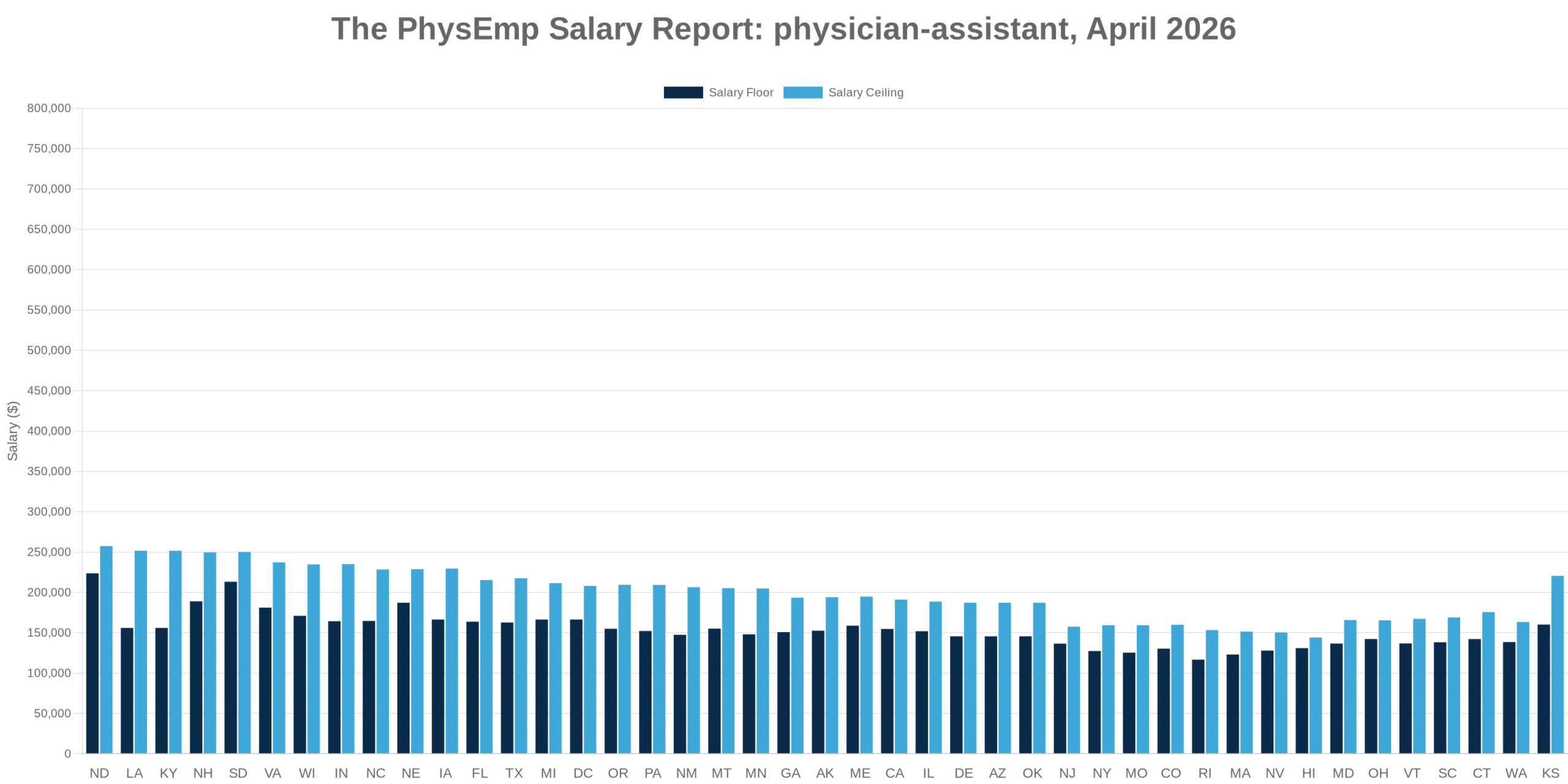
The physician assistant job market currently spans from $55,000 annually for a part-time role in Crowell, TX to $400,000 for what can only be described as the platonic ideal of a specialized travel contract. That is not a typo. That is a 627% spread, which tells you everything and nothing about this market at the same time. There are 1,156 active listings nationally, representing every major region and employment type. The data reveals a market that is both abundant and deeply fragmented—where geography, work structure, and specialty mix determine compensation far more than any single national benchmark ever could.
👉 Explore Physician Assistant job market insights and trends
The Physician Assistant Job Market at a Glance
Total listings: 1,156
Listings with salary data: 460
Full salary range: $55,000 to $400,000
Average salary range: $148,832 to $188,028
The average figures mask extraordinary variation. The floor is artificially depressed by part-time roles, and the ceiling is inflated by high-intensity travel and locum contracts that few clinicians will ever see or want. The practical mid-market range for full-time employed PAs trends between $130,000 and $230,000, depending on state, setting, and scope. This is a market where a PA in North Dakota earns $223,600 on average and a PA in Rhode Island earns $116,667. Both are real. Both are defensible. Neither tells the whole story.
States represented: California, New York, Texas, Washington, North Carolina, Florida, Wisconsin, Oregon, Illinois, Georgia, New Jersey, Connecticut, Massachusetts, Pennsylvania, Virginia, New Hampshire, Vermont, Maine, North Carolina, South Carolina, Tennessee, Alabama, Mississippi, Louisiana, Arkansas, Oklahoma, Missouri, Kansas, Nebraska, Iowa, Minnesota, North Dakota, South Dakota, Montana, Wyoming, Colorado, New Mexico, Arizona, Nevada, Utah, Idaho, Alaska, Hawaii, Ohio, Michigan, Indiana, Kentucky, West Virginia, Delaware, Maryland, and Washington DC.
👉 Browse Physician Assistant physician job opportunities
How States Stack Up
Overperformers:
North Dakota leads nationally at $223,600 to $257,400 across five listings—a premium that reflects geographic isolation and aggressive recruitment, not volume. South Dakota follows at $213,200 to $250,120 with ten listings, continuing the Great Plains compensation theme. New Hampshire averages $188,933 to $249,600 across 29 listings, buoyed by high-paying travel contracts in Manchester that reach $135 per hour ($280,800 annualized). Virginia averages $181,133 to $237,267 across 27 listings, offering both strong pay and reasonable job availability. Wisconsin posts $170,975 to $234,690 across 33 listings, making it one of the rare high-volume, high-pay markets. Texas averages $162,688 to $217,550 across 42 listings, though the $55,000 part-time outlier drags the floor down significantly. North Carolina averages $164,650 to $228,437 across 83 listings, combining volume and competitive pay in a way few states manage. Iowa averages $166,400 to $229,493 across just three salary-reported listings, suggesting rural scarcity pricing. Kansas averages $160,160 to $220,480 across five listings, another low-volume, high-pay signal. Indiana averages $164,320 to $235,040 across two listings, though sample size limits confidence.
Near-Average:
California averages $154,750 to $191,100 across 89 salary-reported listings out of 145 total—solid pay, massive volume, and the closest thing this market has to a benchmark. Illinois averages $151,922 to $188,656 across 20 salary-reported listings out of 45 total, landing squarely in the national midpoint. Oregon averages $154,960 to $209,456 across ten salary-reported listings out of 54 total, offering a wide range that suggests mix variability. Georgia averages $150,800 to $193,440 across ten salary-reported listings out of 36 total. Pennsylvania averages $152,200 to $209,260 across eight salary-reported listings out of 14 total. Florida averages $163,714 to $215,314 across seven salary-reported listings out of 27 total, slightly above average despite being a high-cost state. Minnesota averages $148,070 to $204,884 across 12 salary-reported listings out of 14 total. Montana averages $155,133 to $205,267 across six salary-reported listings out of 14 total. Maine averages $158,771 to $194,857 across seven salary-reported listings out of 20 total. Alaska averages $152,533 to $194,133 across three salary-reported listings out of 15 total, lower than expected given cost of living and remoteness.
Underperformers:
Rhode Island averages $116,667 to $153,333 across three listings, the lowest state average in the dataset. Massachusetts averages $123,059 to $151,494 across 17 salary-reported listings out of 39 total—a high-volume state paying well below the national average, which is a problem. Missouri averages $125,333 to $159,333 across three salary-reported listings out of 11 total. New York averages $127,386 to $159,343 across 54 salary-reported listings out of 74 total, a glaring cost-of-living mismatch for the second-highest volume state in the country. Nevada averages $127,952 to $150,379 across seven listings, all with salary data. Colorado averages $130,343 to $159,886 across nine salary-reported listings out of 15 total, another high-cost state with below-average pay. Hawaii averages $130,960 to $144,085 across eight salary-reported listings out of nine total, the lowest-paying state relative to cost of living. New Jersey averages $136,533 to $157,567 across six salary-reported listings out of 23 total, underperforming for a high-cost Northeastern market. Vermont averages $136,800 to $167,276 across nine salary-reported listings out of ten total. Maryland averages $136,600 to $165,750 across four listings, below expectations for the DC metro area. Washington averages $138,479 to $163,374 across 47 salary-reported listings out of 68 total—one of the highest-volume states, paying below the national average. South Carolina averages $138,200 to $169,000 across two salary-reported listings out of 30 total. Ohio averages $142,233 to $165,410 across six salary-reported listings out of 12 total. Connecticut averages $142,165 to $175,624 across 17 salary-reported listings out of 30 total.
Volume Leaders:
California leads with 145 listings, followed by North Carolina (83), New York (74), Washington (68), Oregon (54), Illinois (45), and Texas (42). The volume-pay relationship is weak. California and Washington are top-three volume states but pay mid-range at best. New York is the third-largest market and pays below average. Meanwhile, North Dakota and South Dakota—tiny markets—pay the most.
👉 Compare Physician Assistant compensation and opportunities by region
What This Means If You’re a Physician
If your priority is maximum compensation: Target North Dakota, South Dakota, New Hampshire, Virginia, and Wisconsin. The highest-paying listing in the dataset is $400,000, likely a specialized or high-acuity travel role with limited geographic or scope detail. New Hampshire offers the highest disclosed hourly rate at $135 per hour in Manchester ($280,800 annualized). North Dakota’s $257,400 ceiling represents the top end of permanent full-time roles.
If your priority is maximum optionality: California offers 145 listings, North Carolina offers 83, and New York offers 74. These are the only markets with enough volume to support true choice. California pays $154,750 to $191,100 on average—mid-range, but livable in non-coastal metros. North Carolina pays $164,650 to $228,437 and offers better cost-of-living arbitrage. New York pays $127,386 to $159,343, which is difficult to justify unless you are committed to the region for non-financial reasons.
If your priority is balance: Wisconsin ($170,975 to $234,690 across 33 listings), Virginia ($181,133 to $237,267 across 27 listings), and New Hampshire ($188,933 to $249,600 across 29 listings) offer the best combination of pay and opportunity. Oregon ($154,960 to $209,456 across 54 listings) and Illinois ($151,922 to $188,656 across 45 listings) are also defensible, though pay is closer to average.
Cost-of-living mismatches worth scrutiny: New York, Massachusetts, Hawaii, Colorado, and California all underperform relative to housing and tax burden. Washington pays below the national average despite Seattle’s cost structure. Conversely, North Dakota, South Dakota, Wisconsin, and Kansas offer strong pay in low-cost-of-living environments, creating real purchasing power.
👉 Search Physician Assistant jobs by location and compensation
What This Means If You’re a Recruiter
Salary transparency rate: 39.8% (460 listings with salary data divided by 1,156 total listings). That means six out of ten listings provide no compensation information, which creates friction in a candidate-driven market and likely extends time-to-fill.
Candidate pipeline implications: High-volume states like California, North Carolina, and Washington will continue to attract applicants based on sheer opportunity, but pay compression in these markets may push experienced PAs toward North Dakota, South Dakota, and New Hampshire, where compensation is 30% to 50% higher. Massachusetts and New York face a structural disadvantage: high volume, below-average pay, and high cost of living. Recruiters in these states will need to lead with mission, team culture, benefits, or loan repayment rather than base salary.
Volume-pay misalignments: New York (74 listings, $127,386 to $159,343 average) and Washington (68 listings, $138,479 to $163,374 average) are the most obvious disconnects. Both states generate significant demand but fail to price competitively. Massachusetts (39 listings, $123,059 to $151,494 average) is another high-volume, low-pay outlier. Conversely, North Dakota and South Dakota pay top-tier wages but offer only five and ten listings, respectively. Recruiters in these states are pricing in scarcity and isolation, not market depth.
👉 Post Physician Assistant positions on PhysEmp
What’s Driving the Numbers
Part-time and PRN roles distort the salary floor significantly.
The $55,000 low is tied to a part-time position in Crowell, TX. Several other listings in the $70,000 to $90,000 range reflect part-time or PRN structures. This creates a misleading floor that does not represent full-time employed PA compensation. The practical floor for full-time roles is closer to $115,000 to $130,000, depending on state and setting. Recruiters and candidates alike should filter for full-time equivalents when benchmarking.
Travel and locum contracts create a secondary, high-intensity market.
The $400,000 ceiling and the $135/hour New Hampshire contract represent a distinct labor class: short-term, high-intensity, often rural or underserved placements. These roles are not comparable to permanent employed positions. They command premiums for flexibility, dislocation, and scope variability. The travel market appears to be strongest in New Hampshire, Montana, and other states with geographic or seasonal demand volatility. This segment inflates the upper range but does not reflect typical earning potential for most PAs.
Underserved and rural markets price in scarcity, but inconsistently.
North Dakota, South Dakota, Kansas, and Iowa all show elevated pay relative to cost of living, consistent with rural recruitment premiums. However, Montana and Alaska—equally remote—pay closer to the national average. This suggests that scarcity alone does not command a premium; it must be paired with either state-level recruitment investment or health system urgency. States that underprice rural roles (Montana, Alaska, New Mexico) may struggle with vacancy duration and turnover.
High-volume states are paying below market, and it is starting to show.
California, Washington, and New York generate the most listings but offer compensation in the bottom half of the national range. This is sustainable only if candidates prioritize geography, lifestyle, or mission over income. In a tight labor market, this dynamic favors states like Wisconsin, Virginia, and North Carolina, which combine reasonable volume with above-average pay. The volume-pay disconnect is not a temporary arbitrage—it is a structural risk for high-cost, high-demand markets that have relied on brand rather than compensation to recruit.
The Bottom Line
The physician assistant job market is large, liquid, and full of contradictions. You can earn $116,667 in Rhode Island or $257,400 in North Dakota. You can choose from 145 jobs in California or five in North Dakota. You can take a $400,000 travel contract or a $55,000 part-time role in rural Texas. The market does not care which you choose, but the data makes clear that geography and employment structure matter far more than credentials or experience in determining your pay.
There is no such thing as a national PA salary—only a series of local and structural markets that happen to share a job title.
👉 Browse all Physician Assistant physician jobs
👉 Upload your CV to get matched with opportunities
👉 Set alerts for new Physician Assistant roles
Salary data based on 460 listings with disclosed compensation. Figures may reflect part-time or specialized roles. This report is informational and should not replace professional judgment or financial planning.