
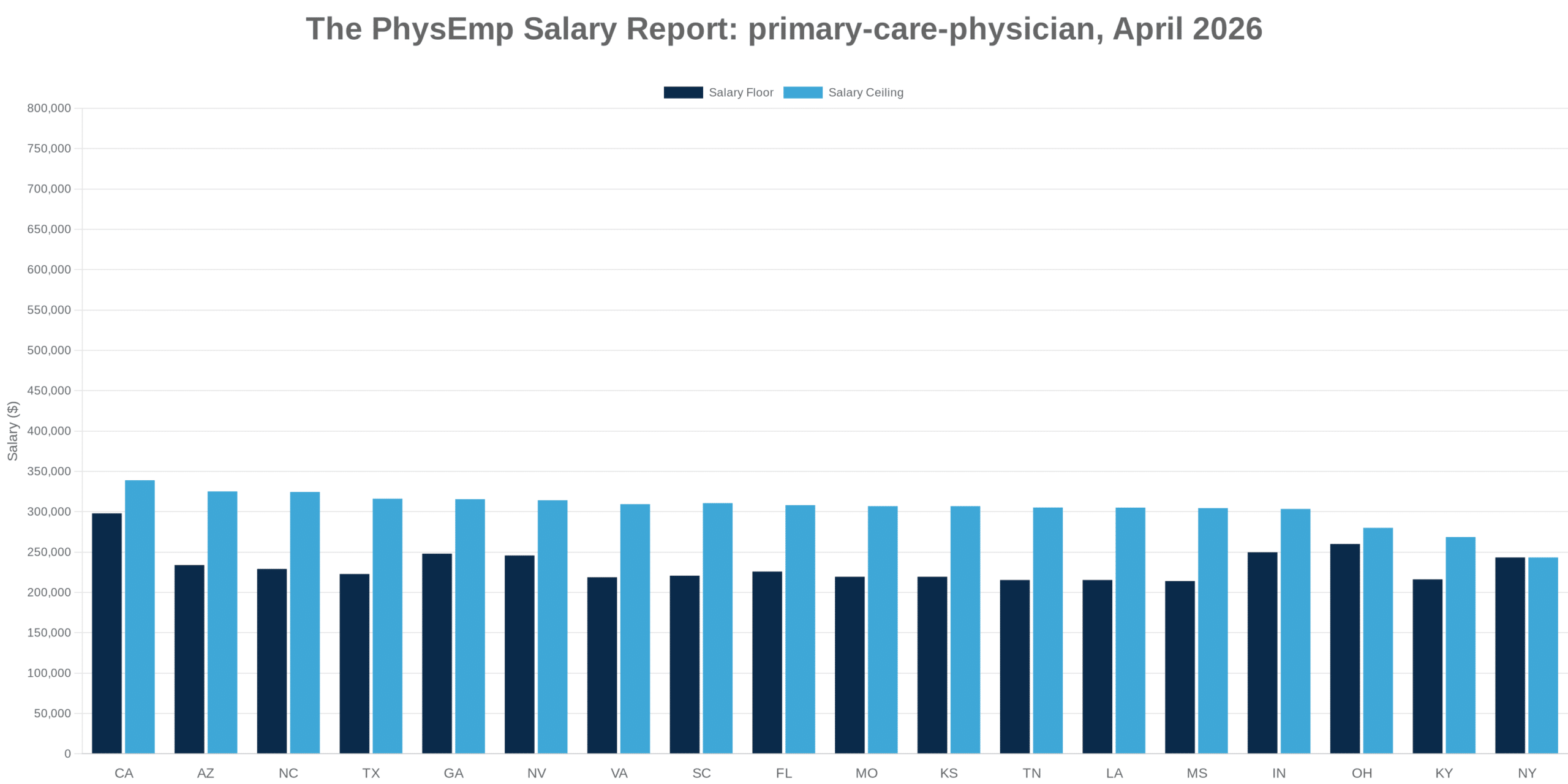
California is paying primary care physicians $298,000 on average just to show up. Mississippi starts at $214,067. That is an $84,000 spread before anyone has seen a patient, billed a visit, or survived their first prior authorization appeal. The national primary care physician job market includes 176 active listings across 27 states, with compensation data disclosed in 135 of them. The data reveals a market defined not by scarcity of opportunity, but by profound geographic inequality in how much that opportunity pays.
👉 Explore Primary Care Physician job market insights and trends
The Primary Care Physician Job Market at a Glance
Total listings: 176
Listings with salary data: 135
Full salary range: $145,000 to $395,000
Average salary range: $229,921 to $310,915
The spread is wide, but not wild. Most listings cluster in the $219,400 to $306,900 band, which represents the market’s center of gravity. The floor of $145,000 likely reflects part-time or rural placements with reduced scope, while the ceiling of $395,000 suggests either leadership roles, underserved market premiums, or part-time arrangements with outsized hourly rates. The average low of $229,921 is respectable; the average high of $310,915 is solid. But the state-level variance tells the real story.
States represented: Alabama, Arizona, Arkansas, California, Colorado, Florida, Georgia, Indiana, Kansas, Kentucky, Louisiana, Massachusetts, Michigan, Mississippi, Missouri, Nevada, New Mexico, New York, North Carolina, Ohio, Oregon, Pennsylvania, South Carolina, Tennessee, Texas, Virginia, Wyoming.
👉 Browse Primary Care Physician physician job opportunities
How States Stack Up
Overperformers: California leads decisively with an average range of $298,000 to $339,000, combining premium pay with 12 active listings. Ohio offers $260,000 to $280,000, though only one listing makes this more anecdote than trend. Indiana averages $249,700 to $303,450 across two listings, a quiet overperformer. Nevada ($245,800 to $314,175) and Georgia ($248,013 to $315,563) both clear the national average with room to spare, and both offer meaningful volume (8 salary listings each).
Near-average: Missouri and Kansas both land at $219,400 to $306,900, textbook national average. South Carolina averages $220,738 to $310,638 across 8 listings, stable and unremarkable. Florida ($225,819 to $308,112) sits just above average with 26 salary-disclosed listings, making it a volume play with predictable pay. North Carolina ($229,055 to $324,491) and Arizona ($233,900 to $325,175) both trend slightly above average and offer double-digit listing counts. Texas averages $222,788 to $316,160 across 25 listings, a workhorse market that pays competently but not lavishly. New York ($243,333 flat average) has only three salary listings, limiting interpretability. Virginia ($218,811 to $309,400) hovers just below the national average low across 9 listings, a modest underperformer masquerading as middle-tier.
Underperformers: Mississippi ($214,067 to $304,433), Louisiana ($215,400 to $305,050), and Tennessee ($215,400 to $305,180) all start below $220,000 and offer limited upside. Kentucky is the most compressed market at $216,150 to $268,600, a ceiling that barely clears the national average floor. These states are paying primary care physicians as if competition does not exist.
Volume leaders: Texas (28 listings), Florida (27), California (12), North Carolina (12), Arizona (12), Georgia (10), South Carolina (10). Texas leads in raw opportunity but pays near-average. Florida follows the same script. California bucks the trend entirely, offering both volume and top-tier compensation.
👉 Compare Primary Care Physician compensation and opportunities by region
What This Means If You’re a Physician
If your priority is maximum compensation: Target California. The state’s $298,000 average floor is $68,000 higher than the national average and $84,000 higher than Mississippi. The highest single salary identified in this dataset is $395,000, though specific city and listing details were not provided in the raw data. California consistently delivers premium pay without requiring physicians to accept geographic or professional isolation.
If your priority is maximum optionality: Go to Texas or Florida. Texas offers 28 listings, Florida offers 27, and both provide near-average pay in the $222,000 to $225,000 range at the low end. These are liquid markets where volume creates negotiating leverage and the ability to be selective about practice setting, patient population, and contract terms.
If your priority is balance: Consider North Carolina or Arizona. Both states offer above-average pay (starting near $229,000 and $233,900 respectively), double-digit job counts, and compensation ceilings that exceed $320,000. Neither requires the cost-of-living trade-offs of California nor the pay compression of the Southeast.
One cost-of-living mismatch merits attention: California’s $298,000 floor is impressive, but it is California. A primary care physician in Kentucky earning $216,150 in a low-cost market may have comparable purchasing power to a California physician earning $280,000 in a high-cost metro. Run the numbers before you move.
👉 Search Primary Care Physician jobs by location and compensation
What This Means If You’re a Recruiter
Salary transparency rate: 76.7% (135 of 176 listings disclosed compensation). That is high by national standards and reflects the reality that primary care physicians will not engage without knowing the pay range upfront. In a market this transparent, vague language about “competitive compensation” is a disqualifier.
Candidate pipeline implications: The states with the weakest pay (Mississippi, Louisiana, Tennessee, Kentucky) will struggle to attract out-of-state candidates and will need to rely on local training pipelines, loan repayment programs, or mission-driven recruitment. Texas and Florida can compete on volume and lifestyle, but not on pay. California can compete on everything.
Volume-pay misalignment: Texas leads the nation in listings but pays near the national average. Florida follows the same pattern. Both states are betting that weather, tax policy, and job availability will offset compensation that lags California by $75,000 or more. That works until it doesn’t. Recruiters in these markets will need to lead with practice autonomy, partnership tracks, and quality of life, because the salary data will not close the deal on its own.
👉 Post Primary Care Physician positions on PhysEmp
What’s Driving the Numbers
Geography is destiny. The $84,000 gap between California’s average floor and Mississippi’s is not a rounding error. It is a structural feature of a market in which state-level policy, payer mix, and cost of living create parallel compensation universes. Primary care physicians are being paid as if they work in different specialties depending on where they practice.
Volume does not command premium pay. Texas has 28 listings and pays near-average. Florida has 27 and does the same. California has 12 and pays $75,000 more on average. High listing counts signal demand, but they do not signal willingness to pay. In this market, scarcity and competition for talent matter more than raw job availability.
Part-time roles distort the ceiling. The highest reported salary of $395,000 appears in the dataset, and part-time roles in Burlington, NC, Phoenix, AZ, and Beaumont, TX are noted as reaching $378,800. Hourly arrangements at $135 to $150 per hour annualize to $280,800 to $312,000. These figures suggest that part-time primary care work in select markets can outpace full-time compensation in underperforming states. The floor is set by full-time employment; the ceiling is set by flexibility and hourly leverage.
The Southeast is underpricing primary care. Mississippi, Louisiana, Tennessee, Kentucky, and Virginia all start below $220,000. South Carolina and North Carolina perform better, but the region as a whole is paying primary care physicians as if supply exceeds demand. It does not. This is a strategy that will fail as soon as physicians realize they can earn $80,000 more by moving 1,500 miles west.
The Bottom Line
The primary care physician job market offers broad geographic opportunity, reasonable volume, and a national average that clears $229,000 at the low end and $310,000 at the high end. But the state-level variance is severe, and physicians who choose based on proximity or inertia rather than compensation strategy will leave six figures on the table over the course of a career. California pays the most, Texas and Florida offer the most jobs, and the Southeast pays the least while hoping no one notices.
Primary care is essential, underpaid relative to procedural specialties, and still capable of generating $395,000 in annual income if you know where to look.
👉 Browse all Primary Care Physician physician jobs
👉 Upload your CV to get matched with opportunities
👉 Set alerts for new Primary Care Physician roles
Salary data based on 135 listings with disclosed compensation. Figures may reflect part-time or specialized roles. This report is informational and should not replace professional judgment or financial planning.