
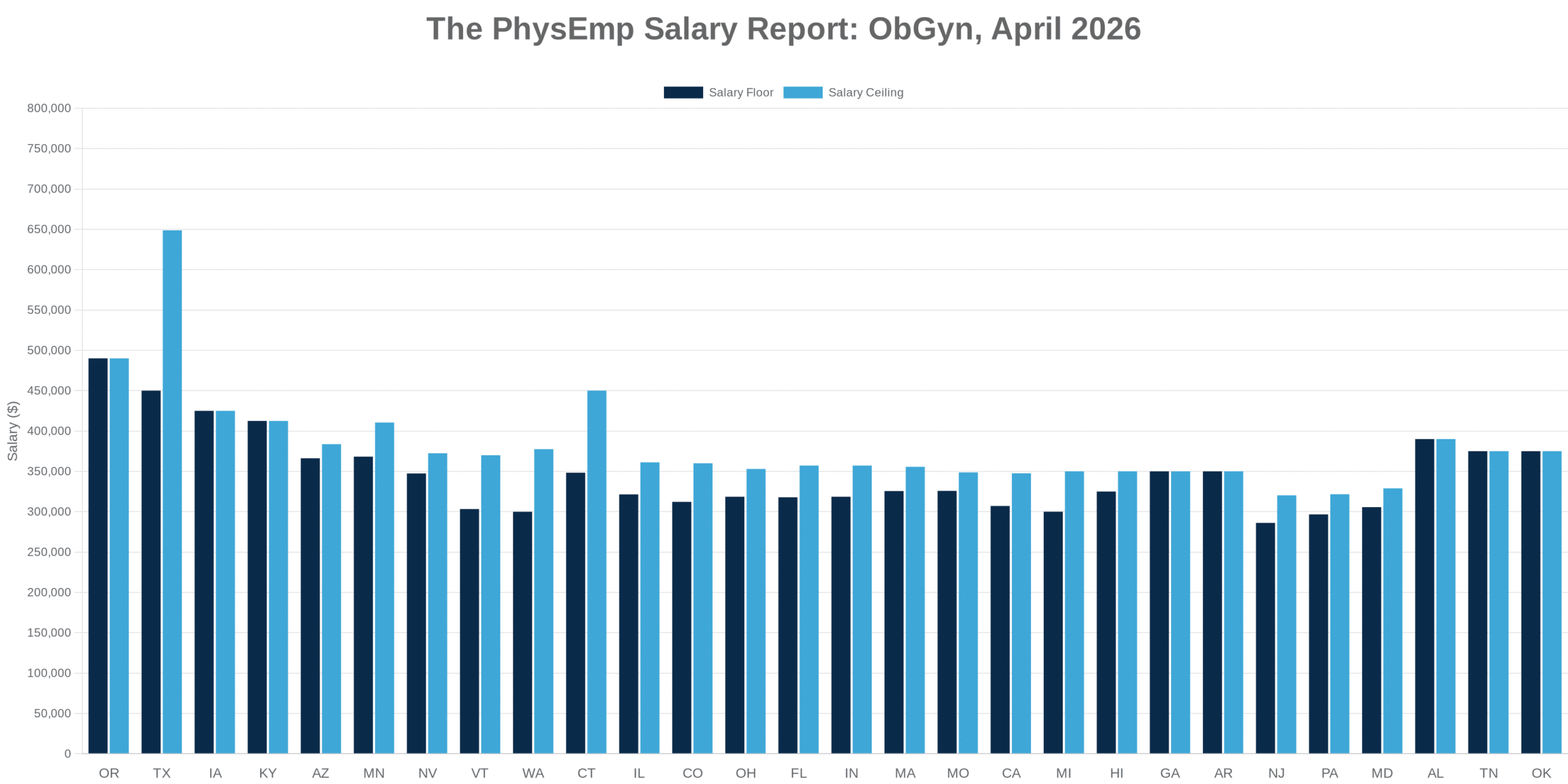
Oregon is paying ObGyn physicians $490,000 on average. Iowa is at $425,000. Kentucky clears $412,500. Meanwhile, New York — with 110 active listings — averages $296,525 to $351,889, and New Jersey bottoms out at $286,138. The national ObGyn market includes 1,137 active listings spanning nearly every state, with compensation data available for 249 positions. What the data shows: high cost-of-living coastal markets are losing the compensation war to states that need ObGyns more than they need prestige.
👉 Explore ObGyn job market insights and trends
The ObGyn Job Market at a Glance
The market includes 1,137 total listings. Of those, 249 disclosed salary data. Compensation ranges from $125,000 to $750,000 annually, with a national average of $315,927 to $359,898.
That $625,000 spread between floor and ceiling tells the story of a specialty where geography, practice setting, and employer desperation matter more than almost anything else. The $125,000 floor likely reflects part-time or highly specialized academic roles, while the $750,000 ceiling represents full-scope private practice or underserved market premiums. The average sits comfortably in the mid-$300,000s, but averages lie — this is a market defined by its extremes.
Listings appear in Arizona, New York, California, Colorado, Florida, Vermont, Nevada, Illinois, New Jersey, Ohio, Texas, Missouri, Connecticut, Pennsylvania, Minnesota, Massachusetts, Maryland, Washington, Hawaii, Alabama, Michigan, Tennessee, West Virginia, Utah, New Mexico, North Carolina, South Carolina, Wisconsin, Virginia, Arkansas, Montana, Kentucky, Louisiana, Indiana, Rhode Island, Georgia, Maine, Wyoming, Iowa, Idaho, Alaska, Mississippi, South Dakota, Oregon, North Dakota, Oklahoma, New Hampshire, Washington DC, Delaware, and Kansas.
👉 Browse ObGyn physician job opportunities
How States Stack Up
Overperformers: Texas leads the nation at $450,000 to $648,667, combining volume and compensation in a way no other state can match. Oregon posts $490,000 (on a single listing, but still). Iowa hits $425,000, proving that the Midwest can pay when it has to. Kentucky averages $412,500, and Minnesota delivers $368,230 to $410,495 across 20 listings, making it the rare high-pay, high-volume combination. Arizona clears $366,200 to $383,700 across 10 salary listings, and Connecticut ranges from $348,333 to $450,000, with the top end rivaling Texas.
Near-average: Illinois sits at $321,448 to $361,207 across 56 listings, offering predictability and volume. Florida averages $317,857 to $357,143 with 54 postings. Indiana mirrors Florida at $318,571 to $357,143 across 48 listings. Ohio matches Indiana almost exactly at $318,571 to $352,971. Colorado, Missouri, Massachusetts, and Hawaii all hover in the $312,000 to $360,000 range with limited salary data but stable positioning.
Underperformers: New Jersey averages $286,138 to $320,292, the lowest in the dataset with meaningful sample size. New York, despite 110 listings, offers $296,525 to $351,889 — below the national average and well behind Texas. Pennsylvania sits at $296,667 to $321,667. Washington averages $299,908 to $377,513, with a wide spread that suggests inconsistency. California, with 94 listings, averages $307,112 to $347,597, underperforming relative to its cost of living. Maryland comes in at $305,640 to $328,960.
Volume leaders: New York (110 listings), California (94), Texas (67), Illinois (56), Florida (54), North Carolina (49), and Indiana (48). Texas is the only high-volume state that also pays above average. New York and California combine high volume with below-average compensation, a mismatch that will require non-salary recruitment strategies.
👉 Compare ObGyn compensation and opportunities by region
What This Means If You’re a Physician
If your priority is maximum compensation: Texas is the answer. The highest-paying listing in the dataset is in El Paso, TX, offering $425,000 to $648,000 annually. Oregon, Iowa, Kentucky, and Minnesota also command premiums, though with lower listing volume. Connecticut’s top-end range of $450,000 makes it a coastal option for physicians unwilling to leave the Northeast.
If your priority is maximum optionality: New York and California dominate by sheer volume, but both pay below the national average. Illinois, Florida, and Indiana offer near-average pay with 48 to 56 listings each, providing solid selection without the coastal cost-of-living penalty.
If your priority is balance: Minnesota offers 20 listings at $368,230 to $410,495, combining strong pay with reasonable volume and a lower cost of living than the coasts. Arizona delivers $366,200 to $383,700 across 10 salary listings in a tax-friendly state. Illinois provides 56 listings at $321,448 to $361,207, offering volume and predictability in a market with established healthcare infrastructure.
Cost-of-living mismatch alert: New York and California are paying $50,000 to $100,000 less on average than Texas, Oregon, and Minnesota, while demanding significantly higher housing and tax burdens. New Jersey, at $286,138, is the worst value proposition in the dataset.
👉 Search ObGyn jobs by location and compensation
What This Means If You’re a Recruiter
Salary transparency rate: 21.9% (249 listings with salary data divided by 1,137 total listings). This is low, and it will cost you candidates. In a market where Texas is openly advertising $450,000 to $648,667 and Oregon is posting $490,000, opacity is a competitive disadvantage.
Pipeline implications: Physicians can now see that high-volume states like New York and California pay below the national average. Recruiters in those markets will need to lead with lifestyle, academic affiliation, subspecialty training opportunities, or practice prestige — because compensation is not the draw. States like North Carolina, Wisconsin, and South Carolina posted 49, 36, and 26 listings respectively with zero salary data, leaving candidates to assume the worst.
Volume-pay misalignment: New York has 110 listings and pays $296,525 on average. California has 94 listings and pays $307,112. Both are losing the compensation war to Texas (67 listings, $450,000 average), and neither can claim superior volume anymore. If you are recruiting in a high-volume, low-pay state, your pitch must be airtight — and it must not rely on salary.
👉 Post ObGyn positions on PhysEmp
What’s Driving the Numbers
Underserved markets price in scarcity. Texas, Oregon, Iowa, and Kentucky are paying premiums because they have to. These are not traditionally prestigious markets, and they are not winning on brand. They are winning on compensation, and the data suggests it is working. States that need ObGyns more than ObGyns need them are bidding up the market, and physicians are noticing.
High cost-of-living states are underperforming. New York, New Jersey, California, and Maryland are all paying below the national average despite ranking among the most expensive places to live in the country. This is not a sustainable recruitment strategy. Either these states are relying on non-financial draws (academic prestige, subspecialty case mix, proximity to family), or they are experiencing attrition they have not yet priced into their offers.
Volume does not correlate with pay. New York leads in listings but ranks in the bottom third for compensation. Texas has fewer listings than California but pays $140,000 more on average. Illinois, Florida, and Indiana are all high-volume, near-average markets, suggesting that volume alone does not command a premium — it simply reflects demand. The takeaway for recruiters: more jobs does not mean better jobs.
The floor is noisy, the ceiling is real. The $125,000 floor almost certainly reflects part-time, academic, or highly specialized roles that skew the range. But the $750,000 ceiling is not an outlier — it is the market clearing price in high-need, low-supply environments. The average of $315,927 to $359,898 is useful for benchmarking, but it obscures the reality that top-tier ObGyn compensation is well into the $400,000s and $600,000s in the right markets.
The Bottom Line
The ObGyn job market is geographically bifurcated, with underserved and lower-cost states outbidding coastal markets by six figures. Physicians have more than 1,100 jobs to choose from, but fewer than one in four comes with salary transparency, and the ones that do reveal a market where prestige and cost of living are inversely correlated with pay. Texas is paying $450,000 on average. New York is paying $296,525. The market has spoken.
👉 Browse all ObGyn physician jobs
👉 Upload your CV to get matched with opportunities
👉 Set alerts for new ObGyn roles
There is a lot of money available for delivering babies and performing surgery in places that need you. Choose wisely.
Salary data based on 249 listings with disclosed compensation. Figures may reflect part-time or specialized roles. This report is informational and should not replace professional judgment or financial planning.