
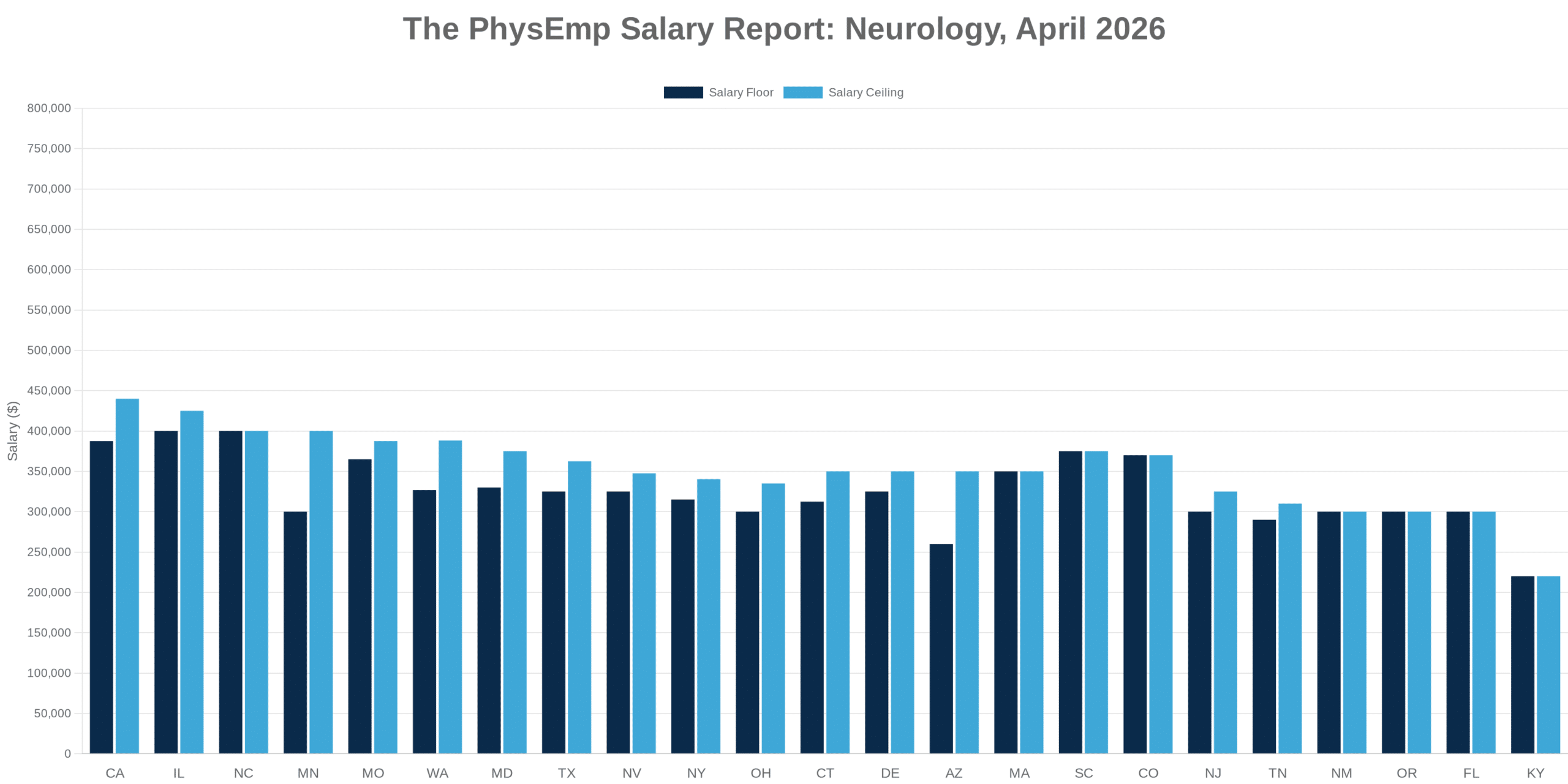
Kentucky is paying Neurology physicians $220,000 annually while Illinois offers up to $425,000 for the same specialty. That is a $205,000 gap for reading the same MRIs and managing the same seizure protocols. The national Neurology job market currently features 496 active listings spread across 48 states, with salary data disclosed in 54 of them. The data reveals a market where geography dictates compensation far more than volume dictates leverage.
👉 Explore Neurology job market insights and trends
The Neurology Job Market at a Glance
Total listings: 496
Listings with salary data: 54
Full salary range: $220,000 to $500,000
Average salary range: $327,015 to $359,212
The national average understates the reality. Most disclosed positions cluster between $300,000 and $400,000, but the range stretches wide enough to fit two entirely different careers. The $280,000 spread from floor to ceiling suggests that either scope, geography, or desperation is doing heavy lifting. The average high of $359,212 feels oddly precise (and oddly modest) given that multiple states are clearing $400,000 without breaking a sweat.
States with active Neurology listings: Alabama, Alaska, Arizona, Arkansas, California, Colorado, Connecticut, Delaware, Florida, Georgia, Idaho, Illinois, Indiana, Iowa, Kansas, Kentucky, Louisiana, Maine, Maryland, Massachusetts, Michigan, Minnesota, Mississippi, Missouri, Nebraska, Nevada, New Hampshire, New Jersey, New Mexico, New York, North Carolina, North Dakota, Ohio, Oklahoma, Oregon, Pennsylvania, Rhode Island, South Carolina, South Dakota, Tennessee, Texas, Utah, Vermont, Virginia, Washington, West Virginia, Wisconsin, Wyoming.
👉 Browse Neurology physician job opportunities
How States Stack Up
Overperformers:
Illinois leads the nation with an average range of $400,000 to $425,000 across 12 listings, proving that the Midwest can compete when it wants to. California follows at $387,500 to $440,000 across 20 listings, combining volume with elite compensation in a rare feat of market efficiency. North Carolina offers a flat $400,000 average across 25 listings, making it the rare high-volume state that doesn’t suppress wages. South Carolina posts $375,000 across 12 listings, a quiet overperformer in the Southeast. Missouri delivers $365,000 to $387,500 across 19 listings, rewarding physicians willing to work in markets the coasts overlook. Colorado averages $370,000 across just 2 listings, though sample size makes this more anecdote than trend. Washington state ranges from $326,832 to $388,206 across 15 listings, with the high end pulling it slightly above average despite the low end hugging the national mean.
Near-Average Performers:
New York averages $315,083 to $340,417 across 20 listings, a surprisingly restrained range for a state that prices everything else at a premium. Texas posts $325,000 to $362,500 across 47 listings, offering the most jobs in the country and the most aggressively average pay. Nevada ranges from $325,000 to $347,500 across 5 listings, with 4 of them disclosing salary in a rare show of transparency. Connecticut averages $312,500 to $350,000 across 10 listings, landing squarely in the middle of the national pack. Delaware offers $325,000 to $350,000 based on a single disclosed listing, making it a data point more than a market. Massachusetts averages $350,000 flat across 11 listings, with only one salary disclosure doing all the work. Maryland ranges from $330,000 to $375,000 across 7 listings, with one disclosed salary suggesting upside potential. Ohio posts $300,000 to $335,000 across 8 listings, a modest range for a state with decent job availability.
Underperformers:
Kentucky averages $220,000 across 16 listings, a figure so low it suggests either part-time work or a fundamental misunderstanding of market rates. Arizona ranges from $260,000 to $350,000 across 12 listings, with the wide spread hinting at a mix of rural desperation and urban indifference. Tennessee averages $290,000 to $310,000 across 9 listings, falling well short of the national benchmark. New Jersey posts $300,000 to $325,000 across 11 listings, an underwhelming range for a state wedged between two major metro markets. New Mexico, Oregon, and Florida all average $300,000 flat, with Florida’s 29 listings making its below-average pay especially conspicuous.
Volume leaders: Texas (47 listings), Florida (29), North Carolina (25), California (20), New York (20), Pennsylvania (20), Missouri (19), Georgia (19), Michigan (14), Virginia (13). Texas leads the nation in openings but pays near-average wages. Florida ranks second in volume and pays below average. Pennsylvania, Georgia, Virginia, and Michigan posted no salary data despite double-digit listing counts, a transparency problem that will cost them candidates.
👉 Compare Neurology compensation and opportunities by region
What This Means If You’re a Physician
If your priority is maximum compensation: Target Illinois, California, or North Carolina, where averages exceed $400,000 and listing volume provides real optionality. The highest individual listing identified is in Riverside, California, offering $375,000 to $450,000 annually. Missouri and South Carolina also clear $365,000 with meaningful job counts, making them viable alternatives to the coasts.
If your priority is maximum optionality: Texas offers 47 listings at competitive mid-range pay ($325,000 to $362,500), giving you the most at-bats. Florida provides 29 openings but pays below average ($300,000), a trade-off worth scrutinizing. California and New York each post 20 listings, with California paying significantly better.
If your priority is balance: Washington state offers 15 listings with an average high of $388,206, combining strong pay with livable geography. North Carolina delivers $400,000 across 25 listings, the best ratio of compensation to opportunity in the dataset. Missouri’s 19 listings and $365,000 to $387,500 range make it a cost-of-living arbitrage play worth considering.
The Kentucky floor of $220,000 sits more than $100,000 below the national average and should be approached with caution unless scope or schedule justifies the gap. Arizona’s $260,000 to $350,000 range suggests inconsistent market pricing.
👉 Search Neurology jobs by location and compensation
What This Means If You’re a Recruiter
Salary transparency rate: 10.9% (54 listings with disclosed compensation out of 496 total). This is a candidate experience problem masquerading as a strategy. In a market where the floor and ceiling are $280,000 apart, withholding salary data guarantees that top earners self-select out before the first conversation.
Pipeline implications: High-volume states with below-average or undisclosed pay will struggle to convert interest into applications. Texas posted 47 listings but disclosed salary in only 2, forcing candidates to guess whether they are walking into a $325,000 offer or a $500,000 one. Florida’s 29 listings yielded one disclosed salary at $300,000, below the national average, meaning recruiters will need to lead with geography, lifestyle, or scope instead of money. Pennsylvania, Georgia, and Virginia combined for 52 listings with zero salary disclosures, a transparency failure that hands leverage to competing markets.
Volume-pay misalignments: Texas and Florida dominate listing counts but trail Illinois, California, and North Carolina on compensation, meaning recruiters in those states will compete on volume and convenience rather than top-dollar offers. Illinois posted 12 listings with an average range of $400,000 to $425,000, proving that smaller markets can win on price when larger ones won’t.
👉 Post Neurology positions on PhysEmp
What’s Driving the Numbers
Geography commands a larger premium than volume.
Illinois and California pay $400,000+ while Texas and Florida hover near $325,000 and $300,000 respectively, despite the latter two posting far more openings. High listing volume does not translate to wage competition when supply is distributed across large geographic footprints. Neurologists can extract maximum compensation by targeting smaller, high-paying markets rather than chasing the states with the most jobs. The data suggests that scarcity and willingness to pay matter more than raw opportunity count.
The salary floor is either distorted or disturbing.
Kentucky’s $220,000 and Arizona’s $260,000 low-end figures sit far enough below the national average to suggest either part-time arrangements, limited scope, or markets that have not adjusted to competitive realities. Tennessee’s $290,000 to $310,000 range also underperforms, raising questions about whether these states are pricing in lower cost of living or simply lagging behind. If these figures reflect full-time, full-scope Neurology roles, they represent a structural disconnect from the rest of the market.
Transparency is a competitive weapon, and most markets are not using it.
States that disclosed salary data in more than 20% of their listings (Washington at 47%, Nevada at 80%, Connecticut at 40%, New York at 60%) are signaling confidence and clarity to candidates. States with double-digit job counts and zero disclosed salaries (Pennsylvania, Georgia, Virginia, Michigan) are either hoping to negotiate from ambiguity or unaware that the market has moved past that strategy. In a specialty where the national range spans $280,000, salary transparency is not a courtesy, it is a sorting mechanism.
The volume-pay relationship is inverse, not proportional.
Texas has 87% more listings than Illinois but pays 15-25% less on average. Florida has more than double the openings of North Carolina but pays 25% less. The states with the most jobs are not the states with the most money, meaning physicians optimizing for income will need to ignore the volume leaders entirely. This breaks the traditional labor market assumption that demand drives price, suggesting instead that diffuse demand dilutes price while concentrated demand concentrates it.
The Bottom Line
The Neurology job market offers abundant opportunity, inconsistent transparency, and a $280,000 salary range that makes geography the single most important variable in career earnings. Physicians who prioritize compensation will ignore the volume leaders and target Illinois, California, and North Carolina. Physicians who prioritize optionality will sort through Texas and Florida’s dozens of listings, knowing they are trading pay for choice. Recruiters in high-volume, low-transparency states will lose candidates to smaller markets willing to name a number.
There is a lot of money available for keeping brains functional, but only if you know which states are actually paying it.
👉 Browse all Neurology physician jobs
👉 Upload your CV to get matched with opportunities
👉 Set alerts for new Neurology roles
Salary data based on 54 listings with disclosed compensation. Figures may reflect part-time or specialized roles. This report is informational and should not replace professional judgment or financial planning.