
The highest-paying Hospitalist position in America will pay you $600,000 to work in Corning, New York. The lowest will pay you $210,000 to work in Brooklyn. Same state, same specialty, same degree — but a $390,000 gap that suggests location still matters more than almost anything else. The national Hospitalist market includes 458 active listings spanning all 50 states, with salary data disclosed in just 50 of them. What the data shows: compensation is geographically chaotic, transparency is rare, and the Midwest is quietly winning.
👉 Explore Hospitalist job market insights and trends
The Hospitalist Job Market at a Glance
Total listings: 458. Listings with salary data: 50. Full salary range: $210,000 to $600,000. Average salary range: $316,246 to $351,616.
The $390,000 spread between floor and ceiling is among the widest in physician specialties, and it reflects more than cost-of-living variation. It reflects desperation, negotiation, part-time distortion, and the fact that not all hospital medicine jobs are created equal. The majority of disclosed positions cluster between $250,000 and $400,000, but the outliers matter. A $600,000 offer in a small upstate New York city is not a typo — it is a signal. The bottom end, meanwhile, is populated by metro markets where volume and prestige may be doing some of the compensatory lifting (or trying to).
States with active listings: Missouri, Oklahoma, Massachusetts, Pennsylvania, Connecticut, Delaware, New York, Indiana, Maryland, California, Rhode Island, Vermont, Tennessee, Virginia, Nebraska, Ohio, New Jersey, Alabama, Washington, South Carolina, Arkansas, Hawaii, Texas, North Dakota, Idaho, Georgia, Florida, Iowa, Colorado, Minnesota, Louisiana, North Carolina, Wisconsin, Montana, New Mexico, Maine, Mississippi, Arizona, Michigan, Nevada, Kentucky, New Hampshire, Oregon, South Dakota, West Virginia, Alaska, Kansas, Utah, Wyoming, and Illinois.
👉 Browse Hospitalist physician job opportunities
How States Stack Up
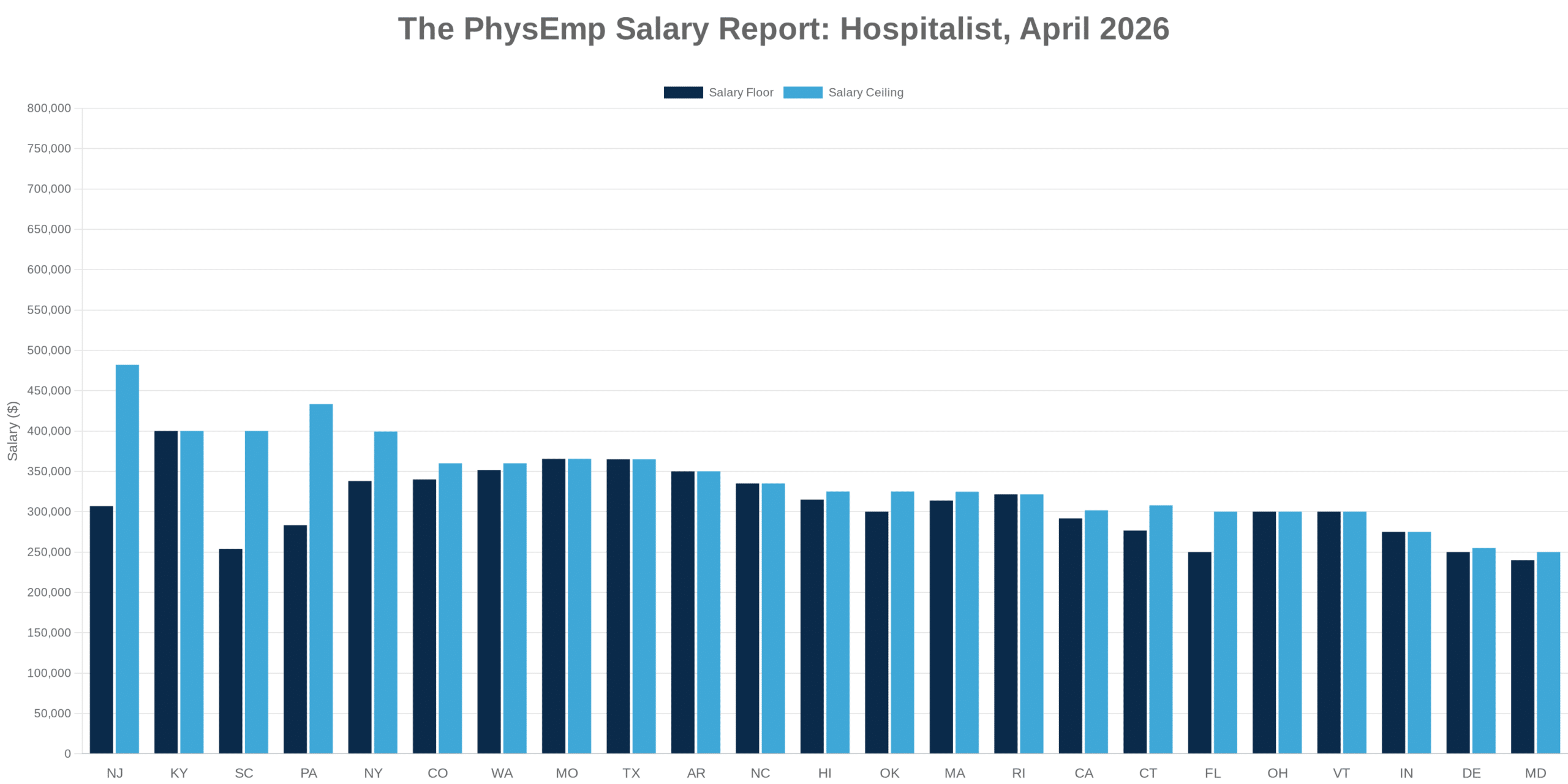
Overperformers: Kentucky leads with a single-data-point average of $400,000 — small sample, large number. Missouri averages $365,500 across four listings, making it one of the most consistently high-paying states in the dataset. Texas averages $365,000, though only one listing disclosed salary. Washington State averages $351,667 to $360,000 across three listings, combining strong pay with West Coast livability. New York averages $338,038 to $399,288 across eight listings, and several individual positions exceed $400,000 (the $600,000 Corning listing does most of the heavy lifting here). Arkansas posts $350,000 on a single listing. Colorado averages $340,000 to $360,000 across two listings, making it one of the stronger Mountain West markets.
Near-average: North Carolina averages $335,000 across two listings, just above the national floor. Rhode Island averages $321,500 across two listings. Hawaii ranges from $315,000 to $325,000. Massachusetts averages $313,750 to $324,750 across four listings — a high volume of jobs, but not a high premium on pay. Oklahoma ranges from $300,000 to $325,000. Ohio averages $300,000. Vermont averages $300,000.
Underperformers: California averages $291,667 to $301,667 across three listings — below the national average despite 19 total postings, confirming that volume does not equal value. Connecticut averages $276,667 to $307,833. Indiana averages $275,000. South Carolina posted one listing with a wide range of $254,000 to $400,000, making it difficult to assess but likely below average at the midpoint. Delaware averages $250,000 to $255,000. Florida averages $250,000 to $300,000 despite 20 total listings, a volume-to-pay mismatch that should concern both candidates and recruiters. Maryland averages $240,000 to $250,000, the lowest state average in the dataset.
Volume leaders: Tennessee and North Carolina tied at 26 listings each. Massachusetts posted 24. South Carolina posted 22. Florida posted 20. California, Texas, and Alabama each posted 19. Tennessee and Alabama, despite high volume, disclosed zero salary data — a transparency gap that may cost them competitive candidates.
👉 Compare Hospitalist compensation and opportunities by region
What This Means If You’re a Physician
If your priority is maximum compensation: the Corning, New York listing at $600,000 annually is the national high. Missouri, Kentucky, Texas, and Washington consistently clear $350,000 and should be on your shortlist. New York offers both the highest ceiling and the lowest floor, so read the fine print.
If your priority is maximum optionality: Tennessee, North Carolina, and Massachusetts lead in job volume, but salary transparency is inconsistent. Florida offers 20 listings but averages below $300,000 — a red flag if compensation matters. Texas, California, and Alabama each posted 19 listings, though only Texas pairs volume with strong pay.
If your priority is balance: Colorado, Washington, and North Carolina combine livable metros, reasonable cost-of-living, and above-average pay. Rhode Island and Massachusetts offer Northeast proximity without the extremes of New York. Avoid Maryland, Delaware, and Florida unless non-salary factors (lifestyle, proximity, part-time scheduling) justify the discount.
One cost-of-living mismatch to flag: California’s $291,667 to $301,667 average is below the national mean, despite some of the highest housing costs in the country. Brooklyn’s $210,000 listing is similarly misaligned with metro New York expenses.
👉 Search Hospitalist jobs by location and compensation
What This Means If You’re a Recruiter
Salary transparency rate: 10.9 percent (50 listings with data divided by 458 total listings). This is among the lowest transparency rates in physician specialties, and it has consequences. Hospitalists are fungible, mobile, and increasingly savvy about compensation benchmarks. If you are recruiting in a state with zero disclosed salary data — Tennessee, Alabama, Virginia, Georgia, and 18 others — you are asking candidates to apply blind, and many will not.
Candidate pipeline implications: high-volume states with low or missing pay data (Florida, California, Tennessee, Alabama) will struggle to convert interest into applications without leading with compensation or lifestyle differentiators. Missouri, Kentucky, and Washington have the dual advantage of strong pay and moderate transparency, making them easier sells.
Volume-pay misalignments: Florida posted 20 listings but averages $250,000 to $300,000. California posted 19 listings but averages below $292,000. Tennessee posted 26 listings with zero salary data. If you are recruiting in these states, you will need to lead with schedule flexibility, partnership track, loan repayment, or geographic appeal — because the salary story is not competitive.
👉 Post Hospitalist positions on PhysEmp
What’s Driving the Numbers
Scope and leadership do not command a meaningful premium in this dataset. Hospitalist roles are structurally similar across employers, and the variation in pay is driven more by geography and institutional desperation than by scope expansion or administrative responsibility. The $600,000 Corning listing is an outlier, but it likely reflects recruitment difficulty in a small market, not an expanded clinical role.
Part-time roles distort the floor. The $210,000 Brooklyn listing and several others in the $240,000 to $275,000 range may reflect part-time, nocturnist, or per-diem arrangements annualized into full-time equivalents. Without clarity on FTE status or shift structure, direct comparisons are unreliable. This muddies the lower bound and makes the “average” range less useful than the interquartile cluster.
Underserved markets price in scarcity — selectively. Missouri, Kentucky, Arkansas, and upstate New York all clear $350,000, and none are major metros. These are not lifestyle destinations, and the salary reflects it. But not all rural or underserved markets pay premiums: Delaware, Maryland, and Indiana all underperform despite lacking major urban centers in the dataset. Scarcity alone does not drive pay unless the employer is willing to compete.
The volume-pay relationship is broken. High-volume states like Tennessee, Florida, and California do not pay above average. Low-volume states like Kentucky, Arkansas, and Delaware span the full range from $250,000 to $400,000. This suggests that Hospitalist hiring is driven more by health system footprint and turnover than by competitive labor market dynamics. Employers in high-volume states may be relying on brand, location, or inertia rather than compensation to fill roles.
The Bottom Line
The Hospitalist job market is wide open, geographically diffuse, and poorly transparent. Physicians willing to prioritize pay over prestige will find the best opportunities in the Midwest and Mountain West, where compensation is high and competition for talent is real. Those chasing volume or coastal proximity will find plenty of listings, but not necessarily plenty of money. The gap between the best-paying and worst-paying jobs is $390,000, and the only way to know which side you are on is to ask.
There is a lot of work available for physicians who admit, round, and discharge. The money, however, is not evenly distributed.
👉 Browse all Hospitalist physician jobs
👉 Upload your CV to get matched with opportunities
👉 Set alerts for new Hospitalist roles
Salary data based on 50 listings with disclosed compensation. Figures may reflect part-time or specialized roles. This report is informational and should not replace professional judgment or financial planning.