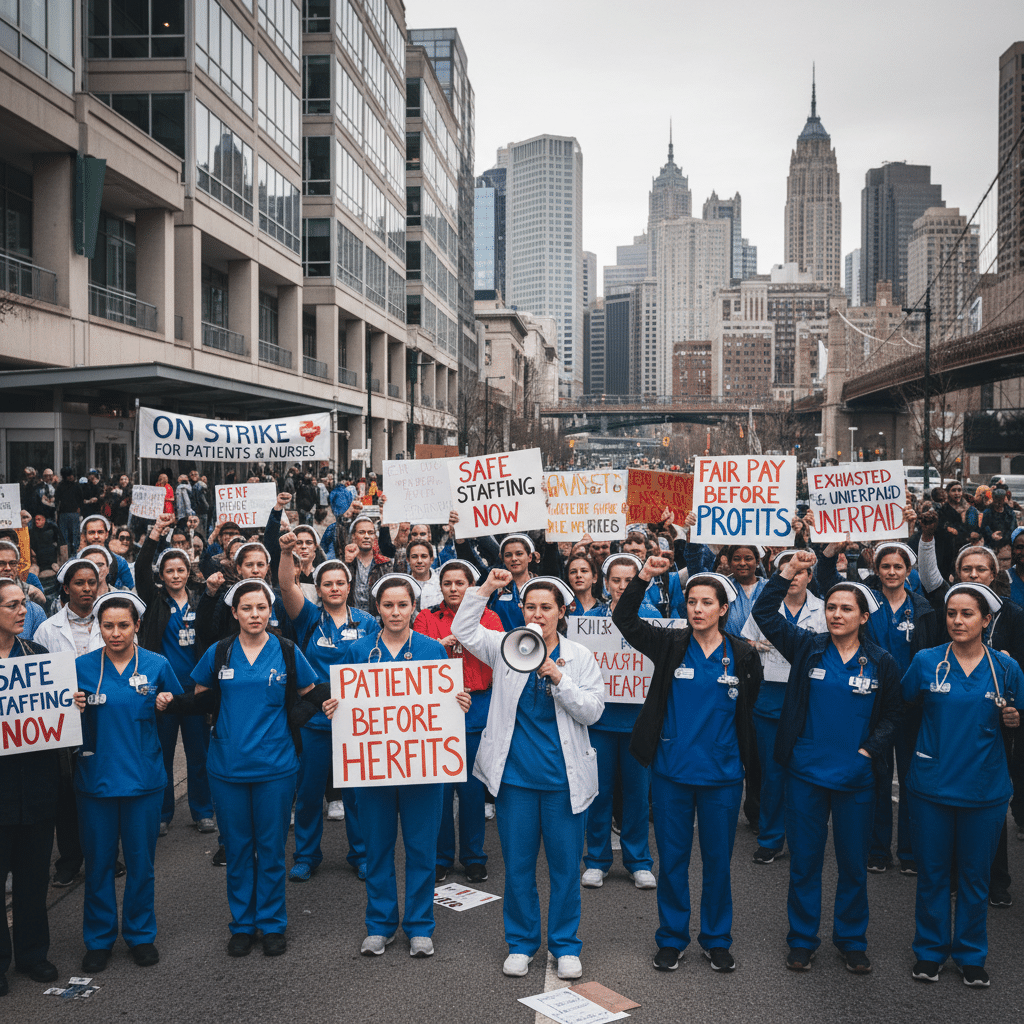
Why This Strike Matters Now
The largest nursing strike in New York City history is more than a labor dispute—it’s a visible rupture in a healthcare workforce system that has been fracturing since the pandemic began. When over 17,000 nurses represented by the New York State Nurses Association walked off the job at multiple major medical centers, they brought into sharp focus issues that have been simmering across the healthcare industry: unsafe staffing ratios, burnout, recruitment challenges, and the fundamental question of how hospitals can maintain quality care while managing financial constraints.
For healthcare recruiters, hospital administrators, and nursing professionals alike, this strike serves as a critical inflection point. It signals that traditional approaches to nurse retention and recruitment are no longer sufficient. The demands being made—enforceable nurse-to-patient ratios, competitive compensation, and improved working conditions—aren’t unique to New York City. They reflect systemic pressures affecting healthcare facilities nationwide, from rural community hospitals to major urban medical centers.
The Staffing Ratio Debate: Safety vs. Sustainability
At the heart of the strike lies a fundamental disagreement about staffing ratios. Striking nurses report being responsible for up to 15 patients at a time, a workload they characterize as dangerous for both caregivers and patients. The union’s demand for binding, enforceable nurse-to-patient ratios represents a shift from aspirational staffing goals to mandatory requirements—a change that would fundamentally alter how hospitals allocate resources and plan operations.
Hospital administrators have countered with concerns about financial viability and the practical challenges of meeting fixed ratios in a constrained labor market. This tension reveals a deeper structural problem: the current healthcare economic model may be incompatible with the staffing levels that nurses argue are necessary for safe care. The difficulty isn’t simply that hospitals are unwilling to hire more nurses—it’s that qualified nurses are increasingly difficult to recruit and retain, even when positions are available.
This dynamic has significant implications for healthcare recruitment strategies. Simply posting more open positions or offering modest salary increases is unlikely to resolve the underlying shortage. The strike suggests that nurses are prioritizing working conditions and patient safety concerns over incremental compensation improvements, a shift that requires recruiters and employers to rethink their value propositions entirely.
The NYC nursing strike exposes a fundamental mismatch between hospital economic models and the staffing levels nurses deem necessary for safe care—a tension that recruitment strategies alone cannot resolve without systemic operational changes.
Post-Pandemic Burnout: A Recruitment Barrier That Won’t Fade
Union leaders explicitly connect the strike to broader frustrations about nurse burnout and understaffing that have intensified since the pandemic. This framing is important because it positions current workforce challenges not as temporary disruptions but as persistent structural problems that have been exacerbated—not created—by COVID-19.
The pandemic served as an accelerant for existing workforce issues. Nurses who might have tolerated challenging conditions in 2019 are no longer willing to do so after years of crisis-level staffing, inadequate protective equipment, and watching colleagues leave the profession. This collective trauma has fundamentally altered the nursing workforce’s expectations and willingness to accept suboptimal working conditions.
For recruitment professionals, this means that attracting new nurses and retaining existing staff requires addressing the root causes of burnout rather than treating symptoms. Signing bonuses and travel nurse contracts—the contingency measures hospitals activated during the strike—are expensive band-aids that don’t resolve the underlying dissatisfaction driving nurses to strike or leave the profession entirely. Healthcare employers must recognize that the post-pandemic nursing workforce has fundamentally different expectations about what constitutes acceptable working conditions.
The Travel Nurse Paradox: Short-Term Solutions, Long-Term Problems
When the strike began, hospitals immediately activated contingency plans that included bringing in travel nurses to maintain operations. This response highlights both the flexibility and the fundamental dysfunction of the current healthcare staffing model. Travel nurses provide essential surge capacity, but their widespread use as a permanent staffing solution creates a paradoxical situation: hospitals pay premium rates for temporary workers while struggling to retain permanent staff at lower compensation levels.
This dynamic creates a perverse incentive structure. Experienced nurses observe that they can earn significantly more as travel nurses than as permanent employees, encouraging workforce mobility over institutional loyalty. Meanwhile, hospitals face escalating labor costs without building the stable, experienced nursing teams that improve patient outcomes and institutional knowledge.
The strike forces a reckoning with this unsustainable model. If hospitals can afford to pay travel nurses premium rates during a strike, the argument that binding staffing ratios are financially impossible becomes harder to sustain. This contradiction isn’t lost on striking nurses or on the broader nursing workforce watching the situation unfold. For healthcare recruiters and talent acquisition professionals, it suggests that competitive permanent positions with strong working conditions may actually be more cost-effective than continued reliance on expensive temporary staffing solutions.
Hospitals’ reliance on premium-priced travel nurses during the strike undercuts arguments about the financial impossibility of improving permanent staff ratios and compensation—a contradiction that savvy nursing candidates increasingly recognize.
Implications for Healthcare Workforce Strategy
The NYC nursing strike isn’t an isolated incident—it’s a warning signal about the future of healthcare workforce management. Several key implications emerge for hospitals, recruiters, and the broader industry:
First, recruitment and retention strategies must evolve beyond compensation alone. While competitive pay remains important, the strike demonstrates that nurses prioritize working conditions, patient safety, and manageable workloads. Healthcare employers that address these concerns proactively will have significant advantages in attracting and retaining talent. Platforms like PhysEmp can help connect healthcare professionals with employers who genuinely prioritize these values, but the underlying workplace conditions must support the promises made during recruitment.
Second, the demand for binding staffing ratios—rather than voluntary guidelines—suggests that nurses no longer trust hospitals to self-regulate on staffing issues. This erosion of trust has profound implications for employer branding and recruitment messaging. Healthcare organizations will need to demonstrate commitment to safe staffing through verifiable policies and transparent metrics, not just aspirational statements.
Third, the strike highlights the interconnected nature of healthcare workforce challenges. Understaffing creates burnout, which drives turnover, which exacerbates understaffing—a vicious cycle that becomes increasingly difficult to break. Breaking this cycle requires comprehensive approaches that address multiple factors simultaneously: competitive compensation, manageable workloads, professional development opportunities, and organizational cultures that value nurse input.
Finally, the visibility and scale of this strike may embolden nursing professionals in other markets to take similar collective action. Healthcare employers across the country should view this as an opportunity to proactively address workforce concerns before they escalate to work stoppages. The cost of preventing strikes through improved working conditions is almost certainly lower than the operational and reputational costs of managing them.
The NYC nursing strike represents more than a local labor dispute—it’s a stress test for the entire healthcare workforce system. The lessons emerging from this conflict will shape recruitment strategies, retention programs, and hospital operations for years to come. Healthcare organizations that recognize these warning signals and adapt accordingly will be better positioned to build stable, satisfied nursing teams. Those that view the strike as an isolated incident risk facing similar challenges as workforce expectations continue to evolve in the post-pandemic healthcare landscape.
Sources
Nurses Strike Enters Second Day at Major New York City Hospitals – MedPage Today
New York City Nurses Have Launched Their Biggest-Ever Strike – Jacobin
Hospital and nurses fail to negotiate during second day of NYC’s largest nursing strike in decades – Big Country Homepage
New York City nurses’ strike: Here’s what to know – Newsday