Why This Matters Now
The healthcare industry is moving past experimental pilots into broad operational deployment of artificial intelligence. The transition from algorithm validation to bedside integration is no longer theoretical. It is happening most visibly in surgical care and diagnostic imaging — environments where error margins are narrow, complications are costly, and workflow inefficiencies carry both clinical and financial consequences.
Postoperative complications affect millions of patients annually, contributing to readmissions, extended hospital stays, malpractice exposure, and billions in excess spending. At the same time, suboptimal imaging studies continue to trigger repeat scans, radiation exposure, diagnostic delays, and throughput bottlenecks. AI tools designed to predict complications, monitor recovery risk, and enhance degraded imaging studies promise measurable efficiency gains — but their integration introduces governance, liability, and supervision questions that directly affect physicians.
These developments sit squarely within our core pillar, AI in Physician Employment & Clinical Practice, because they reshape clinical workflows, alter documentation standards, and influence how hospitals hire, credential, and supervise clinicians in AI-enabled environments.
Predicting Complications Before They Occur
Orthopedic surgery presents a particularly fertile ground for AI-driven prediction models. The specialty’s high volume, standardized procedures, and well-documented complication patterns provide the data density machine learning algorithms require. Recent comprehensive reviews reveal that AI models have demonstrated impressive accuracy in forecasting surgical site infections, venous thromboembolism, readmissions, and mortality following orthopedic procedures, frequently surpassing traditional risk assessment tools that rely on limited clinical variables.
The performance advantage stems from AI’s ability to identify complex, non-linear relationships within massive datasets encompassing patient demographics, comorbidities, laboratory values, and procedural details. Where conventional risk calculators might consider a dozen variables, machine learning models can simultaneously weigh hundreds of factors, detecting subtle patterns invisible to human analysis. This computational power enables more nuanced risk stratification, potentially allowing surgical teams to implement targeted preventive interventions for high-risk patients while avoiding unnecessary precautions for those at lower risk.
The gap between algorithmic accuracy and clinical utility remains substantial. Predictive models that perform brilliantly on historical data often struggle when deployed in different healthcare systems, highlighting the critical need for external validation across diverse patient populations and practice settings.
Yet significant obstacles temper this promise. Limited external validation represents perhaps the most pressing concern—algorithms trained on data from one institution or patient population may not generalize to others, a phenomenon known as dataset shift. Outcome definitions vary across studies, making comparisons difficult and potentially masking important performance differences. Perhaps most troubling is the persistent opacity of many algorithms, which function as “black boxes” that provide predictions without explanations, challenging clinicians’ ability to understand, trust, and act upon AI recommendations.
Real-Time Surveillance During Recovery
While predictive models attempt to forecast complications before surgery, emerging platforms like MDGeniusAI’s system focus on detecting problems as they develop during the critical post-operative period. This real-time surveillance approach analyzes continuous streams of patient data—vital signs, laboratory results, nursing assessments, and other clinical inputs—searching for subtle patterns that may indicate evolving complications before they become clinically obvious.
The temporal advantage is potentially game-changing. Detecting sepsis, bleeding, or other life-threatening complications even a few hours earlier can dramatically alter patient trajectories, enabling interventions when treatments are most effective and before irreversible organ damage occurs. Early pilot data suggesting a 30% reduction in severe complications, if validated in rigorous studies, would represent a substantial improvement in surgical safety with corresponding reductions in mortality, morbidity, and costs.
This approach also illustrates an important philosophical stance in AI deployment: augmentation rather than replacement of clinical judgment. The platform is explicitly designed to provide clinicians with additional information streams rather than automated decision-making. This human-in-the-loop model may prove more acceptable to healthcare providers and more appropriate given the high-stakes nature of post-surgical care, where context, clinical experience, and patient-specific factors remain essential.
However, questions persist about implementation challenges. Real-time monitoring systems must integrate with existing electronic health records and clinical workflows without creating alert fatigue—the phenomenon where excessive notifications lead clinicians to ignore warnings. The path to FDA clearance will require demonstrating not just algorithmic accuracy but clinical utility: proof that the system actually improves patient outcomes in prospective studies, not just retrospective analyses.
Salvaging Diagnostic Value from Imperfect Images
The third frontier addresses a different but equally important problem: what to do when imaging studies fail to meet diagnostic quality standards. Motion artifacts from uncooperative or critically ill patients, technical issues, or suboptimal protocols can render CT scans non-diagnostic, traditionally necessitating repeat studies with attendant radiation exposure, delays, and costs.
AI image enhancement algorithms approach this challenge by using deep learning to reconstruct clearer images from degraded data. Trained on millions of high-quality scans, these systems learn to recognize and correct common artifacts, effectively predicting what a clean image would look like based on the flawed data available. Early research suggests that radiologists can make accurate diagnoses from AI-enhanced images in cases where original scans were deemed unusable.
Image enhancement AI introduces a fundamental tension: the technology could reduce radiation exposure and eliminate delays, but generating diagnostic information not present in original data raises critical questions about reliability and the potential for AI to introduce artifacts or obscure subtle findings.
The implications extend beyond convenience. Reducing repeat scans directly decreases patient radiation exposure, a particularly important consideration for pediatric patients and those requiring multiple studies. For emergency departments and intensive care units, avoiding delays while patients are transported back to radiology can accelerate treatment decisions. The economic benefits—eliminating redundant scans and associated staffing costs—add further appeal.
Yet this application arguably raises the most profound validation questions of the three AI advances discussed. When algorithms generate or enhance image information, how can clinicians be certain the results reflect true anatomy rather than algorithmic hallucinations? What safeguards ensure that subtle but critical findings aren’t obscured or artifacts aren’t introduced? The researchers appropriately emphasize the need for extensive validation before widespread adoption, recognizing that the stakes of misdiagnosis may outweigh the benefits of salvaged studies.
Implications for Healthcare Organizations and Workforce Planning
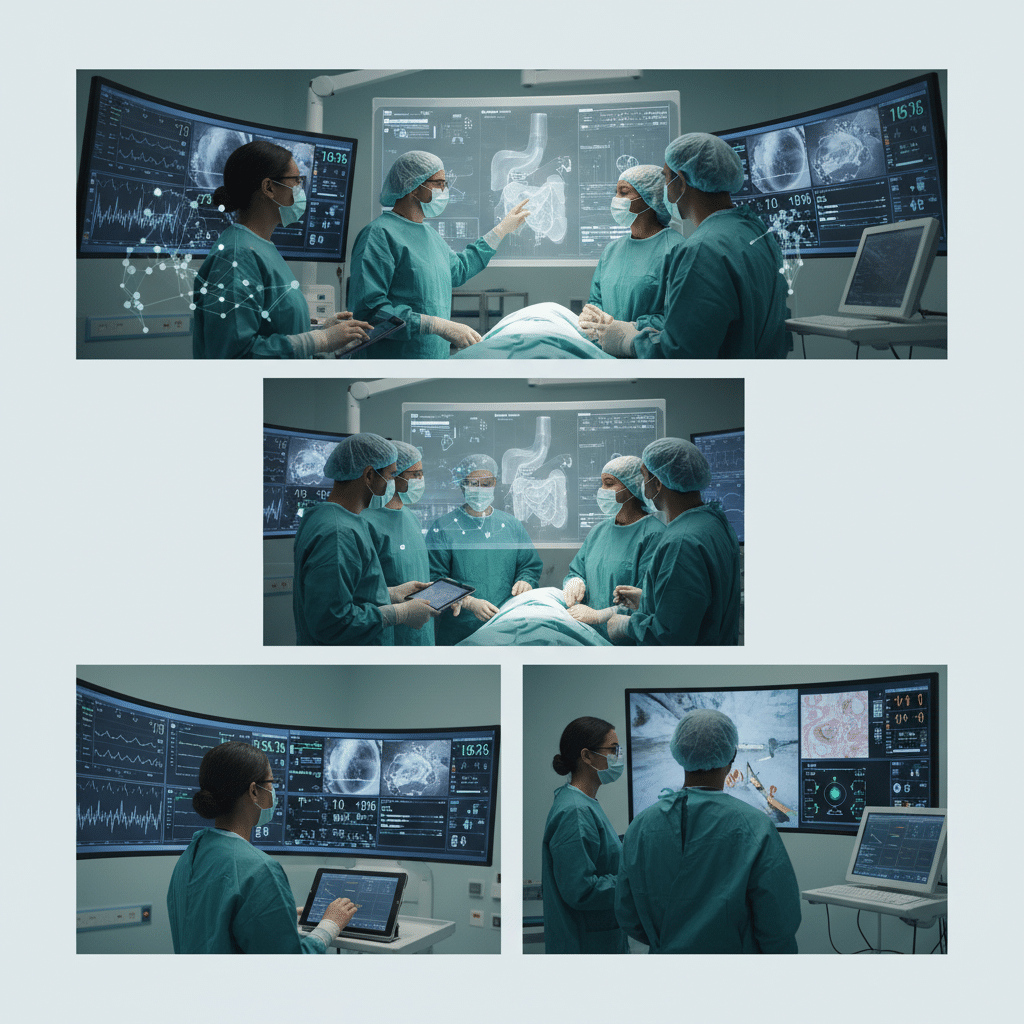
These converging AI capabilities carry significant implications for healthcare organizations and the professionals who work within them. Institutions will need to develop frameworks for evaluating, implementing, and monitoring AI tools across the surgical and imaging care continuum. This requires not just technical infrastructure but also governance structures to assess algorithmic performance, ensure equity across patient populations, and maintain human oversight.
The workforce implications are equally substantial. Surgeons, anesthesiologists, nurses, and radiologists will increasingly work alongside AI systems that augment their capabilities. This shift demands new competencies: understanding algorithmic limitations, interpreting AI outputs within clinical context, and maintaining critical judgment when AI recommendations conflict with clinical intuition. Healthcare organizations must invest in training that prepares clinicians to be effective partners with AI rather than passive consumers of algorithmic outputs.
National recruitment activity in anesthesiology continues to support competitive compensation. View available roles on the Anesthesiology Physician Jobs page.
For healthcare recruiting and workforce planning, these developments signal growing demand for hybrid roles bridging clinical expertise and data science. Professionals who understand both patient care and AI capabilities will become increasingly valuable as organizations navigate implementation challenges. Platforms like PhysEmp that connect healthcare organizations with AI-savvy clinical talent will play an important role in building teams capable of successfully deploying these technologies.
The path forward requires balancing enthusiasm with rigor. AI’s potential to improve surgical outcomes and imaging quality is genuine, but realizing that potential demands careful validation, thoughtful implementation, and ongoing monitoring. Healthcare organizations that approach these tools with appropriate skepticism and systematic evaluation will be best positioned to harness their benefits while minimizing risks. The goal is not AI adoption for its own sake but measurable improvements in patient outcomes—the ultimate metric by which these innovations must be judged.
Sources
Artificial Intelligence for Predicting Postoperative Complications in Orthopedics – Cureus
Miami Startup MDGeniusAI Develops AI Platform to Detect Surgical Complications Early – Fox59
Can AI salvage suboptimal CT studies? – AuntMinnie