
Why Market Maturation Matters Now
The artificial intelligence revolution in medical imaging has entered a defining phase. What began as experimental proof-of-concept deployments has evolved into an $8.5+ billion market projection by 2030, accompanied by substantial institutional investment and an intensifying focus on demonstrable clinical value. This transition from innovation theater to operational reality represents a fundamental shift in how healthcare organizations evaluate, deploy, and sustain AI-powered diagnostic tools.
Three recent developments illuminate this maturation: market analysts forecasting aggressive growth trajectories, health systems directly investing in AI imaging companies, and European radiologists scrutinizing the actual value delivered by AI software updates. Together, these signals suggest the industry has moved past the question of whether AI belongs in radiology workflows and into the more complex territory of how to maximize return on investment, ensure continuous improvement, and integrate these tools into sustainable operational models.
For healthcare organizations navigating workforce shortages and capacity constraints, this maturation couldn’t be more timely. The same AI tools once positioned as futuristic supplements are increasingly viewed as essential infrastructure for maintaining diagnostic quality and patient throughput in resource-constrained environments.
From Market Projections to Institutional Commitment
The projected growth of AI in medical imaging to over $8.5 billion by 2030 reflects more than analyst optimism—it signals structural changes in how diagnostic imaging operates. Key growth drivers include the persistent shortage of radiologists, rising demand for early disease detection, and demonstrable advances in deep learning algorithms capable of analyzing CT, MRI, X-ray, and ultrasound studies across therapeutic areas like oncology and neurology.
What distinguishes the current market environment from earlier hype cycles is the nature of capital flowing into the sector. Vista AI’s recent $29.5 million Series B funding round exemplifies this shift. Rather than venture capital alone, the round attracted direct investment from health systems—the very organizations that will deploy and depend on these technologies. This alignment of investor and end-user interests creates fundamentally different incentive structures than pure venture backing.
When health systems invest directly in AI imaging companies, they signal a strategic commitment that extends beyond vendor relationships. This convergence of capital and clinical operations accelerates real-world validation while aligning product development with actual workflow needs rather than theoretical use cases.
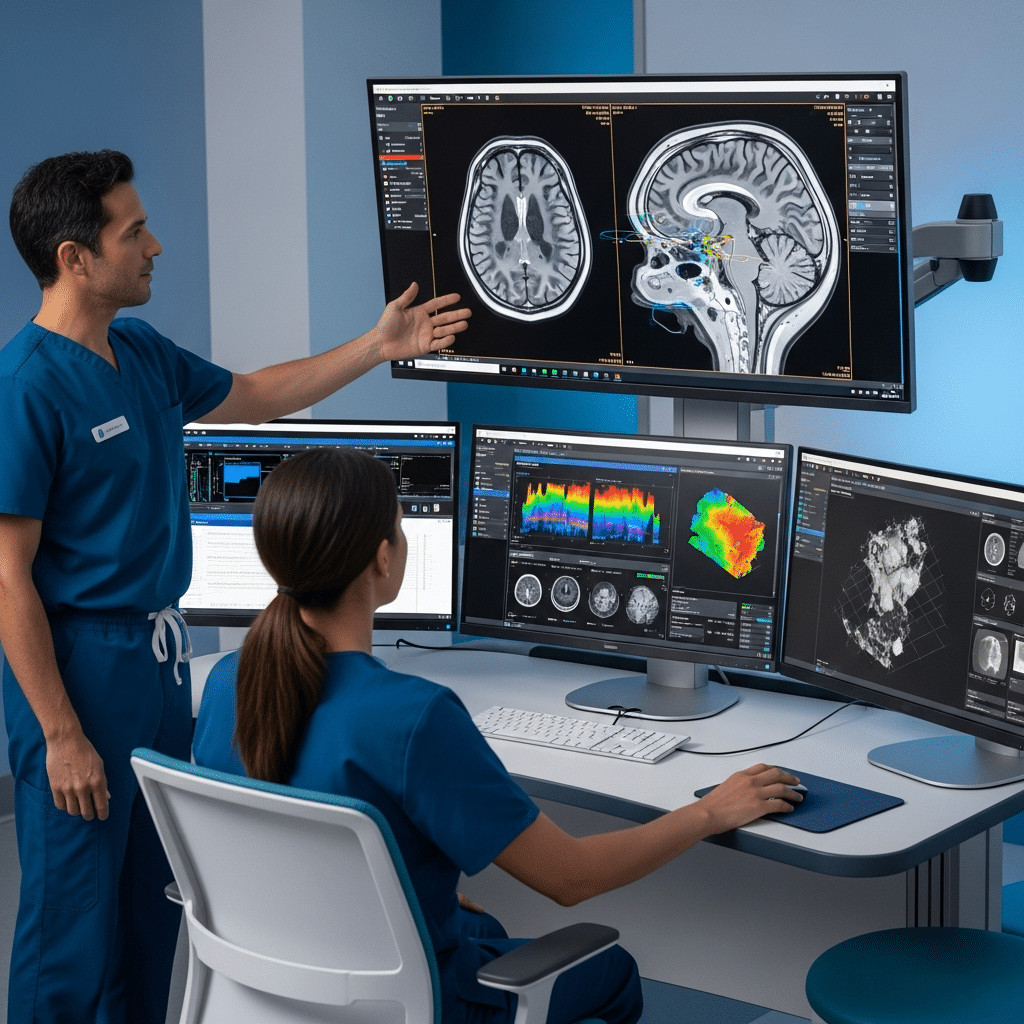
Health system investors cited specific operational imperatives: addressing radiologist shortages and improving patient throughput. Vista AI’s platform, which automates MRI protocol selection and image acquisition while reducing scan times, directly addresses capacity constraints that limit access to advanced imaging. The company’s focus on automation at the acquisition stage—rather than solely interpretation—represents an important evolution in where AI creates value within the imaging workflow.
This institutional backing suggests confidence that AI can deliver measurable operational improvements, not just diagnostic accuracy gains. The willingness of health systems to deploy capital reflects calculated assessments of return on investment based on efficiency gains, throughput improvements, and workforce optimization.
The Value Question: Beyond Initial Deployment
As AI imaging tools move from pilot projects to production environments, a new challenge emerges: how to evaluate and justify ongoing investment in software updates and iterative improvements. European radiologists’ increasing scrutiny of AI update value propositions reveals the industry’s transition from adoption enthusiasm to operational pragmatism.
The central tension is straightforward: AI vendors continuously refine algorithms and release updated versions, but do these iterations deliver clinical improvements sufficient to justify validation costs, workflow disruption, and upgrade expenses? This question becomes particularly acute in breast cancer screening programs, where AI tools have achieved meaningful penetration and organizations now face decisions about maintaining, upgrading, or replacing existing systems.
Several factors complicate these evaluations. Validation requirements for updated AI tools can be substantial, requiring new clinical studies or performance assessments before deployment. Workflow integration challenges mean that even technically superior algorithms may not translate to better outcomes if they disrupt established processes. Cost-effectiveness analyses must account not just for licensing fees but for the total cost of ownership, including validation, training, and potential productivity losses during transitions.
The demand for transparent performance metrics and real-world evidence in evaluating AI updates reflects healthcare’s broader shift toward value-based assessment. Radiologists increasingly expect vendors to demonstrate measurable improvements in sensitivity, specificity, or efficiency—not just claim algorithmic advancement.
This scrutiny benefits the entire ecosystem. It pressures vendors to focus development efforts on clinically meaningful improvements rather than incremental technical refinements. It encourages transparent reporting of performance metrics that enable comparative evaluation. And it establishes precedents for how healthcare organizations should assess AI tools throughout their lifecycle, not just at initial purchase.
Implications for Healthcare Workforce and Operations
The maturation of AI medical imaging carries significant implications for healthcare workforce planning and operational strategy. As these tools transition from experimental to essential, organizations must reconsider how they structure radiology departments, recruit talent, and allocate resources.
The radiologist shortage—a key market driver—won’t be solved by AI alone, but AI does change the equation. Automated MRI scanning that reduces acquisition time and improves consistency allows existing radiologists to focus cognitive effort on interpretation and complex cases. AI-assisted image analysis in oncology and neurology enables radiologists to process higher volumes while maintaining or improving diagnostic accuracy. These efficiency gains don’t eliminate the need for radiologists but do alter the optimal ratio of radiologists to imaging volume.
For organizations like PhysEmp focused on healthcare workforce solutions, this creates both challenges and opportunities. The challenge: traditional radiologist recruiting faces new questions about how AI proficiency factors into candidate evaluation and what skills will remain differentiators as AI handles routine interpretations. The opportunity: organizations that successfully integrate AI into imaging workflows can offer radiologists more intellectually engaging work focused on complex cases, potentially improving recruitment and retention.
Beyond radiology, the AI imaging market’s maturation offers lessons for other specialties considering AI adoption. The progression from hype to institutional investment to value scrutiny will likely repeat across clinical domains. Organizations that develop frameworks for evaluating AI tools across their lifecycle—from initial deployment through successive updates—will navigate these transitions more effectively than those making one-time adoption decisions without considering long-term value trajectories.
The health system investment model pioneered in Vista AI’s funding round may also spread to other AI healthcare applications. When healthcare organizations invest directly in AI companies, they gain influence over product roadmaps, access to preferential pricing or terms, and alignment between vendor success and clinical outcomes. This model could accelerate AI development in areas where pure venture capital has been hesitant due to regulatory complexity or extended sales cycles.
Conclusion: Value-Driven AI Integration
The AI medical imaging market’s evolution from experimental technology to multi-billion dollar industry reflects genuine operational value, not just technological possibility. Market projections, institutional investments, and value-focused scrutiny all point toward a maturing ecosystem where AI tools must demonstrate sustained clinical and operational benefits to justify continued investment.
For healthcare leaders, this maturation demands more sophisticated evaluation frameworks that assess AI tools not as one-time purchases but as evolving platforms requiring ongoing validation and value demonstration. For radiologists and imaging professionals, it suggests careers increasingly defined by AI collaboration, with competitive advantage accruing to those who master both clinical interpretation and AI-augmented workflows. For the broader healthcare industry, it offers a preview of how AI adoption will likely unfold across specialties: initial enthusiasm, substantial investment, operational integration, and eventually, rigorous scrutiny of whether successive improvements justify their costs.
The organizations that thrive in this environment will be those that view AI not as a solution to workforce shortages or capacity constraints, but as an operational capability requiring continuous evaluation, strategic investment, and integration into broader workforce and clinical strategies. As the market grows toward $8.5 billion and beyond, the winners will be defined not by who adopted AI first, but by who extracted the most sustainable value from these powerful tools.
Sources
AI in Medical Imaging Research Report 2026 – Yahoo Finance
Vista AI Secures $29.5M in Series B Funding as Health Systems Back Automated MRI Scanning – The AI Insider
Attention turns to value of AI updates in breast screening – AuntMinnie Europe