Missouri — a state not typically associated with physician compensation leadership — is paying urgent care physicians $374,400 annually. The urgent care physician job market currently features 160 active listings spread across 35 states, with salary data disclosed in just 21 of them. The full national range spans $145,000 to $400,000, a spread so wide it suggests either profound market fragmentation or a few part-time roles dragging down the floor. What the data shows: urgent care is geographically abundant, moderately transparent, and rewards physicians willing to work in places most people cannot locate on a map.
👉 Explore Urgent Care Physician job market insights and trends
The Urgent Care Physician Job Market at a Glance
Total listings: 160. Listings with salary data: 21. Full salary range: $145,000 to $400,000. Average salary range: $281,095 to $305,512.
The $255,000 gap between floor and ceiling is unusually large for a specialty without significant procedural variation. The national average sits comfortably in the $280,000 to $305,000 band, but the presence of a $145,000 listing suggests either part-time work or a compensation structure designed to test the limits of physician tolerance. Most positions cluster between $250,000 and $350,000, a range that reflects the reality of urgent care: high volume, predictable scope, and compensation that rewards availability more than complexity.
States represented: California, Kentucky, Georgia, Ohio, Kansas, Florida, Missouri, Nevada, Texas, Oklahoma, Virginia, Wisconsin, Minnesota, Illinois, Utah, Oregon, New York, North Carolina, Iowa, North Dakota, Hawaii, Arkansas, West Virginia, Delaware, New Mexico, South Carolina, South Dakota, Maryland, Massachusetts, Indiana, Louisiana, Tennessee, Pennsylvania, Michigan, and Idaho.
👉 Browse Urgent Care Physician physician job opportunities
How States Stack Up
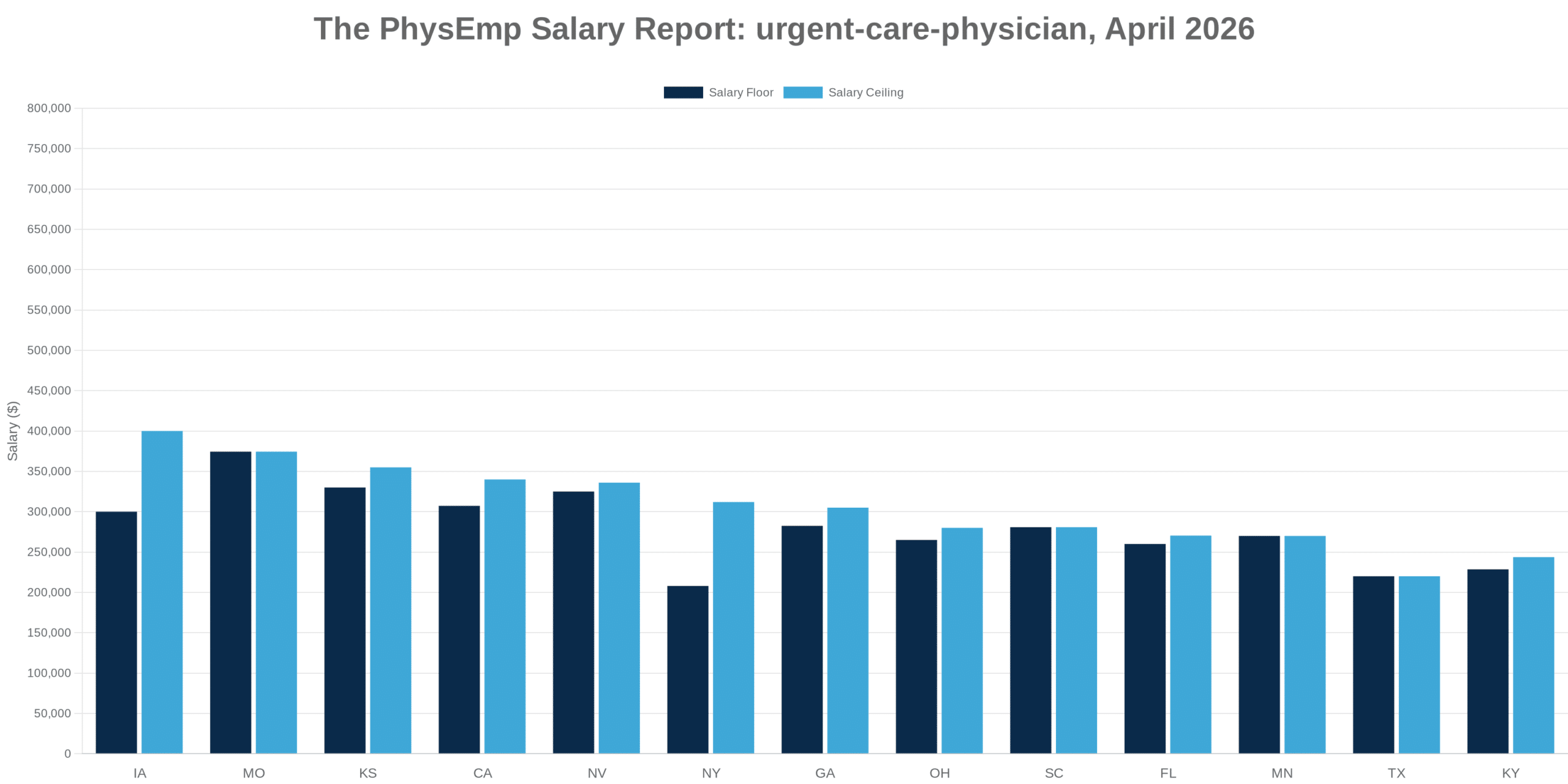
Overperformers: Missouri leads compensation at $374,400 (and leads volume with 24 listings, a rare combination of scale and pay). Iowa offers $300,000 to $400,000, with the $400,000 figure representing the national ceiling. Kansas delivers $330,000 to $355,000, proving the Midwest pays. Nevada posts $325,000 to $336,000, a strong showing for a state with moderate volume. California averages $307,250 to $340,000 across four listings, maintaining its reputation without dominating.
Near-average: Georgia reports $282,500 to $305,000, aligning almost perfectly with the national average despite seven total listings. South Carolina posts $280,800, a stable mid-tier figure. Minnesota comes in at $270,000, just shy of the national low average. Ohio averages $265,000 to $280,000, slightly below the national benchmark but within reasonable proximity. Florida lists $260,000 to $270,400, a respectable if unremarkable figure for a high-volume state.
Underperformers: Kentucky averages $228,600 to $243,720, well below the national norm and difficult to justify outside of cost-of-living arguments. Texas reports $220,000, the lowest state average on record and a surprising figure for a state with three listings. New York posts $208,000 to $312,000, a range so wide it borders on meaningless, with the low end falling far below national expectations.
Volume leaders: Missouri (24 listings), Wisconsin (10), Oregon (10), North Carolina (10), Ohio (8), Georgia (7), and North Dakota (7). Missouri is the only high-volume state with disclosed salary data that also pays above the national average. Wisconsin, Oregon, and North Carolina — all top-five volume markets — disclosed no salary information, limiting their utility for compensation-focused candidates.
👉 Compare Urgent Care Physician compensation and opportunities by region
What This Means If You’re a Physician
If your priority is maximum compensation: Target Iowa, where the highest-paying listing in the dataset sits at $400,000 annually. Missouri also merits attention at $374,400, particularly given its 24-listing volume. Kansas ($330,000 to $355,000) and Nevada ($325,000 to $336,000) round out the top tier. California remains competitive but no longer commands a premium over the Midwest.
If your priority is maximum optionality: Missouri offers 24 listings, the largest pool of opportunities in the country. Wisconsin, Oregon, and North Carolina each provide 10 listings, though none disclosed salary data. Ohio (8 listings) and Georgia (7 listings) combine moderate volume with transparent, near-average pay, making them safer bets for physicians who value both choice and clarity.
If your priority is balance: Georgia ($282,500 to $305,000) and South Carolina ($280,800) offer national-average pay in states with lower costs of living than coastal markets. Ohio ($265,000 to $280,000) provides solid volume and reasonable compensation. The highest-paying listing overall is in Iowa at $400,000, but the cost-of-living advantage in that state makes the effective purchasing power even higher. The Texas figure of $220,000 in San Antonio is difficult to justify unless the cost of living has collapsed or the role is materially different in scope.
👉 Search Urgent Care Physician jobs by location and compensation
What This Means If You’re a Recruiter
Salary transparency rate: 13.1% (21 listings with disclosed compensation divided by 160 total listings). This is among the lowest transparency rates in physician specialties and creates a significant candidate pipeline problem. Physicians evaluating urgent care opportunities are flying blind in 87% of markets, which will push top candidates toward the 13% of listings that do disclose figures — or toward specialties with better data.
Missouri presents a volume-pay alignment that recruiters should study: 24 listings and a $374,400 average. Wisconsin, Oregon, and North Carolina, by contrast, represent volume-pay misalignments — each posts 10 listings but discloses no salary data, forcing recruiters to lead with geography, schedule flexibility, or partnership track instead of compensation. Texas is a cautionary tale: three listings, one salary disclosed, and that figure ($220,000) sits $61,095 below the national average low. Recruiters in Texas will need to explain why.
👉 Post Urgent Care Physician positions on PhysEmp
What’s Driving the Numbers
Midwest markets are pricing in scarcity and winning. Missouri, Iowa, and Kansas are paying at or near the top of the national range, a reversal of the traditional coastal premium. This suggests either genuine physician shortages in rural and exurban urgent care settings or health systems that have learned to compete on compensation. Either way, the Midwest is no longer the discount aisle.
Part-time roles are distorting the floor. The $145,000 low-end figure is difficult to explain unless it reflects part-time work, a limited scope role, or a listing error. Even the $220,000 Texas figure sits far enough below the national average to suggest either reduced hours or a fundamentally different job structure. Candidates should scrutinize any listing below $250,000 for scope, hours, or benefits trade-offs.
High volume does not guarantee high pay — or any pay transparency. Missouri is the exception. Wisconsin, Oregon, and North Carolina are the rule: double-digit listings, zero salary data. This creates inefficiency for both candidates and employers, as high-volume markets that refuse to disclose compensation will lose candidates to lower-volume markets that do.
Leadership and partnership track are not priced into the data. Unlike other specialties where medical directorships or equity stakes command visible premiums, the urgent care market shows no clear compensation signal for leadership roles. This suggests either that such roles are rare, that they are not being advertised with salary premiums, or that the premiums are being rolled into benefits and equity structures not captured in base salary figures.
The Bottom Line
The urgent care physician market is geographically vast, moderately well-compensated, and frustratingly opaque. Physicians willing to work in the Midwest will find the best combination of pay and opportunity, while those committed to coastal markets will find competition, volume, and compensation that no longer justifies the cost of living. The $255,000 spread between the floor and ceiling suggests a specialty still sorting out what it is willing to pay for availability, and what it expects physicians to accept in return.
Urgent care is a volume game, and the physicians who win it are the ones who treat geography as negotiable.
👉 Browse all Urgent Care Physician physician jobs
👉 Upload your CV to get matched with opportunities
👉 Set alerts for new Urgent Care Physician roles
Salary data based on 21 listings with disclosed compensation. Figures may reflect part-time or specialized roles. This report is informational and should not replace professional judgment or financial planning.