Why this theme matters now
Across the United States, hospitals and clinics are contending with sustained shortages of registered nurses that strain capacity, increase burnout, and raise costs—pressures that reflect broader instability across the healthcare workforce and labor market. When a major public university commits a large, targeted investment to expand nursing education capacity, it becomes a test case: can supply-side interventions at the academic level accelerate workforce recovery faster than incremental measures? The University of Alabama’s recent $80 million announcement to double nursing enrollment speaks to an emerging strategy—universities acting as proactive engines of workforce scale-up rather than passive credentialing institutions.
Scaling capacity: physical, pedagogical, and clinical
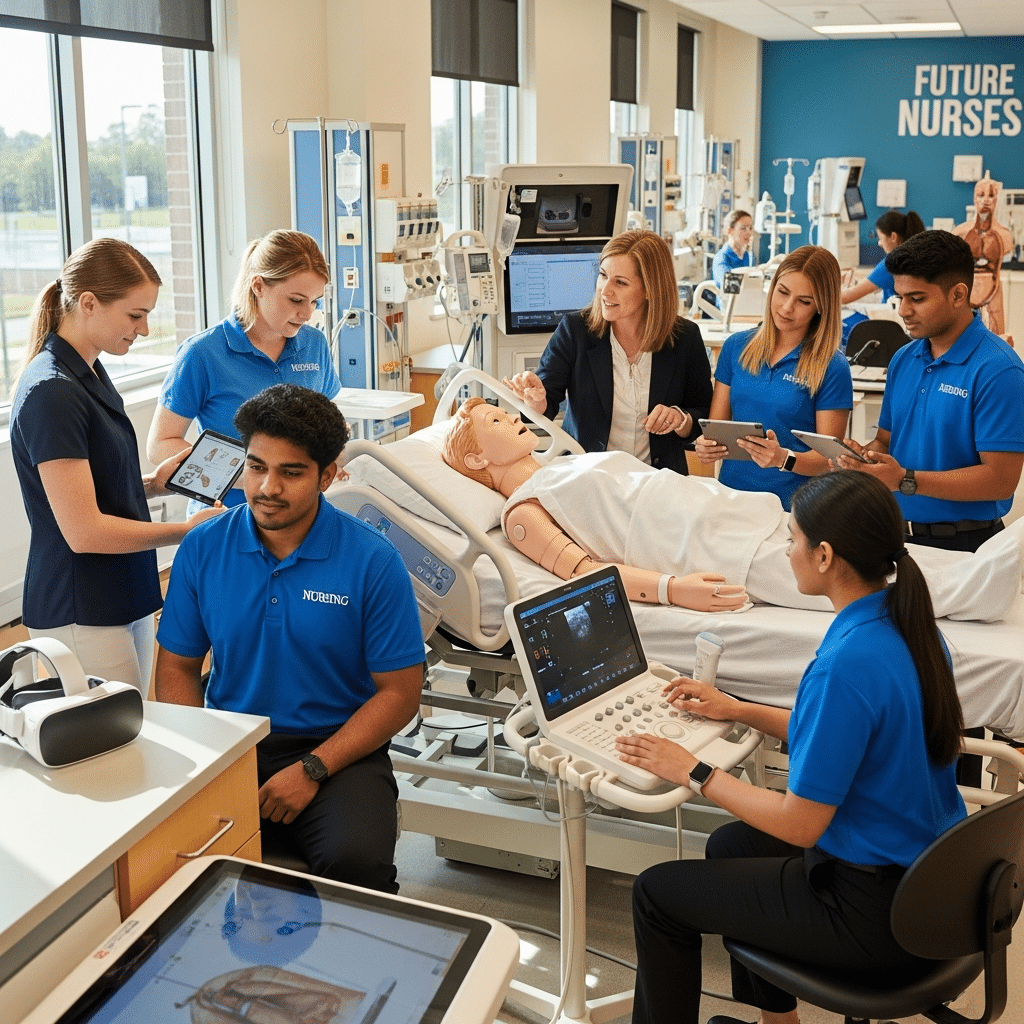
Addressing a shortage requires more than admitting more students. Universities must expand classrooms, faculty headcount, simulation labs, and clinical placement networks. The UA initiative bundles capital investment with program expansion to increase throughput. That means hiring additional nurse educators, investing in high-fidelity simulation to substitute for scarce clinical hours where needed, and strengthening partnerships with regional hospitals and community providers to secure preceptorships and transition-to-practice pathways. These elements are the operational levers that determine whether enrollment increases translate into fully trained, practice-ready nurses.
Workforce alignment: matching graduate supply to employer demand
Scaling graduates does not automatically solve distributional problems. Shortages are often geographic and specialty-specific—rural hospitals, long-term care, and critical care units face distinct gaps. A university-led expansion can be intentionally designed to steer graduates toward high-need settings by embedding community-based clinical rotations, offering targeted scholarships or loan forgiveness for commitment to underserved areas, and coordinating with state health agencies on licensure and incentive structures. Without these alignment mechanisms, an increase in graduates risks clustering in already saturated urban systems.
Retention and transition: beyond initial graduation
The value of producing more nurses hinges on retaining them in the workforce. Academic investment should therefore extend into transition supports: residency programs, mentorship pairings, and continuing education that smooth the shift from student to practitioner. Universities are well-positioned to partner with hospitals to create integrated residency tracks that combine academic credentialing with employment commitments—reducing early-career turnover and preserving the investment value of expanded education slots.
Call Out: A university’s capital commitment can be a force multiplier only when paired with faculty development, clinical partnerships, and post-graduate transition pathways—otherwise increased seats risk becoming an unproductive pipeline leak.
Financing and scalability: lessons for other states
Large-scale university investment models invite questions about financing and replicability. State-supported institutions may leverage a combination of state appropriations, philanthropic contributions, and reallocated institutional resources. For other states contemplating similar moves, the key considerations are sustainability of funding, the long lead time for faculty hiring and facility build-out, and mechanisms to ensure the graduates meet local employer needs. A one-time capital injection can jump-start capacity but needs recurring operational funding to sustain higher enrollment long-term.
Implications for employers and healthcare recruiters
Health systems and staffing leaders should view university expansions as both opportunity and responsibility. On the opportunity side, an influx of new graduates expands candidate pools and creates potential for more diverse hiring pipelines. On the responsibility side, employers must invest in early-career development—structured onboarding, residency programs, and role-specific upskilling—to convert new graduates into retained, productive staff. Recruiters will need to recalibrate forecasting models to incorporate increased graduation volumes while also tracking licensure pass rates and graduate-to-employment timelines.
Call Out: Employers that co-invest in clinical education capacity and robust transition programs will capture the greatest return on regional nursing scale-up—higher retention, reduced agency spend, and faster operational resilience.
What this model could mean nationally
The University of Alabama’s approach signals a strategic pivot: treating higher education as an active lever for workforce policy rather than a passive supplier. If other public universities replicate similar, targeted investments—aligned with state workforce plans—they could collectively shorten the timeline to adequate nurse supply. Key success metrics to monitor will be not only graduate counts, but licensure pass rates, employment in high-need settings, retention at 1- and 3-year marks, and reductions in vacancy rates where graduates are placed.
Conclusion: a coordinated playbook for pipeline recovery
Expanding academic capacity is necessary but not sufficient to resolve nursing shortages. The most promising model combines capital investment with deliberate design: faculty and facility growth, strengthened clinical partnerships, incentives to practice in underserved areas, and employer-led transition supports. For recruiting firms and health systems, the takeaways are clear—partner early with universities, design shared residency frameworks, and align hiring practices to capture the benefit of expanded cohorts.
Sources
University of Alabama begins ambitious plan to shore up nursing shortage – WBRC
Alabama has a nursing shortage. The University of Alabama is spending $80 million to help – AL.com
UA aims to double nursing enrollment to address statewide shortage – University of Alabama News
Capstone College of Nursing expansion – The Tuscaloosa Thread