
Scaling Nursing Pipelines: Capital, Partnerships, Policy
This analysis synthesizes 3 sources published February 2026. Editorial analysis by the PhysEmp Editorial Team.
The central finding: colleges and universities are mounting a coordinated supply-side response to the nursing shortage through targeted capital investments, employer-academic partnerships, and expanded degree authority at community colleges — but unless clinical training capacity and faculty supply expand in lockstep, added seats will not translate into more bedside nurses. This shift is actively reshaping the healthcare workforce and labor market, and will determine whether recent investments produce durable staffing gains or merely increase credential volumes.
Why this theme matters now
Enrollment growth and retooled credential pathways are necessary responses to acute staffing gaps, yet timing and system constraints matter. Hospitals are hiring now; students graduate later. Without simultaneous expansion of clinical preceptors, faculty headcount, and structured transition-to-practice programs, the time-lag between education investment and workforce impact will widen. That temporal mismatch creates risk for hospital staffing plans and career decisions by clinicians considering educator or dual clinical-academic roles.
Institutional strategies in play
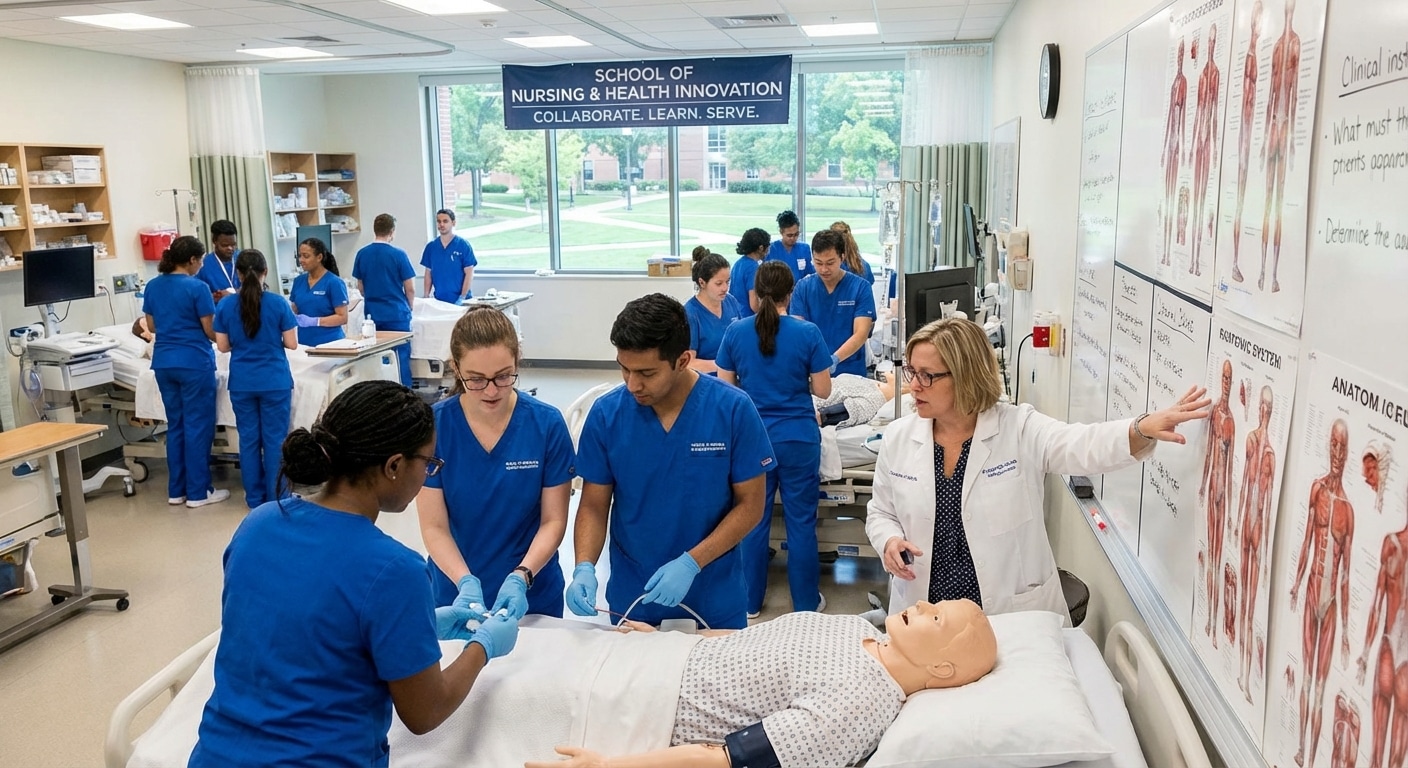
Three discrete but complementary strategies are emerging across higher education: (1) capital upgrades to expand classroom and simulation capacity; (2) formal partnerships with health systems to secure clinical placements and curricular alignment; and (3) policy-enabled expansion of bachelor’s degree authority at community colleges to broaden geographic access. Each approach addresses a different friction point in the pipeline — infrastructure, clinical access, and credential availability — but each also reveals secondary constraints that require separate solutions.
Call Out — Training bottleneck: Increasing physical capacity and classroom hours cannot overcome limits in clinical sites and qualified preceptors; investments must bundle simulation expansion with targeted incentives for clinicians who supervise students.
Comparative analysis: strengths and limits
Capital investments at established nursing schools
Upgrading labs and simulation centers improves throughput and can enhance certain competency exposures. For hospitals, this can produce graduates with stronger controlled-environment skills. However, high-fidelity simulation complements but does not eliminate the need for longitudinal patient-care experience. Administrators should not equate seat counts with immediate clinical readiness.
University–health system partnerships
Partnerships that guarantee clinical rotations, co-develop curricula, and create employment pathways shorten the transition from student to hire. These models align education output with employer demand and can improve retention when employers invest in trainee development. For physicians exploring educator roles, partnership models create adjunct and preceptor opportunities with clearer compensation and time-protection structures than traditional ad hoc teaching arrangements.
Community colleges offering bachelor’s degrees
Expanding four-year degree authority at community colleges decentralizes access and often produces locally rooted graduates who are likelier to remain in-region — a retention advantage for underserved or rural markets. But accrediting and clinical supervision frameworks must adapt to ensure parity of competencies. Recruiters will need competency-based assessment tools to fairly evaluate a broader and more geographically diverse applicant pool.
Call Out — Labor-market effect: Community-college-based bachelor programs can rapidly increase regional nurse supply, but hospitals must redesign onboarding and residency programs to integrate these graduates effectively and reduce early turnover.
Where conventional wisdom falls short
Public discourse often equates increased seat capacity with solved shortages. That view is incomplete. The real systems constraint is multi-dimensional: faculty and preceptor scarcity, limited clinical placement sites, and employer onboarding practices that fail to convert credentialed graduates into retained staff. Absent coordinated action across these elements, headline seat increases will produce limited improvements in bedside staffing and may even exacerbate transition churn as more novices enter systems unprepared for real-world acuity.
Implications for physicians and hospital leaders
For physicians weighing academic or educator roles: the expanding academic ecosystem creates meaningful opportunities to combine clinical practice with teaching, often through formally structured partnerships that offer paid preceptor roles, adjunct appointments, or protected teaching time. Assess potential roles by clarity of expectations, compensation mechanisms (stipend versus salaried), and guarantees for protected time.
For hospital executives and recruiters: anticipate a more heterogeneous incoming workforce. Practical steps include implementing competency-based hiring assessments, investing in nurse residency and transition-to-practice programs (6–12 months), and negotiating outcome-based agreements with academic partners that focus on measurable readiness and time-to-hire rather than seat counts. These steps reduce onboarding costs and improve early retention.
Strategic recommendations
1. Treat clinical training capacity as the binding constraint: co-fund preceptor stipends, release time for clinical instructors, and expand community hospital participation in placements.
2. Structure academic–employer contracts around workforce outcomes (e.g., retention at 6 and 12 months, competency milestones) not just enrollment metrics.
3. Standardize competency-based assessments to compare graduates from varied programs and guide targeted onboarding.
4. Scale residency models that compress independent practice readiness, reducing the risk that increased graduates simply lengthen hiring pipelines.
Conclusion — What to watch
Higher education is mobilizing capital, partnerships, and policy to expand nursing pipelines — a necessary and positive development. The decisive factor will be whether these efforts are integrated with expanded clinical training capacity, faculty recruitment, and employer onboarding redesign. If they are, hospitals will see measurable workforce relief and new clinical-educator roles for physicians. If not, the sector risks impressive enrollment statistics with limited bedside staffing improvements. Recruiters, executives, and clinicians should prioritize outcome-aligned collaborations that bridge education and service delivery.
Sources
Wright State nursing program gets $6M investment to upgrade – Dayton Business Journal
Cornerstone University partners with Mary Free Bed to address nursing shortage – MLive
California bills would allow community colleges to offer bachelor’s degrees – CBS News