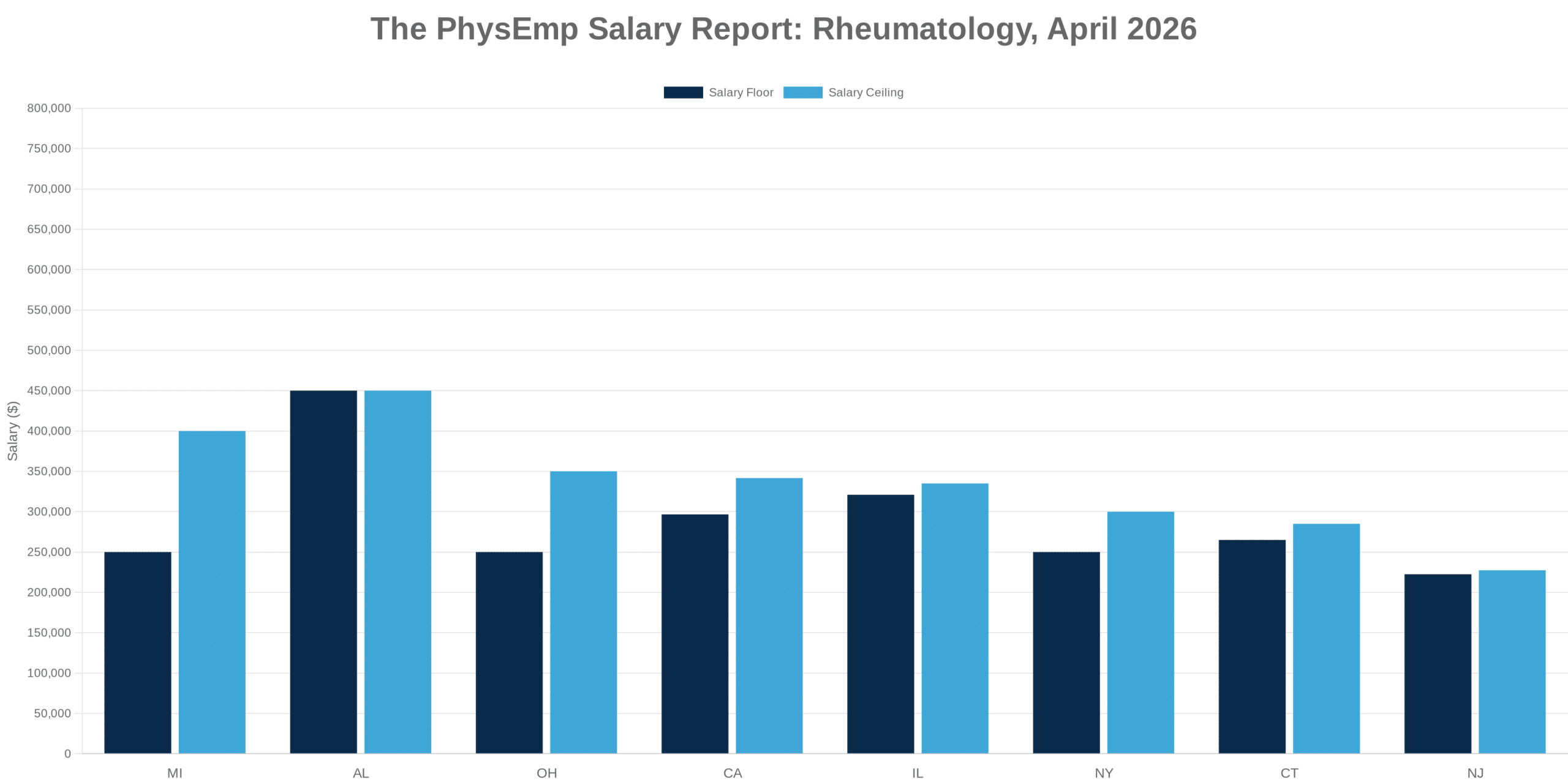
Alabama is paying rheumatologists $450,000 per year. New Jersey is offering $220,000. Both states have access to the same medical journals, the same biologics, and the same Medicare reimbursement schedules. The difference is everything else.
The national Rheumatology job market currently features 108 active listings spread across 31 states, with compensation data available for 18 of them. What emerges is a market defined less by specialty consensus and more by geographic desperation, cost structure, and whoever blinks first during contract negotiations.
👉 Explore Rheumatology job market insights and trends
The Rheumatology Job Market at a Glance
Total listings: 108
Listings with salary data: 18
Full salary range: $220,000 to $450,000
Average salary range: $287,222 to $323,611
That $230,000 spread between the floor and the ceiling is not a rounding error. It reflects a market where some employers are pricing in scarcity, loan forgiveness, and the fact that there are not enough people who can spell “antiphospholipid syndrome” to meet demand. Others are pricing in proximity to major metro areas, established referral networks, and the assumption that someone will take the job anyway.
The average range sits comfortably in the high $200,000s to low $300,000s, but averages flatten volatility. The reality is more bifurcated: you are either in a market that treats Rheumatology as a scarce resource, or you are not.
States represented: New York, Ohio, Illinois, Connecticut, California, New Jersey, Michigan, Pennsylvania, Texas, Florida, Louisiana, West Virginia, Indiana, Oregon, Wisconsin, Tennessee, Georgia, Massachusetts, Arkansas, Idaho, Maryland, North Carolina, Virginia, Arizona, New Mexico, North Dakota, Montana, Maine, South Carolina, New Hampshire, Alabama.
👉 Browse Rheumatology physician job opportunities
How States Stack Up
Overperformers:
Alabama leads the nation with an average salary of $450,000, a figure so clean and round it suggests either confidence or a very good consulting firm. Michigan follows with a $250,000 to $400,000 range, anchored by a Kalamazoo listing that does not apologize for its geography. Illinois averages $321,000 to $335,000 across five listings, a tight band that signals market discipline and competitive intent. California checks in at $296,667 to $341,667 across three listings, which is high but not high enough to fully offset state taxes and housing costs (a recurring theme).
Near-average:
Ohio offers $250,000 to $350,000 based on one listing, a range wide enough to accommodate most negotiations and narrow enough to suggest realism. Connecticut averages $265,000 to $285,000 across two listings, a modest premium over the national average that reflects New England cost structures without the Massachusetts markup.
Underperformers:
New Jersey posts the lowest average compensation at $222,500 to $227,500 across two listings, a figure that falls $65,000 short of the national average low and raises questions about market positioning, employer type, or both. New York, despite being a volume leader with eight listings, averages just $250,000 to $300,000 across three salary-disclosed roles, a number that looks reasonable until you remember what a mortgage costs in Westchester County.
Volume leaders:
New York, Illinois, Indiana, and New Hampshire each posted eight listings. Oregon contributed seven. Connecticut, California, Pennsylvania, and Massachusetts each added six.
Illinois is the rare high-volume state that also pays above average, a combination that suggests both demand and willingness to pay for it. Indiana, Oregon, and New Hampshire lead on volume but provided zero salary data, which means physicians have optionality but no pricing transparency. New York leads on volume and lags on pay, a mismatch that will require recruiters to sell location, prestige, or career trajectory instead of compensation.
👉 Compare Rheumatology compensation and opportunities by region
What This Means If You’re a Physician
If your priority is maximum compensation: Alabama and Michigan are the clear leaders. The highest-paying listing in the dataset is in Kalamazoo, Michigan, offering $250,000 to $400,000 annually. Alabama’s $450,000 figure is based on a single listing, but it sets the ceiling. Both states are betting you will trade coastal proximity for financial acceleration, and the math works if you let it.
If your priority is maximum optionality: Illinois, Indiana, New Hampshire, and New York each offer eight listings, giving you the ability to compare practice models, settings, and cultures within a single state. Illinois pairs volume with above-average pay. The others pair volume with silence on compensation, which means leverage shifts to the negotiation table.
If your priority is balance: Connecticut and Ohio offer near-average pay, reasonable cost of living, and enough listings to suggest stable demand without saturation. California provides strong compensation and six listings, but the cost-of-living mismatch is real—$341,667 in San Francisco does not spend like $341,667 in Ohio. New York’s volume is appealing, but its below-average pay relative to living costs makes it a lifestyle trade, not a financial one.
👉 Search Rheumatology jobs by location and compensation
What This Means If You’re a Recruiter
Salary transparency rate: 16.7 percent (18 listings with data divided by 108 total listings).
That is not a typo. Fewer than one in five Rheumatology listings disclose compensation, which means the candidate pipeline is navigating this market with limited pricing information and maximum skepticism. In a specialty where demand outpaces supply, opacity is a recruiting handicap, not a strategy.
Volume-pay misalignments are evident. New York leads on listings but lags on compensation. Indiana, Oregon, and New Hampshire combine for 23 listings and zero salary data, which means recruiters in those states will need to lead with mission, culture, partnership track, or geography—anything but the number. Illinois is the exception: high volume, high pay, and enough transparency to let the market work. Recruiters there can lead with compensation and win.
For organizations in low-transparency states, the pipeline risk is real. Physicians will assume the worst, discount the opportunity, or skip it entirely. If you are not publishing salary data, you are asking candidates to trust you before you have earned it. In this market, that is a costly ask.
👉 Post Rheumatology positions on PhysEmp
What’s Driving the Numbers
Scarcity pricing is alive and well in underserved markets
Alabama and Michigan are not paying $400,000-plus because the work is harder or the patients are sicker. They are paying it because there are not enough rheumatologists to go around, and someone has to staff the infusion center. Scarcity drives price, and in states where Rheumatology coverage is thin, employers are pricing in the cost of going without. This is not generosity—it is market correction in real time.
Volume and pay do not correlate the way they should
Illinois is the exception that proves the rule. Everywhere else, high listing volume does not predict high pay. New York has eight listings and below-average compensation. Indiana, Oregon, and New Hampshire have 23 combined listings and no salary data at all. Volume signals demand, but it does not signal willingness to pay unless transparency and competition force the issue. In opaque markets, demand alone is not enough.
Cost of living is quietly eating compensation premiums
California’s $341,667 average high looks strong on paper, but after state taxes, housing, and the cost of existing in a major metro, it spends closer to Ohio’s $350,000. New York’s $300,000 average high is even more compromised. Physicians are doing this math, and recruiters should too. Nominal compensation is not the same as take-home purchasing power, and in high-cost states, the gap is wide enough to change decisions.
The salary transparency gap is a structural recruiting disadvantage
At 16.7 percent, the Rheumatology market is operating with one of the lowest transparency rates in physician hiring. That is a problem in a candidate-driven specialty where physicians have options and employers need them more than they need employers. The organizations publishing salary data are not just being transparent—they are gaining a competitive edge in the pipeline. The ones staying silent are hoping reputation or mission will compensate for ambiguity. In most cases, it will not.
The Bottom Line
The Rheumatology job market is geographically broad, competitively tight, and selectively transparent. Physicians have leverage, but only if they know where to look and what to ask for. Employers have demand, but not all of them have figured out that compensation silence is a louder signal than they think. Alabama and Michigan are paying for scarcity. Illinois is paying for talent and volume. New Jersey is paying what it thinks it can get away with.
There is a quarter-million-dollar difference between the top and bottom of this market, and most of it comes down to zip code and negotiation endurance.
👉 Browse all Rheumatology physician jobs
👉 Upload your CV to get matched with opportunities
👉 Set alerts for new Rheumatology roles
Salary data based on 18 listings with disclosed compensation. Figures may reflect part-time or specialized roles. This report is informational and should not replace professional judgment or financial planning.