Someone in Normal, Illinois is offering $850,000 to read imaging studies. This is not a typo, not a partnership buy-in, and not a coastal market correcting for cost of living. The national Radiology job market contains 314 active listings spanning more than 40 states and territories. What the data reveals is a market where compensation swings wildly based on geography, where volume bears no relationship to value, and where a physician willing to move can capture a quarter-million-dollar premium simply by choosing the right zip code.
👉 Explore Radiology job market insights and trends
The Radiology Job Market at a Glance
Total listings: 314. Listings with disclosed salary data: 24. National salary range: $400,000 to $850,000. Average salary range: $535,967 to $611,883.
That $450,000 spread between floor and ceiling is not noise — it is signal. The market is segmented by practice setting, geography, and (one assumes) desperation. Most positions cluster between $450,000 and $650,000, a range that reflects the going rate for competent image interpretation in moderately competitive markets. The top decile, however, breaks into the $700,000-plus tier, reserved for markets where scarcity pricing takes over or employers have decided that subtlety is not a recruitment strategy.
States with active listings: Illinois, New York, New Jersey, Missouri, Maryland, Ohio, Colorado, Hawaii, Massachusetts, North Carolina, Washington, Pennsylvania, Michigan, Louisiana, Georgia, Iowa, Texas, Tennessee, South Carolina, Indiana, Wisconsin, California, Oklahoma, Arizona, Minnesota, Florida, Kentucky, North Dakota, Alabama, Kansas, Oregon, Montana, New Mexico, Arkansas, Virginia, New Hampshire, Idaho, Nebraska, South Dakota, Maine, and the Northern Mariana Islands.
The geographic spread is nearly comprehensive. If you are a Radiologist, you have options. If you are a recruiter in a low-paying state, you have problems.
👉 Browse Radiology physician job opportunities
How States Stack Up
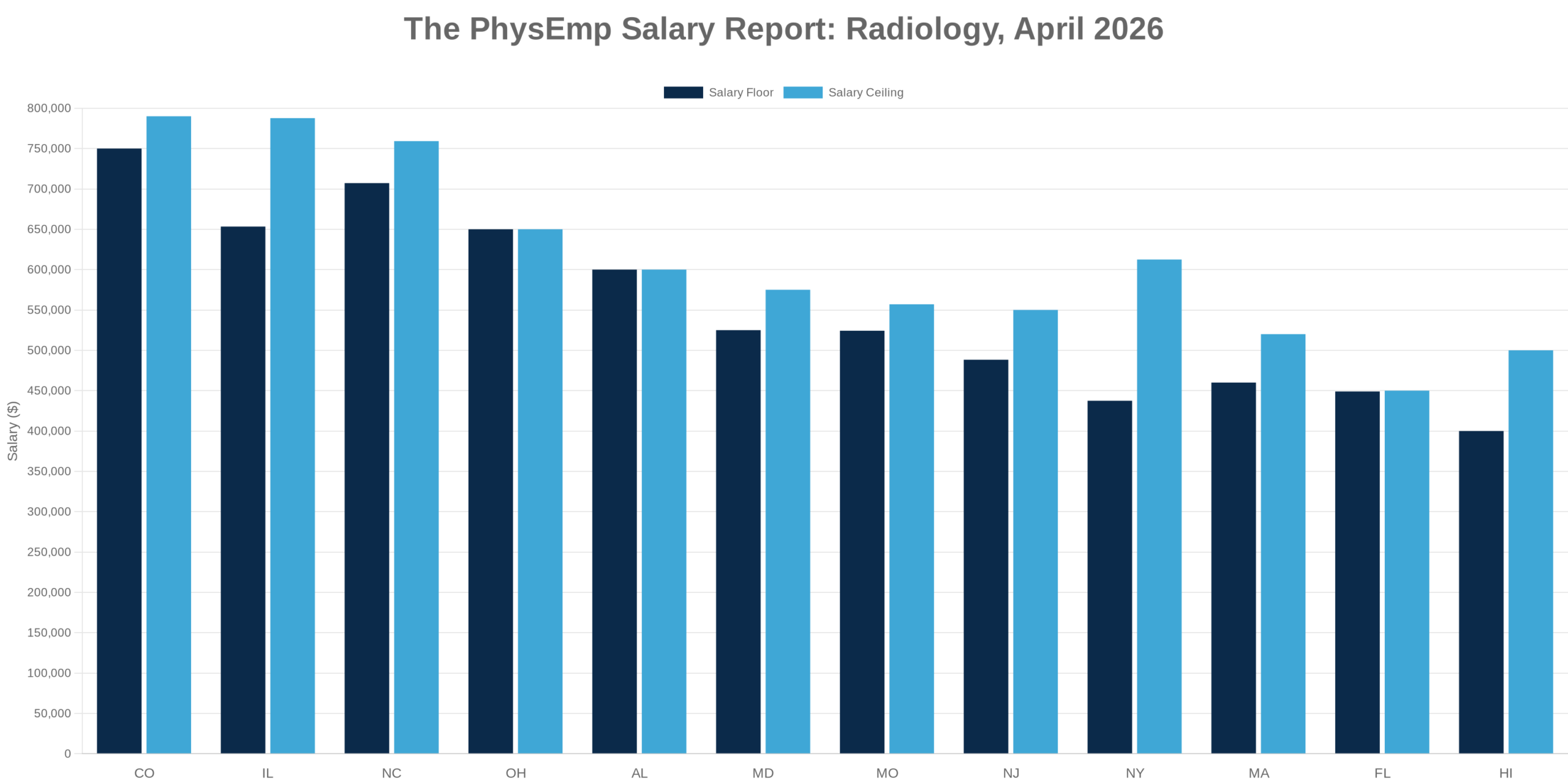
Overperformers: Colorado averages $750,000 to $790,000 across one disclosed listing — a figure so high it suggests either partnership track or a market where no one wants to live (the data does not clarify). North Carolina follows at $707,200 to $759,200, buoyed by a locum tenens hourly rate that annualizes into the stratosphere. Illinois averages $653,333 to $787,667 across three listings and hosts the single highest offer in the nation. Ohio reports $650,000, though only one listing disclosed pay. Alabama comes in at $600,000 flat, based on a single data point.
Near-average: Missouri sits at $524,250 to $557,000 across four listings, a stable middle-market benchmark. Maryland averages $525,000 to $575,000 across three postings. New Jersey lands at $488,333 to $550,000, also across three listings — a respectable showing for a state with high living costs and proximity to New York City’s pricing pressure.
Underperformers: New York averages $437,500 to $612,500 across four listings, a surprisingly soft showing for a state with 19 total postings and high cost of living. Florida averages $449,000 to $450,000 — the lowest among high-volume states and a number that will require recruiters to sell lifestyle, not salary. Hawaii offers $400,000 to $500,000, which may work if you value ocean views over retirement contributions. Massachusetts reports $460,000 to $520,000, based on one listing.
Volume leaders: Florida leads with 34 listings, followed by Indiana and Kentucky with 16 each, Pennsylvania and Wisconsin with 15 each, California with 13, and Illinois, Georgia, and South Carolina with 11 each. Florida’s volume dominance paired with bottom-tier pay is a textbook case of supply-demand imbalance. Colorado’s three listings and top-tier pay represent the opposite extreme.
👉 Compare Radiology compensation and opportunities by region
What This Means If You’re a Physician
If your priority is maximum compensation: The highest-paying listing is in Normal, Illinois, offering $850,000 annually. Colorado and North Carolina also command premiums in the $700,000-plus range. These are outlier markets where either scarcity or strategic overpayment is driving the number. Illinois combines high pay with reasonable job volume (11 listings), making it a rare market where you can optimize for both salary and choice.
If your priority is maximum optionality: Florida offers 34 listings — more than any other state — but averages just $449,000 to $450,000, well below the national mean. Indiana, Kentucky, and Pennsylvania each offer 15-plus listings but disclose no salary data, a red flag for transparency. New York provides 19 listings with a broad salary range ($437,500 to $612,500), though the average skews low relative to cost of living.
If your priority is balance: Missouri, Maryland, and New Jersey offer near-average pay with moderate job counts and disclosed compensation. These are stable, predictable markets. Illinois stands out as the rare state offering both high salaries and double-digit job volume. Physicians willing to consider smaller markets should scrutinize Colorado and North Carolina, where pay significantly outpaces the national average but job counts remain thin.
👉 Search Radiology jobs by location and compensation
What This Means If You’re a Recruiter
Salary transparency rate: 7.6 percent (24 listings with disclosed compensation out of 314 total). This is abysmal. In a market where the floor and ceiling are separated by $450,000, withholding salary data is not a strategic advantage — it is a filter that removes your listing from consideration by candidates who know their worth.
Pipeline implications: High-volume, low-transparency states (Florida, Indiana, Kentucky, Pennsylvania) will struggle to convert interest into applications without leading with compensation or unique value propositions. Florida’s 34 listings and sub-$450,000 average create a toxic combination: high visibility, low competitiveness. Recruiters in these markets will need to lead with lifestyle, partnership track, or scope flexibility, because the salary story is a losing one.
Misalignment watch: Colorado, North Carolina, and Illinois are low-volume, high-pay markets where speed and decisiveness will win candidates. Florida, by contrast, is a high-volume, low-pay market where recruiters will face commoditization and churn. New York’s 19 listings and below-average pay relative to cost of living suggest either oversupply or a market where employers believe brand equity substitutes for compensation (it does not).
👉 Post Radiology positions on PhysEmp
What’s Driving the Numbers
Scarcity pricing dominates the top tier. Colorado, North Carolina, and Illinois are paying $650,000-plus not because the work is harder, but because the supply of willing Radiologists in those markets is limited. Whether that scarcity is geographic, cultural, or operational is unclear, but the salary premium is unambiguous. Employers in these states have determined that a $200,000 overpayment is cheaper than a prolonged vacancy or locum tenens coverage. They are probably correct.
Volume and pay are inversely correlated. Florida has the most listings and some of the lowest pay. Colorado has three listings and the highest average salary. This inversion suggests that high-volume markets are either saturated with candidates or dominated by health systems that have standardized compensation downward. Low-volume, high-pay markets, by contrast, are likely rural, underserved, or otherwise difficult to staff — and are pricing in that difficulty with brutal clarity.
Transparency remains a competitive weapon. Only 7.6 percent of listings disclose salary. In a market where compensation varies by more than 100 percent, this opacity is a strategic error. Candidates with leverage (which is most Radiologists) will bypass non-transparent listings in favor of markets that signal value upfront. Recruiters who disclose early will compress time-to-hire and reduce candidate drop-off. Those who do not will lose to competitors who do.
Part-time and locum rates distort the floor and ceiling. North Carolina’s $707,200 to $759,200 average is driven by an hourly locum rate ($340 to $365 per hour, annualized at 2,080 hours). This inflates the state’s average but does not reflect permanent, full-time compensation norms. Similarly, the $400,000 floor in Hawaii and New York may represent part-time roles, early-career offers, or underserved markets with limited budgets. Without role-level detail, these figures should be interpreted as boundary conditions, not benchmarks.
The Bottom Line
The Radiology job market is geographically diffuse, numerically robust, and economically bifurcated. Physicians have leverage, particularly those willing to move. Markets that combine high pay with reasonable volume (Illinois) or extreme pay with limited competition (Colorado, North Carolina) will clear quickly. High-volume, low-pay markets (Florida) will churn. The $450,000 spread between top and bottom is not a reflection of skill variability — it is a reflection of market power, and right now, that power belongs to the physician willing to read the data and act on it.
There is a lot of money available for ensuring people do not feel things while other people cut them open, and even more for interpreting the images of what is inside them.
👉 Browse all Radiology physician jobs
👉 Upload your CV to get matched with opportunities
👉 Set alerts for new Radiology roles
Salary data based on 24 listings with disclosed compensation. Figures may reflect part-time or specialized roles. This report is informational and should not replace professional judgment or financial planning.