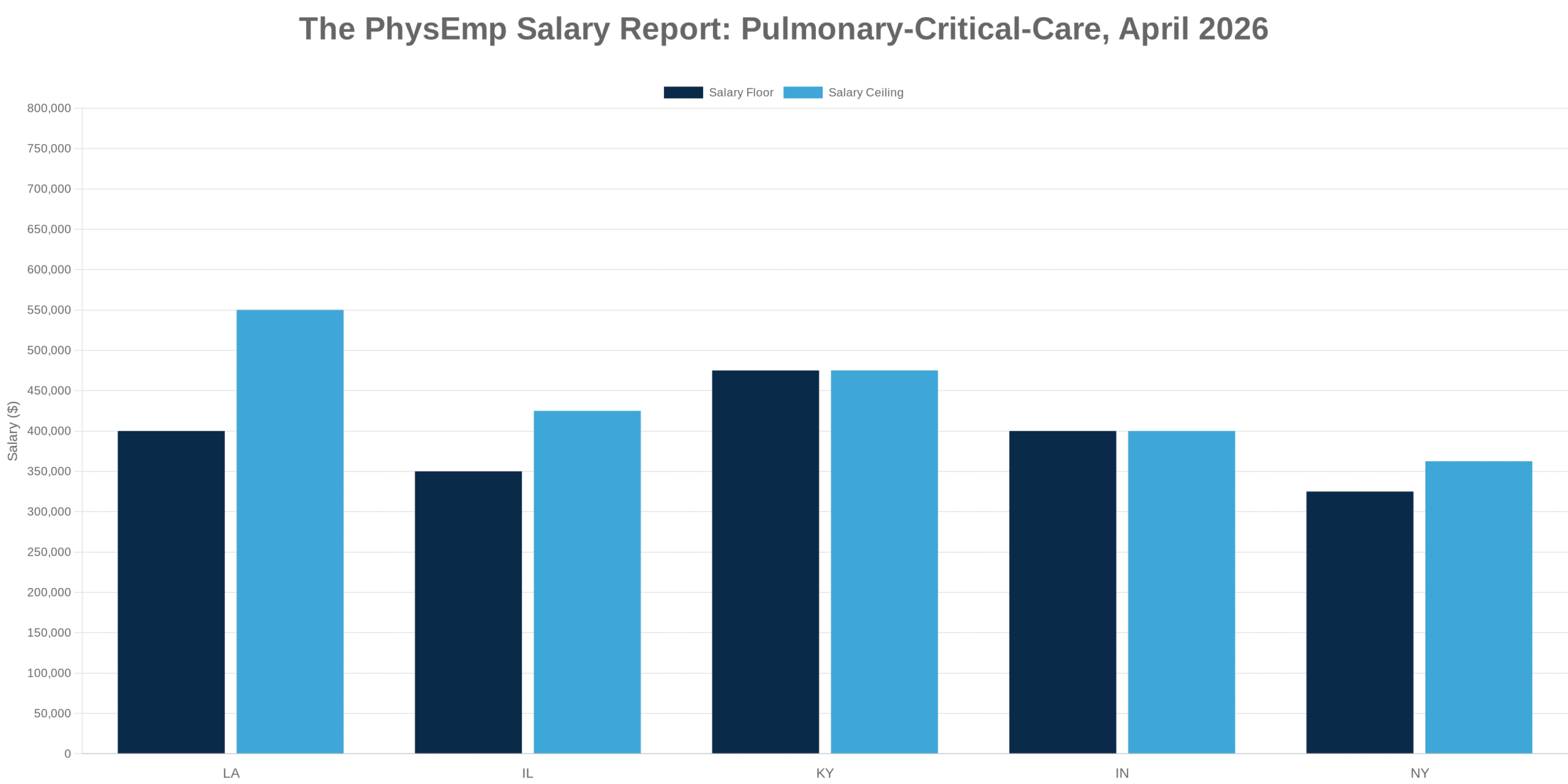
Kentucky is offering half a million dollars annually to pulmonologists willing to relocate. Illinois, meanwhile, is offering $220,000 for the same specialty. The Pulmonology job market currently features 84 active listings across 29 states, with salary data disclosed for 27 positions. The data reveals a market where geography, work structure, and regional scarcity drive compensation spreads so wide they begin to look like different professions entirely.
👉 Explore Pulmonology job market insights and trends
The Pulmonology Job Market at a Glance
Total listings: 84
Listings with salary data: 27
Full salary range: $175,000 to $500,000
Average salary range: $318,074 to $348,889
The $325,000 spread between floor and ceiling is driven largely by part-time roles concentrated in the Midwest and Northeast, which pull the bottom down to $175,000. Full-time positions cluster between $300,000 and $470,000, a range that reflects both standard employment and premium markets willing to pay for scarcity. The national average sits just above $318,000 on the low end and nearly $349,000 on the high end, though this masks significant state-level variance.
States with active listings: Arizona, California, Colorado, Florida, Georgia, Illinois, Indiana, Iowa, Idaho, Kansas, Kentucky, Maryland, Massachusetts, Minnesota, Missouri, North Carolina, North Dakota, Nebraska, New Hampshire, New Mexico, New York, Ohio, Pennsylvania, Tennessee, Texas, Virginia, Washington, Wisconsin, Alabama.
👉 Browse Pulmonology physician job opportunities
How States Stack Up
Overperformers:
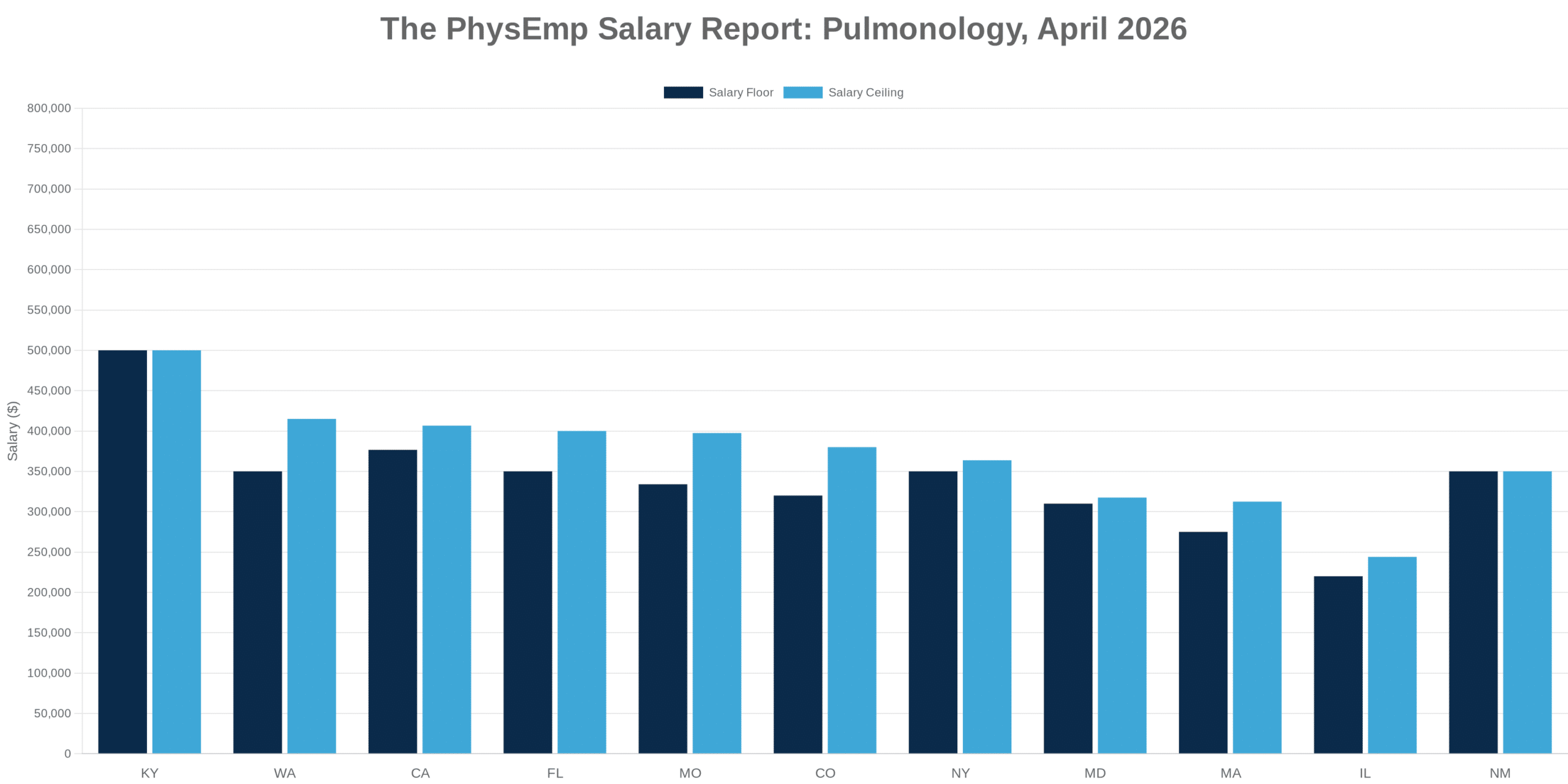
Kentucky leads the nation with a $500,000 average (based on one disclosed listing out of three total), making it the highest-paying state in the dataset despite minimal volume. California averages $376,667 to $406,667 across three listings, combining elite compensation with reasonable job availability. Washington state posts a single listing at $350,000 to $415,000, placing it firmly in the upper tier. Florida averages $350,000 to $400,000 across three salary-disclosed listings out of five total, offering both volume and pay. Missouri delivers $334,000 to $397,500 across two listings, punching above its weight in a traditionally mid-market region.
Near-Average:
New York averages $350,000 to $363,750 across four listings, reflecting the state’s typical premium without reaching the top tier. New Mexico posts a single listing at exactly $350,000, landing squarely in the middle of the national range. Colorado shows $320,000 to $380,000 on one disclosed listing out of three total, suggesting a balanced but unremarkable market.
Underperformers:
Illinois averages $220,000 to $244,000 across five listings, the lowest in the nation due to a concentration of part-time roles that distort the market downward. Massachusetts averages $275,000 to $312,500 across four disclosed listings out of six total, underperforming despite its high cost of living and academic prestige. Maryland sits at $310,000 to $317,500 across two listings, falling below the national average and offering little geographic or financial incentive.
Volume leaders: Arizona leads with nine listings but discloses no salary data, making it a black box for compensation planning. Texas and Massachusetts each post six listings; Texas offers zero salary transparency while Massachusetts underperforms where it does. Wisconsin, Florida, Indiana, and Illinois each report five listings, though only Florida and Illinois provide meaningful salary data (Florida strong, Illinois weak).
👉 Compare Pulmonology compensation and opportunities by region
What This Means If You’re a Physician
If your priority is maximum compensation: Target Kentucky, where the single disclosed listing offers $500,000 annually. The highest full-time salary identified nationally is $470,000 in Fresno, California, a market that pairs elite pay with a cost of living well below coastal metros. California’s average of $376,667 to $406,667 across three listings suggests consistent high-end compensation, not a one-off outlier.
If your priority is maximum optionality: Arizona offers nine listings with no disclosed salary data, making it a volume leader but a compensation mystery. Florida and Wisconsin each post five listings, with Florida offering transparency and strong pay ($350,000 to $400,000 average), while Wisconsin remains opaque. Texas posts six listings but zero salary data, forcing candidates to negotiate blind.
If your priority is balance: New York ($350,000 to $363,750 across four listings) and Florida ($350,000 to $400,000 across three disclosed listings) offer the best combination of volume, transparency, and competitive pay. Colorado and New Mexico sit near the national average with limited volume but reasonable compensation for physicians seeking lifestyle markets. Avoid Massachusetts and Illinois unless you are comfortable with below-average pay or part-time structures that compress earnings.
👉 Search Pulmonology jobs by location and compensation
What This Means If You’re a Recruiter
Salary transparency rate: 32% (27 listings with disclosed compensation out of 84 total). This is low enough to create friction in candidate pipelines, particularly in high-volume states like Arizona, Texas, and Wisconsin, where zero salary data is available despite double-digit combined listings. Candidates evaluating offers in these markets will default to peer networks and salary surveys, not your postings.
Volume-pay misalignments are stark. Arizona leads in listings but offers no compensation insight, forcing recruiters to lead with geography, lifestyle, or organizational reputation instead of dollars. Massachusetts posts six listings but averages $275,000 to $312,500, well below the national average and far below its cost of living; recruiters here will need to emphasize academic affiliation, research opportunities, or loan forgiveness to offset the pay gap. Illinois posts five listings at $220,000 to $244,000, the lowest average nationally, driven by part-time roles that may appeal to semi-retired physicians or those seeking flexible schedules but will struggle to attract mid-career talent seeking full-time income.
Florida, by contrast, demonstrates how volume and pay can align: five total listings, three with disclosed salaries averaging $350,000 to $400,000, creating a candidate-friendly market where both opportunity and transparency exist.
👉 Post Pulmonology positions on PhysEmp
What’s Driving the Numbers
Part-time roles distort the salary floor significantly. The lowest disclosed salary is $175,000 annually in Jarrettsville, Maryland, a part-time position that skews Maryland’s average downward and creates the misleading impression of a weak market. Illinois reports five listings with salary data, all clustering in the $220,000 to $244,000 range due to part-time structures concentrated in the state. This is not a weak full-time market; it is a part-time market being reported as a full-time one. Recruiters and physicians alike must disaggregate work structure from geography when interpreting these figures.
Underserved and rural markets price in scarcity premiums. Kentucky’s $500,000 listing and Missouri’s $334,000 to $397,500 average suggest that low-population states are willing to pay top-tier compensation to attract pulmonologists. Washington’s $350,000 to $415,000 single listing and Florida’s $350,000 to $400,000 average reinforce the pattern: states with geographic barriers, aging populations, or limited specialist supply are competing on price. This is classic supply-demand economics, and it is working.
High-volume states are not high-transparency states. Arizona, Texas, and Wisconsin combine for 20 total listings but provide zero salary data, a transparency failure that undermines their recruiting advantage. Candidates will bypass these markets or demand premium compensation to offset the uncertainty. Massachusetts and Illinois offer transparency but weak pay, a different problem with the same result: pipeline leakage.
The volume-pay relationship breaks in predictable ways. Florida proves that volume and pay can align when markets are competitive and transparent. Illinois proves that volume without pay leads to part-time saturation. Arizona and Texas prove that volume without transparency leads to candidate skepticism. California proves that low volume with high pay and full transparency creates a efficient market where positions fill quickly and candidates know exactly what they are evaluating.
The Bottom Line
The Pulmonology job market is geographically broad, moderately transparent, and unevenly compensated. Full-time positions in undersupplied or high-demand markets command $350,000 to $500,000, while part-time roles and low-transparency states compress the floor and muddy the signal. Physicians with flexibility and a willingness to evaluate cost of living against gross compensation will find significant arbitrage opportunities between high-paying rural markets and underperforming urban ones.
There is a lot of money available for keeping lungs functional, but only if you are willing to go where the lungs are scarce.
👉 Browse all Pulmonology physician jobs
👉 Upload your CV to get matched with opportunities
👉 Set alerts for new Pulmonology roles
Salary data based on 27 listings with disclosed compensation. Figures may reflect part-time or specialized roles. This report is informational and should not replace professional judgment or financial planning.