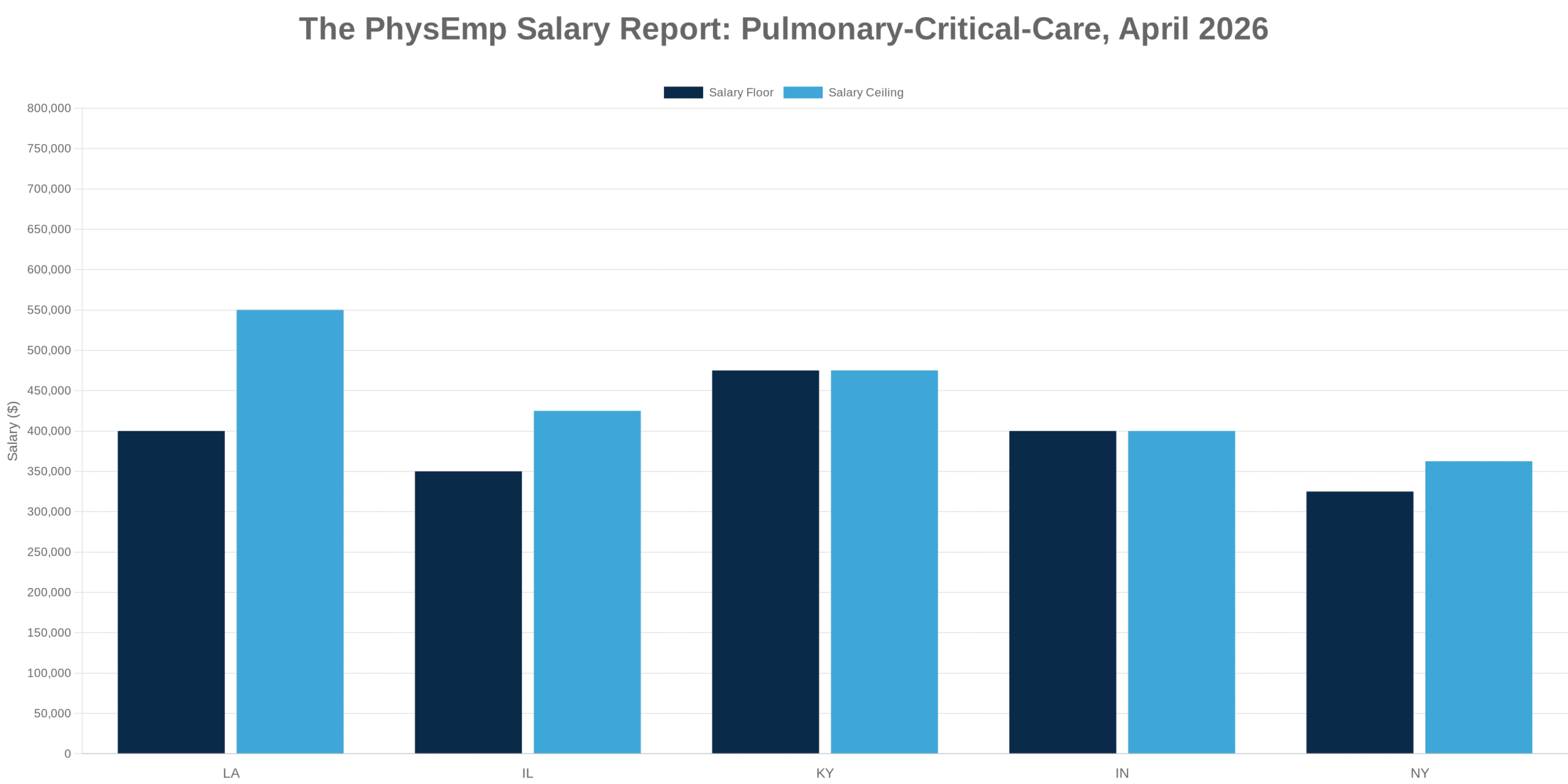
Kentucky is paying $475,000 for dual-trained intensivists while New York—with nine times the job volume—is offering $325,000. The national Pulmonary Critical Care market includes 48 active listings across 18 states, spanning compensation from $300,000 to $550,000 annually. The data reveals a market where geographic flexibility commands a $175,000 premium and volume leaders lag behind on pay.
👉 Explore Pulmonary-Critical-Care job market insights and trends
The Pulmonary-Critical-Care Job Market at a Glance
Nationally, 48 Pulmonary Critical Care listings are active across the market. Of these, 7 listings disclose salary data. Compensation ranges from $300,000 to $550,000 annually, with an average range of $392,857 to $435,714 among listings with disclosed figures.
The $250,000 spread between floor and ceiling reflects a specialty where market forces—not just clinical scope—determine earning potential. The dual certification in pulmonology and critical care typically commands premium compensation, yet the data shows geography mattering more than credentials alone. States with smaller physician populations appear to price in scarcity, while high-volume markets show signs of saturation pressure.
Active markets include New York, Pennsylvania, Texas, Illinois, Florida, California, Kentucky, Louisiana, Indiana, Tennessee, Missouri, Georgia, Utah, Ohio, Arizona, Rhode Island, Massachusetts, and Iowa.
👉 Browse Pulmonary-Critical-Care physician job opportunities
How States Stack Up
Overperformers: Kentucky leads nationally with an average of $475,000 across two salary listings—a figure that reflects genuine scarcity pricing in a state with limited ICU specialist supply. Louisiana follows at $400,000 to $550,000 (one listing in New Orleans), offering the highest ceiling in the dataset and likely competing for talent against larger Gulf Coast markets. Indiana posts $400,000 flat (one listing), positioning itself competitively despite modest job volume.
Near-average: Illinois benchmarks the national midpoint at $350,000 to $425,000 (one listing), offering predictable compensation in a major metro market without the premium or penalty seen elsewhere.
Underperformers: New York averages $325,000 to $362,500 across two salary listings, falling nearly $68,000 below the national average low despite leading in job volume—a cost-of-living mismatch that will require non-salary incentives to close.
Volume leaders are New York (9 listings), Pennsylvania (7 listings), and Texas (5 listings). New York’s volume dominance has not translated to competitive pay. Pennsylvania and Texas disclosed no salary data despite significant listing counts, signaling either strategic opacity or reliance on negotiation-based compensation models.
👉 Compare Pulmonary-Critical-Care compensation and opportunities by region
What This Means If You’re a Physician
If your priority is maximum compensation: Target New Orleans, Louisiana, where the market’s highest-paying listing offers $400,000 to $550,000 annually. Kentucky also merits attention with consistent $475,000 offers across two disclosed positions—a rare example of transparent, top-tier pay in a lower-cost-of-living state.
If your priority is maximum optionality: Focus on New York (9 listings), Pennsylvania (7 listings), and Texas (5 listings) for volume, but prepare for limited salary transparency and below-average disclosed compensation in New York’s case. Illinois and Florida (4 listings each) provide mid-tier volume with greater geographic diversity.
If your priority is balance: Illinois offers near-average pay ($350,000 to $425,000) in a major market with moderate volume, providing a stable reference point. Indiana and Kentucky combine strong compensation with lower costs of living, though job counts remain limited. Avoid New York if income is a primary driver—the $325,000 floor represents a $75,000 discount relative to Kentucky despite significantly higher living expenses.
👉 Search Pulmonary-Critical-Care jobs by location and compensation
What This Means If You’re a Recruiter
Salary transparency across this market stands at 14.6% (7 listings with disclosed data out of 48 total). This represents a significant information gap that will complicate candidate pipeline development, particularly for out-of-state or passive candidates who rely on posted ranges to evaluate opportunities.
High-volume states show troubling misalignment: New York leads in listings but lags in pay, while Pennsylvania and Texas offer no salary data despite combining for 12 listings. Recruiters in these markets will need to lead with lifestyle factors, academic affiliation, procedural volume, or partnership track instead of compensation. Conversely, Kentucky and Louisiana demonstrate that smaller markets can compete effectively on salary alone when transparency is high.
Candidates evaluating offers in non-disclosing states should benchmark against the $392,857 to $435,714 national average and demand clarity on base, incentives, and partnership timelines before proceeding.
👉 Post Pulmonary-Critical-Care positions on PhysEmp
What’s Driving the Numbers
Scarcity pricing dominates in underserved markets. Kentucky’s $475,000 average and Louisiana’s $550,000 ceiling reflect genuine supply constraints in states where dual-trained intensivists remain scarce. These figures exceed the national average by $40,000 to $115,000 and suggest that rural or smaller metro ICU programs are willing to pay premiums to secure coverage. Physicians willing to relocate to less saturated markets can extract significant compensation advantages.
High-volume states underperform on disclosed pay. New York’s 9 listings come with the market’s lowest average salary ($325,000 to $362,500), a counterintuitive outcome unless saturation is suppressing wages or cost-of-living adjustments are assumed. Pennsylvania and Texas—second and third in volume—disclosed no salary data at all, raising questions about whether these markets are avoiding transparency due to competitive pressure or relying on negotiation to set terms. Either way, volume is not translating to pay leadership.
Salary transparency remains the exception, not the rule. Only 14.6% of listings disclose compensation, leaving 41 positions in a data vacuum. This opacity benefits employers in negotiations but hampers candidate evaluation and market efficiency. States with full transparency (Kentucky, Louisiana, Indiana, Illinois) are competing more effectively for out-of-state talent, while non-disclosing states risk losing candidates who filter by posted salary.
The floor may reflect part-time or limited-scope roles. The $300,000 minimum in New York (Long Island) sits $92,857 below the national average low and $175,000 below Kentucky’s going rate. While the data does not specify scope, this gap is large enough to suggest either part-time scheduling, fewer ICU shifts, or a primarily outpatient pulmonary role. Physicians evaluating low-end listings should verify FTE expectations and call burden before assuming full-time ICU compensation.
The Bottom Line
The Pulmonary Critical Care market is paying a premium for scarcity and penalizing volume saturation. Kentucky and Louisiana are outbidding New York by six figures, Pennsylvania and Texas are hiring in the dark, and the $250,000 national range suggests that where you practice matters more than what you do. For a specialty built on managing the sickest patients in the hospital, the compensation model is surprisingly dependent on ZIP code.
There is strong demand for physicians who can intubate, ventilate, and relocate.
👉 Browse all Pulmonary-Critical-Care physician jobs
👉 Upload your CV to get matched with opportunities
👉 Set alerts for new Pulmonary-Critical-Care roles
Salary data based on 7 listings with disclosed compensation. Figures may reflect part-time or specialized roles. This report is informational and should not replace professional judgment or financial planning.