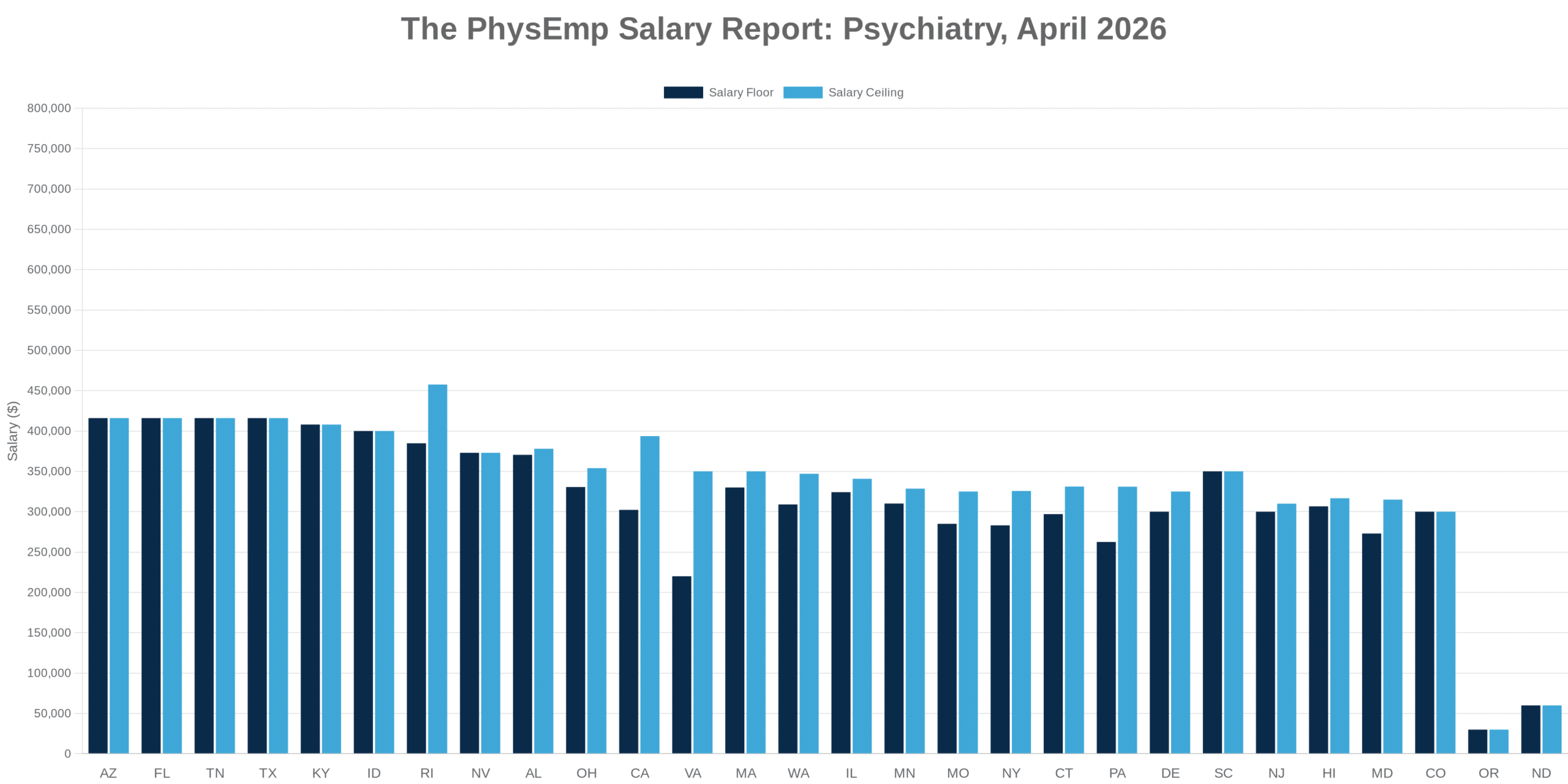
The Physiatry job market spans from $140,000 to $475,000 annually, a range so wide it could accommodate three separate careers (or one very confused compensation committee). The national dataset includes 221 active listings spread across 44 states, from Alaska to New Hampshire, with salary data disclosed in 109 of them. This is a specialty with strong geographic reach and meaningful earning potential, but where you practice determines how much you take home.
👉 Explore Physiatry job market insights and trends
The Physiatry Job Market at a Glance
Total listings: 221
Listings with salary data: 109
Full salary range: $140,000 to $475,000
National average range: $341,037 to $391,257
The spread here is notable without being chaotic. The floor of $140,000 likely reflects part-time or highly specialized arrangements, while the $475,000 ceiling suggests premium compensation for leadership or underserved markets. The national average sits comfortably in the mid-$300,000s to low-$400,000s, which positions Physiatry as a well-compensated specialty with meaningful upside for physicians willing to target the right geography or role type.
States represented: Wisconsin, New York, Ohio, Washington, Virginia, South Carolina, Pennsylvania, California, Texas, Indiana, Rhode Island, Florida, Tennessee, Illinois, Nevada, Colorado, Arizona, North Carolina, Alabama, New Jersey, Oklahoma, Kentucky, Maryland, New Mexico, Missouri, Oregon, Minnesota, Michigan, Kansas, Massachusetts, North Dakota, Iowa, Georgia, Arkansas, West Virginia, South Dakota, Alaska, Delaware, Montana, Utah, Nebraska, Maine, Mississippi, and New Hampshire.
👉 Browse Physiatry physician job opportunities
How States Stack Up
Overperformers
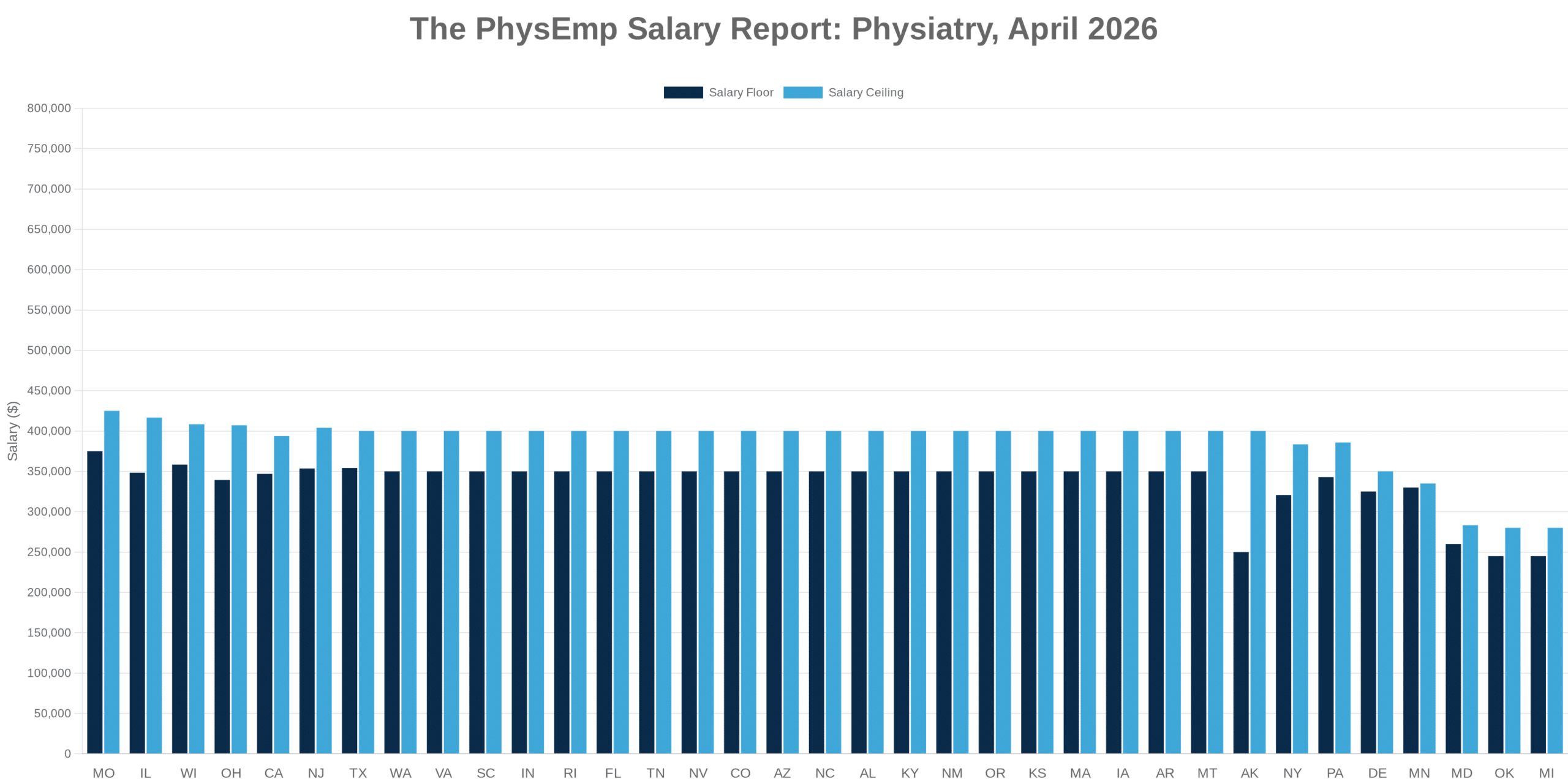
Missouri leads the nation with an average range of $375,000 to $425,000, offering a $50,000 premium over the national average low. Wisconsin follows closely at $358,333 to $408,333, bolstered by a $450,000 Medical Director listing in Green Bay that sets the national high-water mark. Illinois rounds out the top tier at $348,333 to $416,667, with a salary ceiling that outpaces most of the country.
Near-Average States
Florida ($350,000 to $400,000) offers solid compensation and the second-highest job volume in the country. Tennessee ($350,000 to $400,000) mirrors Florida almost exactly, with 15 listings and reliable pay. Texas ($354,167 to $400,000) leads the nation in volume but pays right at the national average — quantity over premium. New Jersey ($353,500 to $404,000) delivers consistent compensation in a high-cost-of-living state. Virginia, South Carolina, Washington, Indiana, Rhode Island, Nevada, Colorado, Arizona, North Carolina, Alabama, Kentucky, New Mexico, Oregon, Kansas, Massachusetts, Iowa, Arkansas, and Montana all cluster tightly around $350,000 to $400,000, representing stable benchmark markets.
Underperformers
Oklahoma and Michigan both average $245,000 to $280,000, trailing the national average by nearly $100,000. Maryland ($260,000 to $283,333) is only slightly better, a surprising result for a state with proximity to high-cost urban centers. Minnesota ($330,000 to $335,000) underperforms modestly, with a narrow range that offers little negotiating room. Delaware ($325,000 to $350,000) and Alaska ($250,000 to $400,000) sit below average, though Alaska’s wide range suggests high variability in role type or location.
Volume Leaders
Texas leads with 27 listings, followed by Florida (19), Tennessee (15), Pennsylvania (13), and California (12). Texas and Florida dominate volume but pay at or near the national average, making them opportunity-rich but not premium markets. Wisconsin, with just 10 listings, offers some of the highest salaries in the country (a reminder that scarcity can command a premium).
👉 Compare Physiatry compensation and opportunities by region
What This Means If You’re a Physician
If your priority is maximum compensation: Target Missouri, Wisconsin, and Illinois. The highest-paying listing in the dataset is a Medical Director role in Green Bay, Wisconsin, offering $400,000 to $450,000. Missouri’s average range of $375,000 to $425,000 represents the most consistent high-end market nationally.
If your priority is maximum optionality: Go to Texas (27 listings), Florida (19), or Tennessee (15). These states offer the most job postings and the broadest range of practice settings, though compensation is firmly middle-of-the-road.
If your priority is balance: New Jersey ($353,500 to $404,000) and Ohio ($339,286 to $407,143) offer above-average salaries with moderate job volume and access to major metros. Pennsylvania (13 listings, $342,857 to $385,714) provides solid volume in a lower-cost region, though compensation trails the top tier.
Cost-of-living mismatches: Maryland pays below the national average despite proximity to Washington, D.C. and Baltimore. California’s average of $346,875 to $393,750 is unremarkable given state tax rates and housing costs.
👉 Search Physiatry jobs by location and compensation
What This Means If You’re a Recruiter
Salary transparency rate: 49.3% (109 listings with data divided by 221 total listings). This is a coin-flip market for candidates evaluating opportunities, and the lack of disclosed compensation in more than half of all postings creates friction in the pipeline. Physicians will default to the listings that show their cards.
Candidate pipeline implications: High-volume states like Texas and Florida are paying at the national average, which means recruiters in those markets will need to lead with lifestyle, practice autonomy, or partnership track rather than compensation. Missouri and Wisconsin, by contrast, can lead with salary and close faster.
Volume-pay misalignments: Texas has 27 listings but pays $354,167 to $400,000 on average. Wisconsin has 10 listings and pays $358,333 to $408,333. The inverse relationship here suggests that underserved or lower-volume markets are pricing in scarcity, while high-supply markets are compressing wages. Recruiters in high-volume states will need to emphasize non-financial differentiators to compete.
👉 Post Physiatry positions on PhysEmp
What’s Driving the Numbers
Leadership and scope command a meaningful premium. The highest-paying listing in the dataset is a Medical Director role in Green Bay, Wisconsin, offering up to $450,000. Missouri’s consistently elevated range ($375,000 to $425,000) also suggests that administrative responsibility or expanded scope drives top-tier compensation. Physicians willing to take on leadership roles can expect a $50,000 to $75,000 premium over clinical-only positions.
Part-time roles and specialized arrangements distort the floor. The $140,000 minimum almost certainly reflects reduced hours or highly specific scope limitations. Even the Smithtown, New York listing, which appears to be hourly, annualizes to $364,000 to $416,000 (well above the floor). This suggests the true clinical full-time floor is closer to $250,000, with anything below that representing non-standard arrangements.
Underserved markets price in scarcity, but inconsistently. Missouri and Wisconsin offer premium pay with moderate volume, suggesting real demand and limited supply. Alaska, despite its remote geography, pays $250,000 to $400,000 on average (below the national benchmark), indicating that isolation alone does not guarantee a premium. Scarcity drives pay only when paired with functional healthcare infrastructure and population density.
Volume and pay do not correlate in this specialty. Texas leads the nation in listings but pays at the national average. Wisconsin has one-third the volume and pays significantly more. This is the opposite of a supply-constrained market; it is a market where geography, role type, and institutional need determine compensation far more than aggregate demand. Physicians optimizing for income should ignore volume and focus on state-level averages and role specifics.
The Bottom Line
The Physiatry job market is geographically broad, financially stable, and structurally bifurcated. High-volume states offer opportunity but not premium pay. Low-volume states with strong compensation (Missouri, Wisconsin) offer the clearest path to top-tier earnings, particularly for physicians willing to take on leadership roles. The $335,000 spread between the floor and ceiling reflects real differences in scope, geography, and institutional need, not market dysfunction.
Physiatry pays well nationally, but it pays best when you choose the employer, not just the specialty.
👉 Browse all Physiatry physician jobs
👉 Upload your CV to get matched with opportunities
👉 Set alerts for new Physiatry roles
Salary data based on 109 listings with disclosed compensation. Figures may reflect part-time or specialized roles. This report is informational and should not replace professional judgment or financial planning.