The highest-paying Pain Management positions in America are not in Manhattan, San Francisco, or Miami. They are in Youngstown, Ohio and Eldorado, Illinois, where physicians can earn up to $700,000 annually for managing chronic pain in markets most coastal doctors could not locate on a map. The current Pain Management job market includes 111 active listings spread across 28 states, with compensation data disclosed in just 13 of them. What the data reveals is a specialty with strong earning potential, wide geographic distribution, and a profound lack of salary transparency that obscures nearly 90% of the opportunity landscape.
👉 Explore Pain Management job market insights and trends
The Pain Management Job Market at a Glance
Total listings: 111
Listings with salary data: 13
Full salary range: $300,000 to $700,000
Average salary range: $380,769 to $492,308
The $400,000 spread between floor and ceiling reflects a market shaped more by geography and practice setting than by clinical scope. The average range sits comfortably in the mid-$400,000s, but the distribution is uneven. Most disclosed positions cluster between $350,000 and $550,000, with outliers on both ends driven by specific regional dynamics (Ohio and Illinois on the high side, South Carolina on the low). The national footprint is broad: Georgia, South Carolina, Ohio, New York, California, Illinois, Wisconsin, New Jersey, Pennsylvania, Nevada, Texas, Michigan, Florida, Indiana, Missouri, Kentucky, West Virginia, Arkansas, Connecticut, Minnesota, Maine, Alabama, Virginia, Tennessee, Louisiana, Delaware, and Arizona all have active listings. But volume does not predict pay, and transparency remains the exception rather than the rule.
👉 Browse Pain Management physician job opportunities
How States Stack Up
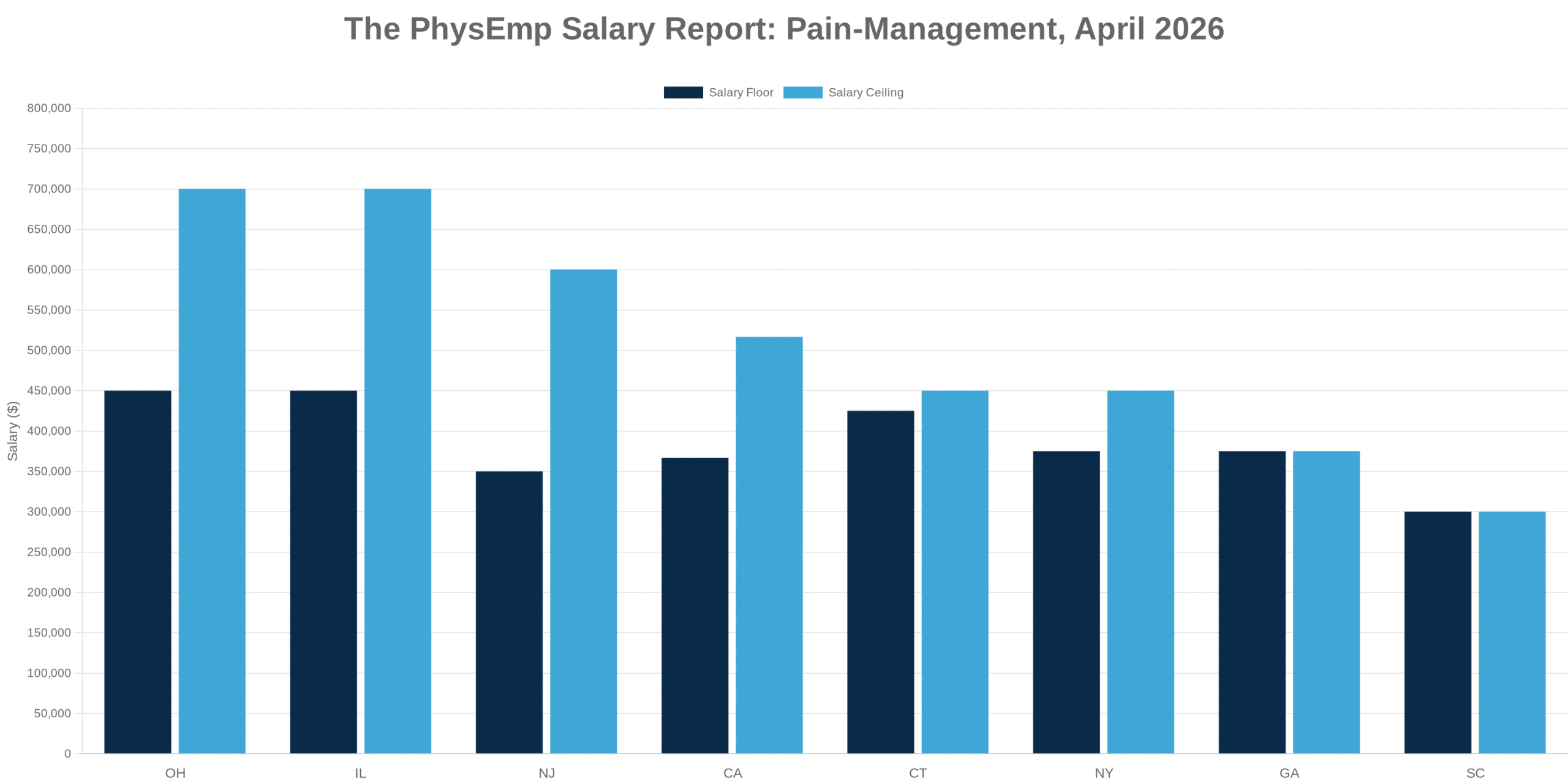
Overperformers: Ohio and Illinois lead the nation with salary ranges of $450,000 to $700,000, anchored by single high-value listings that set the national ceiling. New Jersey offers a strong range of $350,000 to $600,000, delivering upside without requiring a move to the Rust Belt. California averages $366,667 to $516,667 across three listings, competitive but not commanding.
Near-average: Connecticut posts a tight range of $425,000 to $450,000, making it a reliable benchmark market. New York averages $375,000 to $450,000 across three disclosed listings, consistent and predictable. Georgia, despite leading the nation in volume with 15 listings, shows a flat $375,000 average across its two salary-disclosed positions.
Underperformers: South Carolina anchors the bottom with a $300,000 average, roughly $80,000 below the national floor and a meaningful discount for a state with six active listings.
Volume leaders: Georgia (15 listings), Florida (13 listings), Texas (10 listings), Michigan and California (8 listings each). Florida, Texas, and Michigan disclosed no salary data despite their volume, and Georgia’s disclosed pay sits well below the national high-water marks set by smaller markets.
👉 Compare Pain Management compensation and opportunities by region
What This Means If You’re a Physician
If your priority is maximum compensation: Ohio and Illinois are the clear targets. The highest-paying listing in the dataset is located in Youngstown, OH and Eldorado, IL, offering $450,000 to $700,000 annually. These are not high-cost-of-living markets, which means the purchasing power of a $700,000 salary in Youngstown substantially exceeds the same figure in San Francisco or New York (where the floor is $300,000). The cost-of-living arbitrage here is significant.
If your priority is maximum optionality: Georgia, Florida, and Texas offer the most listings (15, 13, and 10 respectively), but none of the Florida or Texas positions disclosed salary data, and Georgia’s disclosed pay averages just $375,000. You will have options, but you will be negotiating in the dark.
If your priority is balance: New York and Connecticut offer competitive pay near the national average ($375,000 to $450,000) with reasonable job availability and proximity to major metro areas. California provides similar balance across eight listings, though the pay ceiling is lower than the Midwest leaders.
👉 Search Pain Management jobs by location and compensation
What This Means If You’re a Recruiter
Salary transparency rate: 11.7% (13 listings with disclosed compensation out of 111 total listings). This is among the lowest transparency rates across physician specialties and creates a significant friction point in candidate attraction. Physicians evaluating Pain Management opportunities are flying blind in nearly 90% of the market, which shifts negotiating leverage heavily toward candidates willing to walk away from non-transparent postings.
The volume-pay misalignment is striking: Georgia leads in listings but pays below the national average. Florida and Texas combine for 23 listings without a single disclosed salary figure. Meanwhile, Ohio and Illinois—with just five and three listings respectively—command the highest compensation in the specialty. Recruiters in high-volume, low-transparency states will need to lead with lifestyle, partnership track, procedural autonomy, or geographic desirability, because they cannot lead with pay data they refuse to disclose. Candidate pipelines in Ohio and Illinois will benefit from the clarity and the premium, while high-volume states risk losing top-tier candidates to better-informed competitors.
👉 Post Pain Management positions on PhysEmp
What’s Driving the Numbers
Scarcity pricing in underserved markets commands a clear premium. Ohio and Illinois are not traditional physician magnets, yet they offer the highest compensation in the specialty. This suggests that Pain Management positions in smaller, less competitive markets must price in geographic scarcity and difficulty attracting talent. The $700,000 ceiling in Youngstown is not a reflection of higher revenue per patient; it is a reflection of fewer physicians willing to practice there.
High-volume states show no consistent pay advantage. Georgia, Florida, and Texas dominate in listing count but lag or disappear entirely in disclosed compensation. Volume appears to correlate with demand for services, but not with willingness to pay premium rates or disclose those rates publicly. This creates a two-tier market: high-volume, low-transparency states where physicians negotiate in the dark, and low-volume, high-transparency states where compensation is used as a competitive differentiator.
Salary floors appear stable, but the ceiling is wide open. The $300,000 floor is consistent across South Carolina and New York, suggesting a baseline market rate for Pain Management that holds across geographies. But the $700,000 ceiling in the Midwest indicates that top-end compensation is highly variable and likely tied to practice setting, procedural volume, call responsibilities, or partnership structures. The spread is not noise; it is signal.
Transparency remains the exception, and that shapes everything. With an 11.7% disclosure rate, the Pain Management job market is effectively a black box for most candidates. States and health systems that choose to disclose salary data gain a structural advantage in attracting informed, high-intent candidates. Those that do not are betting that volume, geography, or reputation will carry the day. In a market where $700,000 positions exist in Youngstown, that bet looks increasingly expensive.
The Bottom Line
The Pain Management physician job market offers strong earning potential across a wide geographic footprint, but the opportunity set is obscured by a near-total absence of salary transparency. Physicians willing to consider smaller markets in Ohio and Illinois can access the highest compensation in the specialty, while those prioritizing volume will find the most listings in Georgia, Florida, and Texas—though without the data needed to evaluate them. The market rewards flexibility, punishes assumptions, and privileges the few candidates who know where the $700,000 jobs actually are.
There is a lot of money available for managing chronic pain in places most doctors have never considered living.
👉 Browse all Pain Management physician jobs
👉 Upload your CV to get matched with opportunities
👉 Set alerts for new Pain Management roles
Salary data based on 13 listings with disclosed compensation. Figures may reflect part-time or specialized roles. This report is informational and should not replace professional judgment or financial planning.