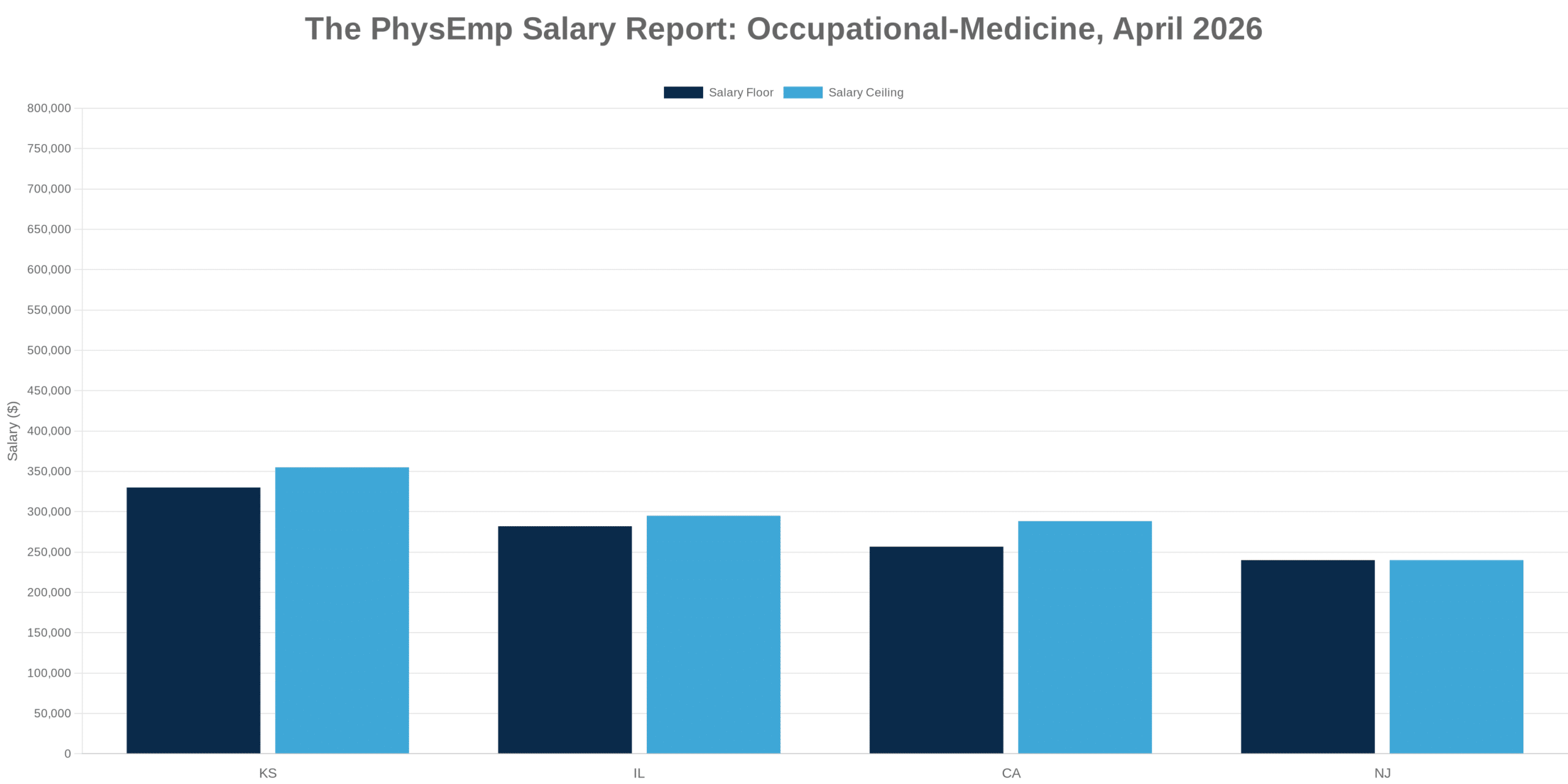
A single listing in Wichita, Kansas offers up to $355,000 annually to keep workers healthy and employers compliant. Meanwhile, a position in coastal New Jersey sits at $240,000 (a gap wide enough to lease a Tesla every year for the next decade). The Occupational Medicine market comprises 49 listings across 20 states, with salary data disclosed in exactly seven of them. What the data shows: this is a geographically distributed specialty where compensation transparency is rare and regional variance is dramatic.
👉 Explore Occupational Medicine job market insights and trends
The Occupational Medicine Job Market at a Glance
The market includes 49 total listings, with salary data available for just 7. Disclosed compensation ranges from $240,000 to $355,000 annually, with an average range of $272,000 to $292,857. That average, however, is built on a narrow sample (14% of the market), which means most physicians will be negotiating in the dark.
The $115,000 spread between floor and ceiling reflects more than cost-of-living adjustments. It suggests fundamental differences in employer type, practice setting, and regional scarcity. Kansas and Illinois anchor the top. New Jersey anchors the bottom. California straddles the middle with volume but not premium pay.
States with active listings: California, Colorado, Illinois, Kansas, New Jersey, Washington, Ohio, Missouri, Pennsylvania, Florida, Michigan, Nebraska, New Mexico, Kentucky, Idaho, Wisconsin, Texas, Indiana, Hawaii, and Georgia.
👉 Browse Occupational Medicine physician job opportunities
How States Stack Up
Overperformers: Kansas leads the disclosed market at $330,000 to $355,000, a figure supported by exactly one transparent listing in Wichita (but what a listing). Illinois follows at $282,000 to $295,000 across two positions, offering both volume and pay above the national midpoint.
Near-average: California posts $256,667 to $288,333 across three disclosed roles, which places it slightly below the national average despite leading the country in total listings. New Jersey offers a fixed $240,000, undershooting the national floor by $32,000 and raising questions about market positioning or role scope.
Underperformers: New Jersey is the only state with disclosed data materially below average, and it shows.
Volume leaders: California dominates with 13 listings, followed by Colorado with 9 and Florida with 3. Colorado’s nine listings disclosed zero salary figures, making it the market’s largest black box. California leads in volume but trails in pay. Florida offers optionality without transparency.
👉 Compare Occupational Medicine compensation and opportunities by region
What This Means If You’re a Physician
If your priority is maximum compensation: Target Kansas. The Wichita listing with Premise Health offers $330,000 to $355,000 and represents the disclosed ceiling. Illinois is a close second with two roles averaging near $290,000.
If your priority is maximum optionality: California provides 13 listings, the most in the nation, though average disclosed pay sits below $290,000. Colorado offers 9 opportunities but zero salary transparency, which may work in your favor during negotiation or against you if the market is softer than expected.
If your priority is balance: Illinois combines above-average pay with multiple listings, offering both compensation and choice. Avoid New Jersey unless the role includes significant non-cash value (equity, loan repayment, or a very compelling call schedule). The $240,000 figure is an outlier worth scrutiny, particularly given proximity to high cost-of-living metro areas.
👉 Search Occupational Medicine jobs by location and compensation
What This Means If You’re a Recruiter
Salary transparency rate: 14% (7 listings with data divided by 49 total listings). This is among the lowest disclosure rates across physician specialties, and it has pipeline implications. Candidates in Occupational Medicine are accustomed to negotiating blind, which means your competitive advantage lies in early and clear communication about total compensation.
Volume-pay misalignments are evident. California leads in listings but pays below Kansas and Illinois. Colorado offers the second-highest volume nationally with zero disclosed figures, suggesting either strategic opacity or a fragmented employer base. If you’re recruiting in high-volume, low-transparency states, lead with lifestyle, scope, and organizational mission. Compensation alone will not differentiate you (because no one knows what anyone else is offering).
Candidates will ask why Kansas pays $115,000 more than New Jersey. Have an answer.
👉 Post Occupational Medicine positions on PhysEmp
What’s Driving the Numbers
Salary transparency is the exception, not the rule. Only 14% of Occupational Medicine listings disclose compensation, the lowest rate among many physician specialties. This creates asymmetry that favors informed candidates and disadvantages those relying on advertised figures. Employers may be withholding data to preserve negotiating flexibility, but the effect is a market where most physicians are operating without benchmarks.
Volume does not predict premium pay. California leads the nation with 13 listings but offers below-average disclosed compensation. Colorado ranks second in volume with zero transparency. This breaks the typical volume-pay relationship seen in other specialties and suggests that Occupational Medicine demand is geographically dispersed rather than concentrated in high-cost urban centers. Physicians can access opportunities nationwide without sacrificing pay to follow the coasts.
Regional outliers drive the range. Kansas, with one disclosed listing, commands the national ceiling at $355,000. New Jersey, also with one disclosed listing, sits at the floor with $240,000. These are not statistical anomalies—they are the market. In a specialty with limited transparency, single listings carry outsize weight in shaping perception and negotiation strategy.
Scope and employer type likely explain variance. The $115,000 gap between top and bottom suggests differences in clinical responsibility, administrative load, or employer model (corporate occupational health versus hospital-affiliated versus independent). Part-time roles do not appear to distort the data meaningfully, as disclosed figures align with full-time equivalent expectations. The variance is structural, not methodological.
The Bottom Line
The Occupational Medicine job market is geographically broad, moderately compensated, and profoundly opaque. Physicians have leverage in negotiation due to low transparency and distributed demand, but only if they know what to ask for. Kansas pays the most. California offers the most. New Jersey offers the least (and should be prepared to explain why). For a specialty built on workplace safety and regulatory clarity, the job market itself operates with surprisingly little of either.
Keeping American workers safe and compliant pays between $240,000 and $355,000, depending on whether you’re willing to live in Wichita.
👉 Browse all Occupational Medicine physician jobs
👉 Upload your CV to get matched with opportunities
👉 Set alerts for new Occupational Medicine roles
Salary data based on 7 listings with disclosed compensation. Figures may reflect part-time or specialized roles. This report is informational and should not replace professional judgment or financial planning.