Somewhere in the United States, a nurse practitioner position is listed at $1,250,000 annually. Elsewhere, another is posted at $45,000. The same credential, the same scope of practice, and a compensation gap wide enough to fit 27 Honda Civics. The nurse practitioner job market comprises 1,751 active listings nationwide, with salary data disclosed in 731 of them. What emerges is a market defined not by consistency, but by profound geographic and structural variation—and by the reality that where you practice matters far more than what most practitioners expect.
👉 Explore Nurse Practitioner job market insights and trends
The Nurse Practitioner Job Market at a Glance
Total listings: 1,751
Listings with salary data: 731
Full salary range: $45,000 to $1,250,000
National average range: $143,113 to $182,998
The national salary range is deceptively wide, shaped in part by the dual compensation structure prevalent in this market. Travel and temporary assignments typically quote hourly rates between $70 and $100 per hour (annualized: $145,600 to $208,000), while permanent full-time roles present annual salary bands. The $1,250,000 ceiling is an extreme outlier, but even setting that aside, the spread from $45,000 to the mid-six figures reflects real market segmentation by practice setting, geography, and employment model.
Job listings span all 50 states and the District of Columbia: Alabama, Alaska, Arizona, Arkansas, California, Colorado, Connecticut, Delaware, Florida, Georgia, Hawaii, Idaho, Illinois, Indiana, Iowa, Kansas, Kentucky, Louisiana, Maine, Maryland, Massachusetts, Michigan, Minnesota, Mississippi, Missouri, Montana, Nebraska, Nevada, New Hampshire, New Jersey, New Mexico, New York, North Carolina, North Dakota, Ohio, Oklahoma, Oregon, Pennsylvania, Rhode Island, South Carolina, South Dakota, Tennessee, Texas, Utah, Vermont, Virginia, Washington, West Virginia, Wisconsin, Wyoming, and the District of Columbia.
👉 Browse Nurse Practitioner physician job opportunities
How States Stack Up
Overperformers:
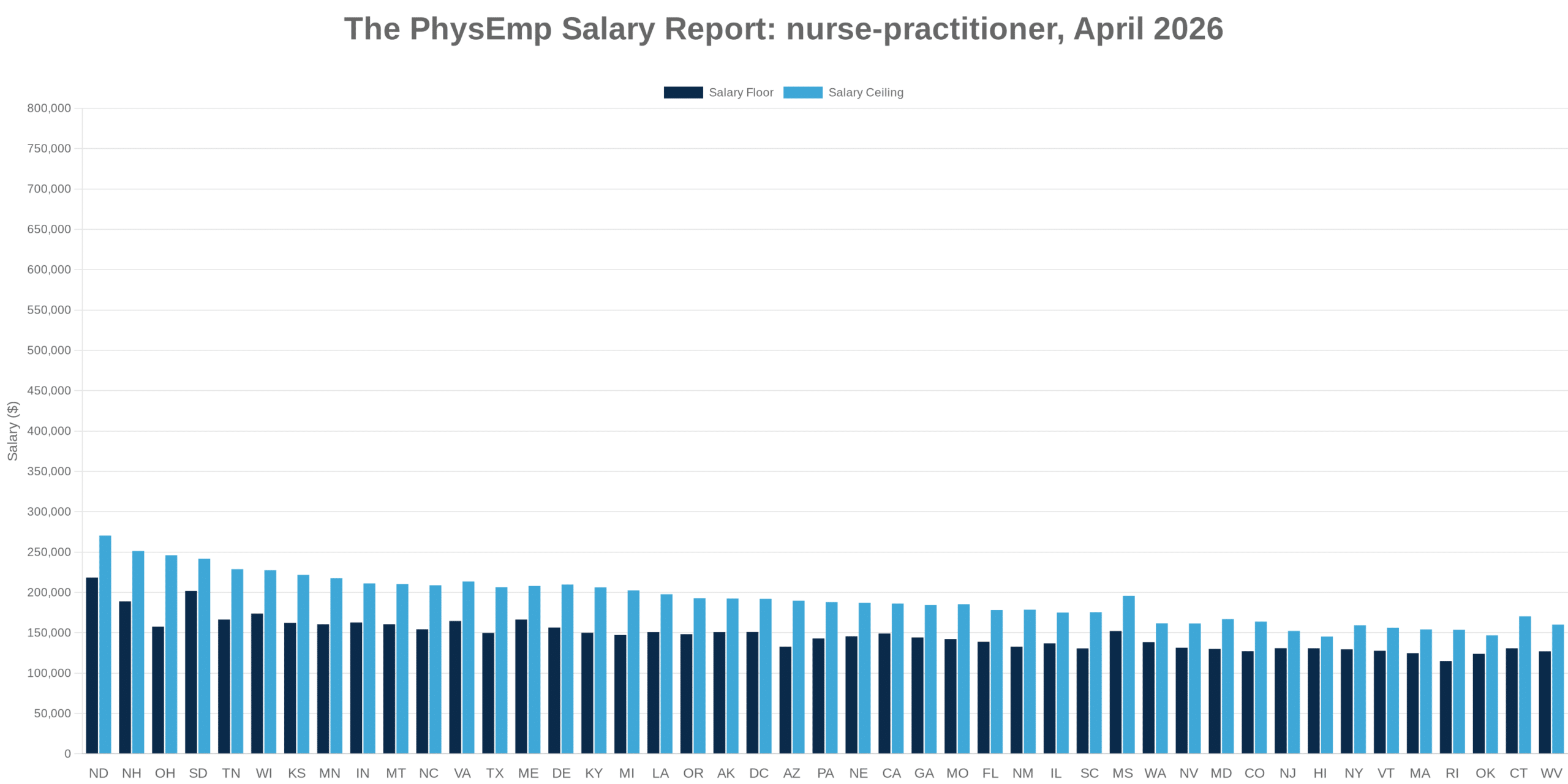
North Dakota leads the nation with an average range of $218,400 to $270,400, though only two listings contribute to that figure. New Hampshire offers $188,933 to $251,333 across 32 postings—a rare combination of premium pay and meaningful volume. South Dakota averages $201,760 to $241,696, and Wisconsin delivers $173,765 to $227,492 across 33 listings, making it one of the most credible high-pay markets. Ohio spans $157,589 to $246,077, with notable internal variation. Kansas averages $162,267 to $221,678, Minnesota $160,457 to $217,509, Tennessee $166,400 to $228,800, and Virginia $164,552 to $213,538 across 42 listings. Montana comes in at $160,480 to $210,320, Indiana at $162,660 to $211,150, and Maine at $166,400 to $208,000. North Carolina averages $154,288 to $208,858 across 122 postings—a volume leader that also pays well. Delaware ($156,480 to $209,760), Kentucky ($150,000 to $206,300), Texas ($149,746 to $206,521), and Arkansas ($157,584 to $203,040) round out the upper tier.
Near-Average Performers:
California averages $149,090 to $186,174 across 207 listings—the highest volume in the nation, paired with middle-of-the-road compensation. Michigan ($147,229 to $202,486), Michigan ($147,229 to $202,486), Louisiana ($150,800 to $197,740), Iowa ($144,000 to $199,893), Oregon ($148,262 to $192,803), Alaska ($150,800 to $192,400), District of Columbia ($150,933 to $192,000), Mississippi ($152,200 to $195,733), Pennsylvania ($142,929 to $187,985), Nebraska ($145,600 to $187,200), Missouri ($142,267 to $185,400), Georgia ($144,210 to $184,317), Florida ($138,885 to $178,142), and Arizona ($132,800 to $189,767) all cluster near the national average.
Underperformers:
Rhode Island posts the lowest average in the nation at $115,000 to $153,750. Oklahoma follows at $123,900 to $146,800, falling well short of the national average floor. Massachusetts, despite 81 listings, averages just $124,740 to $154,156—a high-volume, low-pay outlier. Colorado ($127,130 to $163,886), West Virginia ($127,000 to $160,167), Vermont ($127,677 to $156,286), Maryland ($130,040 to $166,896), Hawaii ($130,768 to $145,268), Connecticut ($130,749 to $170,379), New Jersey ($130,874 to $152,295), South Carolina ($130,622 to $175,511), Nevada ($131,419 to $161,549), New Mexico ($132,800 to $178,600), and New York ($129,441 to $159,213) all underperform relative to the national benchmark.
Volume Leaders:
California leads with 207 listings, followed by New York (127), North Carolina (122), Washington (90), Massachusetts (81), Oregon (79), Florida (71), and Texas (71). High volume does not guarantee high pay. California and Washington offer near-average compensation despite their dominance in listing count. Massachusetts, the fifth-largest market, pays below the national average. Meanwhile, North Dakota, South Dakota, and New Hampshire—each with fewer than 35 listings—command some of the highest compensation in the country.
👉 Compare Nurse Practitioner compensation and opportunities by region
What This Means If You’re a Physician
If your priority is maximum compensation: Target North Dakota, New Hampshire, South Dakota, Wisconsin, or Ohio. The single highest-paying listing identified nationally is $1,250,000 (location and scope unspecified in the dataset). Among credible high-end opportunities, New Hampshire offers the best combination of elite pay and job availability, with an average high of $251,333 across 32 postings.
If your priority is maximum optionality: California, New York, and North Carolina offer the deepest job markets. California alone accounts for 207 listings, providing unmatched geographic and practice setting diversity. The tradeoff is compensation that hovers near the national midpoint.
If your priority is balance: Wisconsin, Virginia, North Carolina, and Montana offer strong pay with reasonable job availability. Wisconsin averages $173,765 to $227,492 across 33 listings. Virginia spans $164,552 to $213,538 across 42. North Carolina combines 122 listings with an average high of $208,858. These markets reward practitioners who want both competitive compensation and meaningful choice.
One cost-of-living mismatch deserves scrutiny: Massachusetts, with 81 listings and a high cost of living, pays an average of just $124,740 to $154,156—well below the national average and among the lowest in the Northeast.
👉 Search Nurse Practitioner jobs by location and compensation
What This Means If You’re a Recruiter
Salary transparency rate: 41.7% (731 listings with data divided by 1,751 total listings).
Less than half of all nurse practitioner job postings disclose compensation. In a market this fragmented, that opacity creates friction. Candidates evaluating offers across states with $100,000+ pay differentials will default to the listings that provide clarity. Organizations that withhold salary data in underperforming markets—particularly Massachusetts, New York, Rhode Island, and Oklahoma—will struggle to compete for attention, let alone talent.
The volume-pay misalignment is stark. Massachusetts posts 81 jobs but pays in the bottom quartile nationally. New York offers 127 listings at an average of $129,441 to $159,213, trailing states with a fraction of its population. California’s 207 listings come with middle-tier pay. Meanwhile, North Dakota, South Dakota, and New Hampshire—accounting for just 45 combined postings—dominate the top of the pay scale. Recruiters in high-volume, low-pay states will need to lead with practice autonomy, lifestyle, or organizational mission, because the compensation story will not close the deal on its own.
👉 Post Nurse Practitioner positions on PhysEmp
What’s Driving the Numbers
Geographic scarcity commands a premium in low-population states
North Dakota, South Dakota, and Montana—states with small populations and vast rural geographies—consistently rank among the highest-paying markets. The premium is not incidental. It reflects the structural difficulty of recruiting advanced practice providers to regions with limited amenities, harsh climates, and professional isolation. Scarcity pricing is real, and it works.
High-volume markets suppress wages through competition
California, New York, and Massachusetts generate extraordinary listing volume but deliver compensation that lags or underperforms the national average. The dynamic is straightforward: when supply is abundant (or perceived to be), employers have less incentive to compete on salary. Candidates drawn to these states for lifestyle, culture, or proximity to academic medicine effectively subsidize their geography with lower pay.
The $1,250,000 ceiling distorts the national range but reveals niche opportunity
The highest salary found—$1,250,000—is almost certainly tied to a specialized role: executive leadership, a high-acuity procedural niche, or an ownership structure. It is not representative of the broader market, but it does signal that nurse practitioners with rare skill sets or willingness to assume operational risk can access compensation well beyond the typical range. The floor of $45,000, by contrast, likely reflects part-time, per-diem, or rural health clinic structures with limited hours.
The hourly-to-salary divide creates comparison friction
Travel and temporary roles quote hourly rates ($70 to $100 per hour, or $145,600 to $208,000 annualized), while permanent positions present annual figures. This dual structure makes it difficult for candidates to compare offers directly and may obscure the true cost of benefits, stability, and long-term earning potential. Recruiters should normalize compensation to annual equivalents and disaggregate base pay from sign-on bonuses or productivity incentives.
The Bottom Line
The nurse practitioner job market is geographically vast, structurally inconsistent, and defined by a compensation logic that rewards scarcity over volume. Practitioners willing to work in low-population states can command salaries 50% to 100% above the national average. Those drawn to high-volume coastal markets will trade pay for optionality and lifestyle. The gap between the two is not small, and it is not narrowing.
There is no such thing as a national nurse practitioner salary—only 50 state markets wearing the same credential.
👉 Browse all Nurse Practitioner physician jobs
👉 Upload your CV to get matched with opportunities
👉 Set alerts for new Nurse Practitioner roles
Salary data based on 731 listings with disclosed compensation. Figures may reflect part-time or specialized roles. This report is informational and should not replace professional judgment or financial planning.