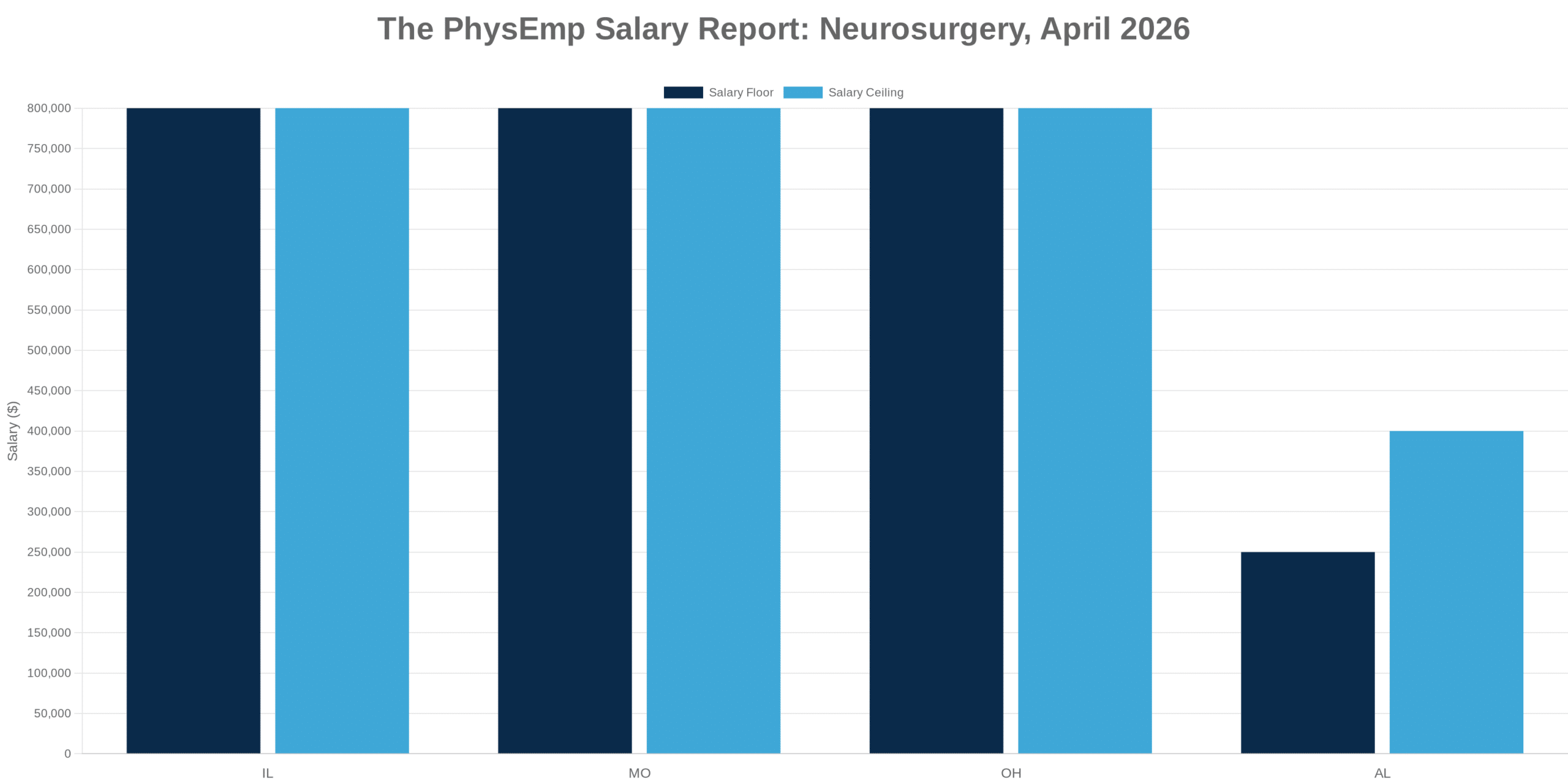
One Neurosurgery position in Alabama pays $250,000 per year. Another in Illinois pays $1,000,000. Both are brain surgery. Both require roughly a decade of post-graduate training. One pays four times the other.
The market has 71 active listings spread across 25 states, but only 4 bother to disclose what they’re willing to pay. What the data shows: Neurosurgery compensation is wildly variable, frustratingly opaque, and structured around a truth the market would rather not say out loud—geography determines your worth more than your skillset.
👉 Explore Neurosurgery job market insights and trends
The Neurosurgery Job Market at a Glance
Total listings: 71
Listings with salary data: 4
Full salary range: $250,000 to $1,000,000
Average salary range: $781,250 to $818,750
The floor-to-ceiling spread is $750,000, which is more than most physicians in other specialties will earn at the top of their range. The average range sits just above $800,000, but that figure is doing heavy lifting—it’s pulled upward by three disclosed salaries above $900,000 and dragged down by Alabama’s $250,000 outlier (which may reflect a part-time or limited-scope role, though the data doesn’t say). The result is a national average that captures neither the ceiling nor the floor with much accuracy.
States represented: Missouri, Ohio, Florida, Virginia, North Carolina, Michigan, California, Georgia, Arkansas, Indiana, Connecticut, Texas, Illinois, Alabama, Pennsylvania, Utah, Mississippi, South Carolina, Idaho, Iowa, Kentucky, Nebraska, West Virginia, Washington, and Tennessee.
👉 Browse Neurosurgery physician job opportunities
How States Stack Up
Overperformers
Illinois leads the nation with a disclosed salary of $1,000,000—a clean, round number that suggests confidence, market power, or both. Missouri follows at $975,000 in Springfield, proving that the Midwest can compete at the top when it wants to. Ohio discloses $900,000 in Youngstown, a smaller market punching well above its weight class.
Underperformers
Alabama reports a range of $250,000 to $400,000, with the floor representing the lowest Neurosurgery salary in the dataset—by a margin of $650,000. The upper bound of $400,000 is still half what Illinois is offering, and there’s no geographic or cost-of-living justification that closes that gap.
Near-Average States
Ohio’s $900,000 sits comfortably within the national average range and serves as the closest thing this dataset has to a benchmark.
Volume Leaders
Virginia leads with 7 listings but discloses no salary data, making it the busiest black box in the market. Ohio, Illinois, and Pennsylvania each post 6 listings, with Illinois being the only one transparent enough to name a number. Florida contributes 5 listings with zero salary disclosures, while Michigan, California, Texas, and Alabama each add 4. Illinois is the rare high-volume state that also leads on pay—a combination that should make it the first stop for any serious job search.
👉 Compare Neurosurgery compensation and opportunities by region
What This Means If You’re a Physician
If your priority is maximum compensation: Illinois, Missouri, and Ohio are your only visible options. The highest-paying listing is in Illinois at $1,000,000 per year, with no city specified in the data but tied to a state posting 6 total openings. Springfield, Missouri offers $975,000, and Youngstown, Ohio comes in at $900,000. All three exceed the national average and represent the top tier of disclosed Neurosurgery pay.
If your priority is maximum optionality: Virginia has 7 listings, the most in the nation, but none include salary data. Pennsylvania and Ohio each offer 6 listings, with Ohio providing the transparency advantage. Florida adds 5 openings but remains silent on compensation. You’ll have options in these states, but you’ll be negotiating in the dark in most of them.
If your priority is balance: Illinois combines high pay ($1,000,000) with solid volume (6 listings), making it the rare market where you don’t have to choose between compensation and choice. Ohio offers similar dynamics at a slightly lower pay point ($900,000 across 6 listings). Both states give you leverage, visibility, and a competitive wage—assuming you can tolerate the Midwest.
One cost-of-living mismatch stands out: Alabama’s $250,000 floor is low even after adjusting for regional economics, and the $400,000 ceiling still leaves a $500,000 gap against Illinois. Unless the scope is dramatically reduced or the role is part-time, the compensation gap demands scrutiny.
👉 Search Neurosurgery jobs by location and compensation
What This Means If You’re a Recruiter
Salary transparency rate: 5.6% (4 listings with data ÷ 71 total listings).
That’s not a typo. Fewer than one in twenty Neurosurgery listings disclose compensation, which means 94.4% of your candidate pipeline is being asked to express interest without knowing what the job pays. For a specialty where training takes 7 years post-residency and the earnings floor in this dataset is $250,000, that’s a strategic miscalculation. Neurosurgeons have options. They also have leverage. Asking them to guess what you’re offering is a good way to lose them to the 5.6% of employers who respect their time.
Volume-pay misalignments are everywhere. Virginia leads the nation in job postings (7) but discloses nothing. Pennsylvania ties for second place (6 listings) and also stays silent. Florida, Michigan, California, and Texas combine for 17 listings and zero salary figures. Meanwhile, Missouri posts one job and one salary ($975,000), and that listing now serves as a benchmark for every candidate evaluating the Midwest. If you’re recruiting in a high-volume state without salary data, you’ll need to lead with something else—partnership track, research support, subspecialty infrastructure, or geographic appeal. Compensation silence is a positioning choice, and it’s costing you speed and credibility in the candidate pipeline.
👉 Post Neurosurgery positions on PhysEmp
What’s Driving the Numbers
Scope and leadership premiums are invisible in this dataset.
With only 4 salary disclosures and no accompanying detail on role scope, leadership responsibility, or subspecialty focus (spine, vascular, pediatric, oncology), it’s impossible to assess whether the $1,000,000 Illinois listing reflects a chair position or a high-volume general neurosurgeon role. The $750,000 spread from floor to ceiling suggests that something beyond geography is at play—likely a combination of scope, call burden, and institutional resources—but the data doesn’t give us enough to parse it. What’s clear: the market is segmented, and salary alone doesn’t tell the story.
Part-time roles may distort the floor, but the data doesn’t confirm it.
Alabama’s $250,000 listing is the obvious outlier, sitting $650,000 below the next-lowest disclosed figure. It’s plausible this reflects a part-time or limited-scope arrangement, but without confirmation, it’s equally plausible that it reflects a rural or underserved market attempting to recruit at a price point that no longer works. Either way, it’s an anchor weight on the national average and a cautionary tale about the risks of salary compression in low-transparency environments.
Underserved markets are not pricing in scarcity.
If anything, the data suggests the opposite. Alabama, a state with well-documented rural healthcare access challenges, is paying the least. Meanwhile, Illinois and Ohio—states with denser provider networks and more competitive markets—are paying the most. The traditional logic of rural scarcity driving premium pay is not showing up here. Instead, the premium appears to follow institutional capacity, market maturity, and willingness to compete transparently. Underserved markets that refuse to price competitively are underserved for a reason.
The volume-pay relationship is broken.
Virginia has the most job listings (7) and no disclosed salaries. Illinois has 6 listings and the highest disclosed salary ($1,000,000). Pennsylvania has 6 listings and no salary data. Florida has 5 and says nothing. The states hiring the most are not paying the most—or at least, they’re not saying so. That creates a strategic disadvantage for volume leaders, because candidates will assume silence means weakness. Missouri, with one listing and one disclosed salary of $975,000, is now outpositioning states with five times the job openings. Volume without transparency is noise.
The Bottom Line
The Neurosurgery job market is geographically broad, numerically active, and informationally starved. Seventy-one listings across 25 states suggest robust demand, but only 4 salary disclosures suggest a market that still believes compensation is a negotiation rather than a signal. The states that disclose are winning—Illinois, Missouri, and Ohio are setting the benchmark while higher-volume markets stay silent and lose positioning. The $750,000 spread from floor to ceiling reflects real structural variation, but without transparency into scope, subspecialty, or role design, candidates are left guessing whether they’re comparing apples to brain surgery.
There is a lot of money available for preventing people from dying on an operating table, but only if you know where to look—and only if someone bothers to tell you what it is.
👉 Browse all Neurosurgery physician jobs
👉 Upload your CV to get matched with opportunities
👉 Set alerts for new Neurosurgery roles
Salary data based on 4 listings with disclosed compensation. Figures may reflect part-time or specialized roles. This report is informational and should not replace professional judgment or financial planning.