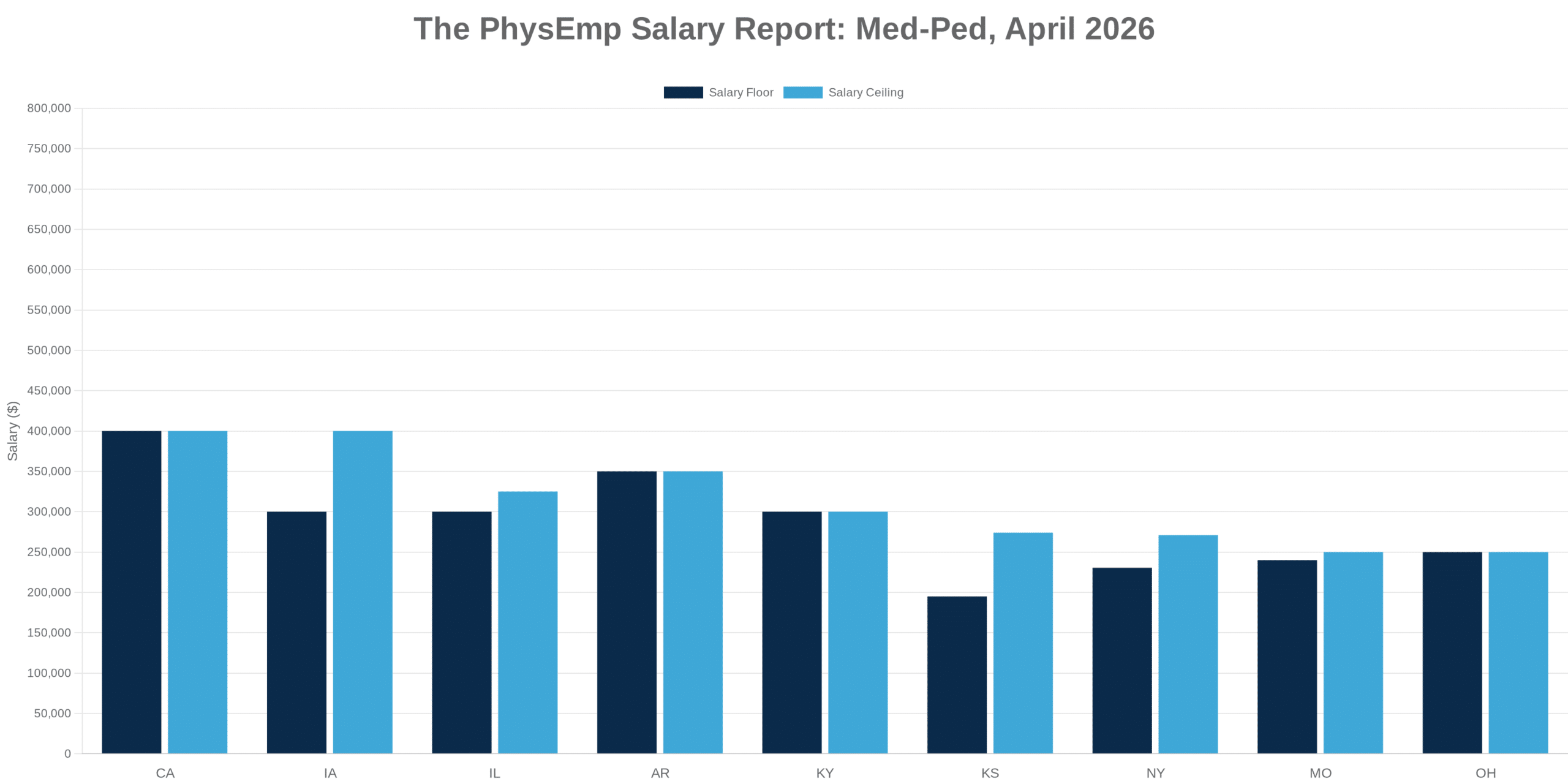
A physician trained in both internal medicine and pediatrics can earn $400,000 in California or $195,000 in Kansas. That is a $205,000 spread for the same dual-board skillset, and it tells you nearly everything you need to know about how geography rewrites compensation in this market. The national Med-Ped landscape includes 80 active listings across 27 states, with 18 positions disclosing salary figures. The data reveals a market that is geographically diverse, moderately transparent, and surprisingly bifurcated between high-paying outliers and volume-heavy states that either pay modestly or decline to disclose compensation altogether.
👉 Explore Med-Ped job market insights and trends
The Med-Ped Job Market at a Glance
Total listings: 80
Listings with salary data: 18
Full salary range: $195,000 to $400,000
National average range: $252,972 to $291,483
The Med-Ped market shows a $205,000 range between floor and ceiling, which is wide but not unusual for a specialty that serves both adult and pediatric populations across diverse practice settings. The national average sits comfortably in the mid-$200,000s to low-$290,000s, but this figure masks significant geographic variation. A handful of states push well into the $300,000s and even $400,000, while others remain anchored in the low-to-mid $200,000s. The 22.5% transparency rate (18 of 80 listings) means most positions require direct negotiation to surface compensation details, and the absence of data from high-volume states like Massachusetts complicates any effort to assess true market value.
States represented: Kansas, New York, Missouri, Illinois, Georgia, Tennessee, Massachusetts, California, North Carolina, Florida, Oregon, South Carolina, Wisconsin, Maryland, Virginia, Alabama, Michigan, New Hampshire, Indiana, West Virginia, Arizona, Minnesota, Kentucky, Iowa, Arkansas, New Jersey, and Ohio.
👉 Browse Med-Ped physician job opportunities
How States Stack Up
Overperformers
California leads the nation with a flat $400,000 salary (based on one disclosed listing out of eight total), placing it at the absolute top of the market. Arkansas offers $350,000 from a single disclosed listing, making it the second-highest-paying state despite contributing just one job to the national count. Iowa matches California’s ceiling with a range of $300,000 to $400,000, proving that low volume does not preclude high pay. Illinois delivers $300,000 to $325,000 from one disclosed listing, rounding out the top tier with a well-defined and competitive range. Kentucky posts a flat $300,000 from one disclosed listing, placing it at the threshold of the high-paying cohort.
Near-Average
Ohio reports $250,000 flat based on two disclosed listings out of three total, landing just below the national average floor. Missouri shows a range of $240,000 to $250,000 from one disclosed listing out of seven total, making it a middle-of-the-road option with decent volume but unremarkable pay.
Underperformers
Kansas anchors the bottom of the market with an average range of $195,000 to $274,000 across four disclosed listings (out of four total), starting nearly $58,000 below the national average low. New York, despite being the second-highest volume state with nine listings, trends toward the lower-to-middle range with an average of $230,583 to $270,950 across six disclosed salaries.
Volume leaders: Massachusetts (10 listings, zero disclosed salaries), New York (9 listings, 6 disclosed), California (8 listings, 1 disclosed), Missouri (7 listings, 1 disclosed), and Illinois, North Carolina, and Virginia (5 listings each). Massachusetts leads in volume but offers no salary transparency. New York combines high volume with below-average pay. California, by contrast, offers the highest disclosed salary in the nation despite ranking third in volume.
👉 Compare Med-Ped compensation and opportunities by region
What This Means If You’re a Physician
If your priority is maximum compensation: Target California, Arkansas, Iowa, and Illinois. The highest-paying listing in the dataset is located in California and offers $400,000 annually (matched by the upper end of an Iowa listing that ranges from $300,000 to $400,000). These states represent the financial ceiling of the Med-Ped market, and all four offer disclosed salaries above $300,000 despite modest listing counts. California’s $400,000 figure is particularly striking given the state’s high cost of living, though it remains unclear whether this reflects a single outlier or a broader trend within the state’s eight total listings.
If your priority is maximum optionality: Look to Massachusetts, New York, and Missouri. Massachusetts leads the nation with 10 listings but discloses no salary data, requiring physicians to engage directly with recruiters to assess compensation. New York offers 9 listings with partial transparency, though disclosed salaries trend toward the lower-to-middle range. Missouri contributes 7 listings with one disclosed salary, providing a moderate volume of opportunities at mid-range pay. None of these states will maximize your paycheck, but they will maximize your ability to compare offers and negotiate from a position of choice.
If your priority is balance: Consider Illinois, Kentucky, and Ohio. Illinois offers a well-defined range of $300,000 to $325,000 from one disclosed listing in Rockford, combining strong pay with a clear compensation structure. Kentucky posts $300,000 flat, and Ohio delivers $250,000 flat across two disclosed listings, both providing straightforward salary figures without the opacity that plagues higher-volume markets. These states offer a middle path between top-tier pay and geographic flexibility, though none provide the volume of opportunities found in Massachusetts or New York.
👉 Search Med-Ped jobs by location and compensation
What This Means If You’re a Recruiter
The Med-Ped market has a salary transparency rate of 22.5% (18 disclosed listings out of 80 total). This is low enough to create friction in the candidate pipeline, particularly for physicians who are comparing offers across multiple states and unwilling to invest time in exploratory conversations without a clear compensation baseline. Massachusetts exemplifies the risk: it leads the nation in volume with 10 listings but discloses zero salaries, forcing recruiters to rely entirely on institutional reputation, location appeal, or practice structure to generate candidate interest. That works in Boston. It works less well in markets without brand recognition or lifestyle draw.
New York presents a different challenge. It ranks second in volume with 9 listings and discloses 6 salaries, but those figures trend toward the lower-to-middle range ($230,583 to $270,950 on average). High volume and below-average pay is a tough combination, and recruiters in this market will need to lead with non-compensation differentiators such as academic affiliation, visa sponsorship, or patient population diversity. Missouri faces a similar dynamic, with 7 listings and only one disclosed salary in the $240,000 to $250,000 range.
The volume-pay misalignment is most visible when comparing Massachusetts and New York (high volume, low or missing pay data) to California, Arkansas, and Iowa (low volume, high disclosed pay). Candidates with geographic flexibility will gravitate toward the latter. Recruiters working in high-volume, low-transparency markets should expect longer time-to-fill and more aggressive counteroffers from competitors willing to disclose early.
👉 Post Med-Ped positions on PhysEmp
What’s Driving the Numbers
Dual training commands a premium, but not universally.
Med-Ped physicians bring dual board certification and the ability to care for patients across the lifespan, a skillset that theoretically justifies higher compensation. The data supports this in select markets. California, Arkansas, Iowa, and Illinois all offer salaries at or above $300,000, suggesting that some employers are willing to pay for the flexibility and scope that Med-Ped training provides. But the floor of $195,000 in Kansas and the clustering of disclosed salaries in the $230,000 to $270,000 range suggests that many employers treat Med-Ped physicians as interchangeable with general internists or pediatricians, rather than as a premium category. The result is a market where compensation depends less on training and more on geography, employer type, and individual negotiation.
Underserved markets do not consistently price in scarcity.
Kansas, with four disclosed listings and full salary transparency, represents one of the most data-rich slices of the Med-Ped market. It is also the lowest-paying state in the dataset, with salaries starting at $195,000. This is counterintuitive. Kansas is a rural state with well-documented physician shortages, and economic theory would predict that scarcity drives up wages. Instead, the data suggests that underserved markets may face budget constraints, lower reimbursement rates, or a reliance on loan repayment programs and visa sponsorship to attract talent rather than pure compensation. Arkansas, by contrast, offers $350,000 and demonstrates that some underserved markets do price in scarcity. The difference likely comes down to employer type (federally qualified health centers vs. private groups) and state-level funding for physician recruitment.
High-volume states are not high-pay states.
Massachusetts and New York combine for 19 listings (nearly one-quarter of the national total), but neither cracks the top tier of disclosed compensation. Massachusetts offers zero salary data, and New York trends toward the lower-to-middle range. This is a recurring pattern in physician labor markets: volume correlates with competition among employers, but not with higher wages. In fact, high-volume markets often attract physicians for non-compensation reasons (academic prestige, urban amenities, family ties), which reduces the need for employers to compete on salary. The inverse is also true. Low-volume states like California, Arkansas, and Iowa lead on pay, likely because they face thinner candidate pipelines and must use compensation to overcome geographic or lifestyle disadvantages.
The transparency gap creates a two-tier market.
Eighteen listings disclose salary. Sixty-two do not. This creates a bifurcated market in which physicians with disclosed offers can benchmark and negotiate with confidence, while those evaluating non-disclosed listings must rely on anecdote, rumor, and trust. The gap is not evenly distributed. Kansas discloses 100% of its salaries. Massachusetts discloses 0%. California discloses one out of eight. The result is a market in which some states (Kansas, New York, Ohio) provide clear pricing signals, while others (Massachusetts, North Carolina, Virginia) remain opaque. Physicians who prioritize transparency will self-select into the former. Physicians who tolerate ambiguity (or who have insider knowledge of specific employers) will consider the latter.
The Bottom Line
The Med-Ped job market is geographically broad, moderately active, and defined by a $205,000 salary spread that rewards physicians who research carefully and negotiate hard. High-volume states like Massachusetts and New York offer optionality but not top-tier pay, while low-volume states like California, Arkansas, and Iowa offer the highest disclosed salaries in the dataset. The 22.5% transparency rate means most positions require direct engagement to surface compensation details, and the absence of data from major markets complicates any effort to assess true national value. The market works for physicians who know what they want and where to find it.
There is a lot of money available for caring for humans from birth through old age, but you will need to choose your state carefully.
👉 Browse all Med-Ped physician jobs
👉 Upload your CV to get matched with opportunities
👉 Set alerts for new Med-Ped roles
Salary data based on 18 listings with disclosed compensation. Figures may reflect part-time or specialized roles. This report is informational and should not replace professional judgment or financial planning.