Pennsylvania is paying Internal Medicine physicians an average of $315,000 to $420,000 with only 28 job listings. New York, with 112 listings, is paying $225,724 to $271,299. The math is not mathing, and the market knows it. Across the United States, 1,523 active Internal Medicine job listings span 49 states and the District of Columbia, making this one of the most geographically distributed physician specialties tracked. The data reveals a market where volume and compensation move in opposite directions, where underserved markets pay premiums that major metros cannot match, and where a physician’s willingness to relocate may be worth six figures.
👉 Explore Internal Medicine job market insights and trends
The Internal Medicine Job Market at a Glance
Total listings: 1,523. Listings with salary data: 450. Full salary range: $125,000 to $600,000. Average salary range: $259,886 to $298,120.
The spread is wide, the floor is low, and the ceiling is aspirational. The $125,000 floor likely reflects part-time roles, academic positions, or listings that should not have been published without adult supervision. The $600,000 ceiling suggests leadership, ownership, or a practice in a location so remote that the compensation includes hazard pay for boredom. The average range sits comfortably in the mid-$200,000s to high-$200,000s, which is reasonable for a specialty that serves as the backbone of American outpatient medicine.
States represented: California, New York, Florida, Texas, Massachusetts, Connecticut, Georgia, Illinois, Pennsylvania, Tennessee, Virginia, North Carolina, South Carolina, Indiana, Alabama, Washington, Colorado, Missouri, New Jersey, Maryland, North Dakota, Nevada, New Mexico, Ohio, Wisconsin, Louisiana, Kentucky, Oregon, Montana, Minnesota, Vermont, Wyoming, Iowa, Oklahoma, Michigan, New Hampshire, Maine, South Dakota, Mississippi, Hawaii, West Virginia, Rhode Island, Kansas, Idaho, Utah, Arkansas, Nebraska, Alaska, and the District of Columbia. If you cannot find an Internal Medicine job, the problem is not geographic.
👉 Browse Internal Medicine physician job opportunities
How States Stack Up
Overperformers:
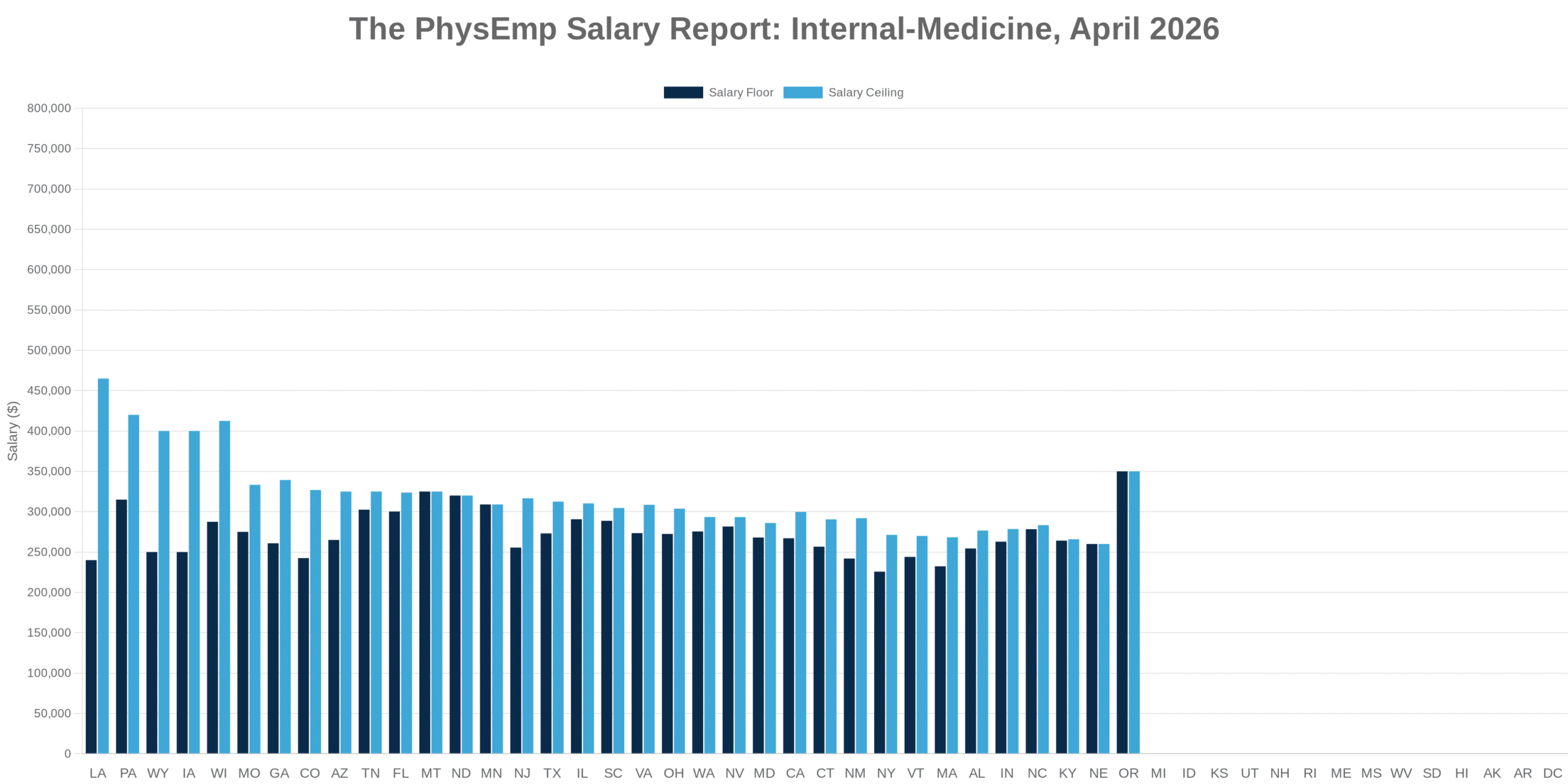
- Pennsylvania averages $315,000 to $420,000 across five salary listings, making it the most consistently lucrative market in the dataset.
- Wisconsin averages $287,500 to $412,500, with a top-end range that rivals Pennsylvania’s.
- Oregon reports a flat $350,000 on a single listing, which either represents the market or represents one very persuasive recruiter.
- North Dakota averages $320,000 flat across eight listings, offering rare reliability in a high-paying market.
- Montana averages $325,000 flat on two listings, rewarding physicians willing to work where the population density is measured in cattle per square mile.
- Tennessee averages $302,500 to $325,000, and Minnesota averages $309,000 flat, both offering strong compensation with more than one data point to back it up.
- Florida averages $300,231 to $323,692 across 13 listings, making it the rare high-volume state that also pays above the national average.
- Wyoming and Iowa each average $250,000 to $400,000, though both are based on a single listing and should be treated as interesting rather than reliable.
Near-average performers:
- Illinois averages $290,667 to $310,278 across 18 listings, making it a solid benchmark market with enough volume to trust the numbers.
- South Carolina averages $288,750 to $304,583 across 12 listings, offering near-average pay with meaningful job availability.
- Nevada averages $281,667 to $293,333 on three listings, and North Carolina averages $278,333 to $283,333 on 12 listings, both clustering tightly around the national midpoint.
- Washington averages $275,538 to $293,389 across nine listings, and Virginia averages $273,455 to $308,545 across 11 listings, both offering geographic diversity within the near-average band.
- Texas averages $273,124 to $312,500 on eight listings, which is fine but not exceptional for a state with 91 total postings.
- Ohio averages $272,500 to $303,750 on four listings, and Maryland averages $268,000 to $286,000 on five listings, both falling just slightly below the national average.
- California averages $267,107 to $299,751 across 101 salary listings, making it the most data-rich state in the survey and a near-average market with the highest total job volume.
- Arizona averages $265,000 to $325,000 on four listings, and Kentucky averages $264,167 to $265,833 on six listings, both hovering near the national average low.
- Indiana averages $262,857 to $278,571 on seven listings, and Georgia averages $260,900 to $339,333 on 12 listings, with Georgia showing a wider range that suggests variability in practice setting or scope.
Underperformers:
- Connecticut averages $256,663 to $290,493 across 45 salary listings, making it a high-volume state that pays slightly below the national average.
- New Jersey averages $255,583 to $316,617 on six listings, and Alabama averages $254,444 to $276,667 on nine listings, both falling below the national average low.
- Vermont averages $244,000 to $270,000 on two listings, and Colorado averages $242,571 to $326,857 on seven listings, with Colorado showing a wide range that does not compensate for a low floor.
- New Mexico averages $242,000 to $292,000 on three listings, and Louisiana averages $240,000 to $465,000 on five listings, with Louisiana’s high ceiling driven by outliers rather than consistency.
- Massachusetts averages $232,357 to $268,321 across 28 salary listings, paying below the national average despite being a major academic and healthcare hub.
- New York averages $225,724 to $271,299 across 87 salary listings, making it the second-highest volume state and one of the lowest-paying per listing.
- Oklahoma averages $140,000 to $160,000 on a single listing, which is either a part-time role or a cautionary tale.
Volume leaders:
California leads with 185 total listings, followed by New York with 112, Florida with 110, Connecticut with 98, Massachusetts with 91, and Texas with 91. Georgia contributes 70 listings, and North Carolina adds 67. High volume does not guarantee high pay. California and New York, the two largest markets, both pay near or slightly below the national average. Florida is the exception, offering both high volume and above-average compensation.
👉 Compare Internal Medicine compensation and opportunities by region
What This Means If You’re a Physician
If your priority is maximum compensation, look at Pennsylvania, Wisconsin, North Dakota, Montana, and Oregon. The highest-paying listing in the dataset is located in Crescent City, California, offering $312,000 to $375,000 annually (the $600,000 ceiling appears to be an outlier or a leadership role not tied to a specific listing). Pennsylvania’s $315,000 to $420,000 average is based on five listings, making it the most reliable high-pay market with multiple opportunities.
If your priority is maximum optionality, California offers 185 total listings with 101 salary disclosures, giving you the widest selection of employers, practice settings, and geographic regions within a single state. New York offers 112 listings, but the compensation is below average. Florida offers 110 listings and above-average pay, making it the best combination of volume and compensation.
If your priority is balance, consider Florida, Illinois, South Carolina, or Virginia. Florida pays $300,231 to $323,692 on average with 110 total listings. Illinois pays $290,667 to $310,278 with 46 total listings. Both offer strong compensation, meaningful job availability, and geographic diversity. South Carolina and Virginia offer similar profiles with slightly lower volumes but consistent pay.
Cost-of-living mismatches: New York and Massachusetts both pay below the national average despite having some of the highest costs of living in the country. Colorado and Vermont show similar misalignments. If you are considering these states, you are paying a lifestyle tax.
👉 Search Internal Medicine jobs by location and compensation
What This Means If You’re a Recruiter
Salary transparency rate: 29.5 percent (450 listings with salary data divided by 1,523 total listings). This is low, and it will cost you candidates. In a market this geographically distributed, physicians have options. If you are not disclosing salary, you are asking candidates to guess whether your opportunity is worth their time. In a specialty where the average range is $259,886 to $298,120 and the top markets are paying $315,000 to $420,000, that is a costly gamble.
Candidate pipeline implications: High-volume states like California, New York, and Connecticut are paying at or below the national average. Physicians in these markets are one LinkedIn message away from learning that Pennsylvania, North Dakota, or Florida will pay them $50,000 to $100,000 more. If you are recruiting in a high-volume, below-average-pay market, you will need to lead with non-compensation differentiators: academic affiliation, subspecialty support, research opportunities, or work-life balance. Compensation alone will not close the deal.
Volume-pay misalignments: New York has 112 listings and pays $225,724 to $271,299. Pennsylvania has 28 listings and pays $315,000 to $420,000. Connecticut has 98 listings and pays $256,663 to $290,493. Massachusetts has 91 listings and pays $232,357 to $268,321. These are not small gaps. If you are recruiting in a high-volume, low-pay state, expect longer time-to-fill and more candidate drop-off. You are competing with markets that have fewer jobs and better offers.
👉 Post Internal Medicine positions on PhysEmp
What’s Driving the Numbers
Underserved markets price in scarcity.
North Dakota, Montana, Wyoming, and Iowa all offer compensation that exceeds the national average, often by significant margins. North Dakota’s $320,000 flat average across eight listings is not an accident. It is the cost of convincing a physician to live in a state where winter lasts six months and the nearest major airport is a two-hour drive. Montana’s $325,000 flat average tells the same story. These markets do not have the luxury of brand recognition or lifestyle appeal, so they compete on salary. It works.
The volume-pay relationship is inverse.
The states with the most job listings are not the states with the highest pay. California, New York, Connecticut, and Massachusetts combine for 486 total listings and pay at or below the national average. Pennsylvania, North Dakota, and Montana combine for 52 total listings and pay well above it. This suggests that Internal Medicine physicians are not concentrating in the highest-paying markets, either because they are unaware of the pay differential or because they are prioritizing geography, family, or lifestyle over income. For recruiters, this creates an arbitrage opportunity. For physicians, it creates a decision point.
High-volume markets rely on non-compensation advantages.
New York and Massachusetts are paying below the national average and still attracting enough candidates to generate 112 and 91 listings, respectively. This suggests that these markets are competing on factors other than salary: academic prestige, subspecialty training, research infrastructure, or proximity to major population centers. These advantages are real, but they are not infinite. As salary transparency increases and physicians become more aware of geographic pay differentials, high-volume markets may need to narrow the gap or risk losing mid-career physicians to higher-paying regions.
Part-time roles and academic positions distort the floor.
The $125,000 floor is not representative of full-time Internal Medicine compensation. It likely reflects part-time clinical roles, academic positions with research or teaching responsibilities, or listings that bundled benefits into the total compensation figure in a way that understated base salary. The $600,000 ceiling is similarly non-representative, likely reflecting a leadership role, ownership stake, or a position with significant administrative or procedural scope. The true full-time employed Internal Medicine range is closer to $225,000 to $420,000, depending on geography and setting.
The Bottom Line
The Internal Medicine job market is geographically vast, numerically deep, and financially uneven. Physicians who prioritize location will find opportunities in nearly every state. Physicians who prioritize compensation will find that the highest-paying markets are not the most competitive, and the most competitive markets are not the highest-paying. The gap between Pennsylvania’s $315,000 average and New York’s $225,724 average is $89,276. That gap does not close because you like bagels.
There is work everywhere, but the money is not distributed equally.
👉 Browse all Internal Medicine physician jobs
👉 Upload your CV to get matched with opportunities
👉 Set alerts for new Internal Medicine roles
Salary data based on 450 listings with disclosed compensation. Figures may reflect part-time or specialized roles. This report is informational and should not replace professional judgment or financial planning.