A locum tenens physician in Olean, New York can earn $1,144,000 annually by ensuring cancer patients receive chemotherapy without losing hope or hair prematurely. Meanwhile, an academic counterpart in Valhalla starts at $285,000 for roughly the same skill set. The national Hematology Oncology market includes 331 active listings spanning 47 states, with salary data disclosed in just 73 postings. The data reveals a specialty where compensation varies wildly by geography, employment model, and willingness to work in places most people cannot locate on a map.
👉 Explore Hematology-Oncology job market insights and trends
The Hematology-Oncology Job Market at a Glance
Total listings: 331
Listings with salary data: 73
Full salary range: $250,000 to $1,144,000
Average salary range: $500,672 to $580,494
The floor of $250,000 reflects academic or part-time roles, likely in markets where prestige substitutes for compensation. The ceiling of $1,144,000 is driven entirely by locum tenens hourly rates annualized at 2,080 hours, which no human actually works but makes for excellent marketing. The average range sits comfortably in the mid-500s, a figure that reflects the majority of full-time employed positions. Most offers cluster between $400,000 and $600,000, a band wide enough to encompass both comfortable suburban private practice and mission-driven safety net health systems.
States represented: New York, California, North Carolina, Wisconsin, Florida, Ohio, Michigan, Texas, Illinois, Washington, Hawaii, Massachusetts, Connecticut, Colorado, Minnesota, Nevada, South Carolina, Missouri, Vermont, Kentucky, Oregon, Georgia, Pennsylvania, Wyoming, Montana, New Mexico, Indiana, Mississippi, Tennessee, Virginia, Alabama, Kansas, Oklahoma, Idaho, Iowa, Louisiana, North Dakota, Arizona, West Virginia, Alaska, Maine, New Hampshire, South Dakota, Arkansas, Rhode Island, New Jersey.
👉 Browse Hematology-Oncology physician job opportunities
How States Stack Up
Overperformers:
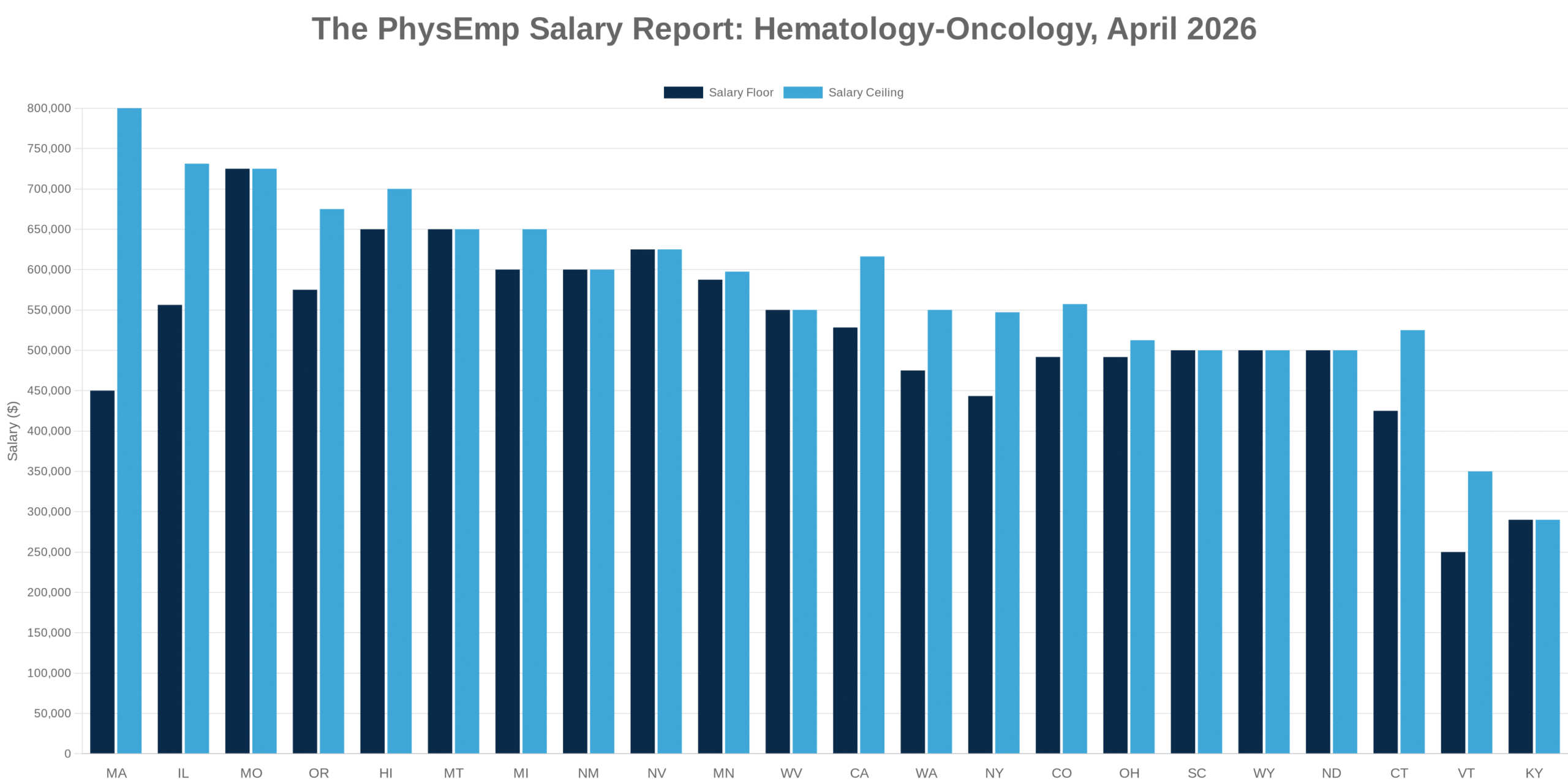
Missouri leads the nation with an average range of $725,000 to $725,000, a figure so consistent it suggests either exceptional market discipline or a very small sample size. Illinois follows at $556,250 to $731,250, offering both a respectable floor and meaningful upside for physicians willing to negotiate or take on leadership roles. Massachusetts averages $450,000 to $800,000, a range wide enough to fit both a Harvard fellowship and a community hospital directorship. Hawaii pays $650,000 to $700,000, which includes the cost of paradise but not the cost of shipping your belongings there. Michigan and Montana each average $600,000 to $650,000, proving that cold weather and physician shortages both command premiums. Nevada offers a flat $625,000, the kind of number that suggests a single high-paying employer dominates the market.
Near-average performers:
Ohio averages $491,667 to $512,500, a solidly predictable Midwestern figure. Colorado comes in at $491,750 to $557,250, where cost of living may quietly erode purchasing power. Washington averages $475,000 to $550,000, trailing its tech sector neighbors in compensation enthusiasm. South Carolina, Wyoming, and North Dakota each report $500,000, the platonic ideal of an average Hematology Oncology salary. West Virginia averages $550,000, a modest premium for serving an underserved population. Minnesota averages $587,500 to $597,500, offering stable pay in a stable market. California averages $528,304 to $616,304, a figure that looks generous until compared to the cost of housing. Oregon averages $575,000 to $675,000, a respectable range for a state with one major metro and a lot of trees. New Mexico averages $600,000, likely pricing in scarcity and the challenge of recruitment.
Underperformers:
Vermont averages $250,000 to $350,000, the lowest in the nation and a figure that suggests either part-time work or an academic role heavy on teaching and light on clinical revenue. Kentucky averages $290,000, a number that will not attract physicians with medical school debt exceeding their first home purchase. Connecticut averages $425,000 to $525,000, surprisingly low for a high-cost Northeastern state. New York, despite leading the nation with 39 listings, averages just $443,360 to $547,160, a reminder that volume does not equal value.
Volume leaders:
New York leads with 39 listings, followed by California with 22, North Carolina with 18, Wisconsin with 17, and Florida, Michigan, Ohio, and Washington each with 14. High volume does not correlate with high pay. New York’s 39 listings come with below-average compensation. Wisconsin’s 17 listings include zero salary disclosures, as do North Carolina’s 18 and Florida’s 14. Texas, Georgia, and Pennsylvania each contribute meaningful volume but no salary data, rendering them invisible to compensation-focused candidates.
👉 Compare Hematology-Oncology compensation and opportunities by region
What This Means If You’re a Physician
If your priority is maximum compensation: Target the Redding, California listing offering $770,000 to $870,000 annually, the highest permanent position in the dataset. Alternatively, pursue locum tenens work such as the Olean, New York role paying $550 per hour (approximately $1,144,000 annualized), though sustainability and benefits will require separate consideration.
If your priority is maximum optionality: Focus on New York (39 listings), California (22 listings), or North Carolina (18 listings). New York offers the most choices but pays below the national average. California combines volume with above-average pay. North Carolina offers strong volume but zero salary transparency, requiring aggressive negotiation or acceptance of uncertainty.
If your priority is balance: Consider Illinois, which combines a small but competitive job market (6 listings) with top-tier compensation averaging $556,250 to $731,250. Minnesota offers stability and above-average pay ($587,500 to $597,500) in a market with reasonable cost of living. Michigan provides both volume (14 listings) and strong compensation ($600,000 to $650,000), though salary data is limited to two disclosed positions. Avoid Vermont and Kentucky unless non-financial priorities dominate your decision-making.
👉 Search Hematology-Oncology jobs by location and compensation
What This Means If You’re a Recruiter
Salary transparency rate: 22.1% (73 listings with data divided by 331 total listings). This is a remarkably opaque market, one where nearly four out of five job postings expect candidates to engage without knowing whether the opportunity pays $250,000 or $725,000. For recruiters, this creates friction in the candidate pipeline, particularly among early-career physicians with debt or mid-career physicians with established compensation expectations. Listings without salary data must lead with other value propositions: geography, partnership track, research support, or lifestyle.
High-volume states with low or missing pay data face the steepest challenges. Wisconsin, North Carolina, and Florida each offer 14-plus listings but disclose zero salaries, forcing recruiters to sell on reputation, location, or organizational mission. New York’s high volume comes with below-average pay, requiring recruiters to emphasize proximity to urban centers, academic affiliation, or career development. Texas, Georgia, and Pennsylvania contribute 20 combined listings without a single disclosed salary, a strategy that may work for marquee institutions but will cost lesser-known employers qualified applicants.
Low-volume, high-pay states like Missouri and Illinois will attract disproportionate interest relative to their listing counts, creating competitive candidate environments. Recruiters in these markets should move quickly and emphasize total compensation, not just base salary.
👉 Post Hematology-Oncology positions on PhysEmp
What’s Driving the Numbers
Locum tenens roles distort the ceiling but reveal true scarcity pricing. The $1,144,000 annualized figure for the Olean, New York locums position reflects what health systems will pay when they cannot secure permanent coverage. Hourly rates of $550 are not sustainable as annual salaries, but they signal desperation in underserved or less desirable markets. Physicians with flexibility and tolerance for short-term assignments can extract significant premiums, though at the cost of benefits, stability, and long-term wealth-building through partnership or equity.
Academic and institutional employers compress the floor. The $250,000 Vermont listing and $290,000 Kentucky listing almost certainly reflect academic medical centers, where compensation is offset by teaching responsibilities, research time, or prestige. These roles appeal to a narrow band of physicians for whom career development and intellectual environment outweigh income maximization. For most physicians, these figures represent undervaluation, particularly in a specialty where private practice and hospital employment routinely offer double the compensation.
Underserved markets price in scarcity, but inconsistently. Missouri, Montana, and New Mexico all pay above-average salaries, likely reflecting rural or underserved geographies where recruitment is difficult. However, Vermont and Kentucky also serve underserved populations yet pay well below average, suggesting that state Medicaid reimbursement rates, health system financial health, or regional economic conditions override scarcity premiums. Physicians should not assume that underserved automatically means well-compensated.
Volume and pay decouple in saturated academic markets. New York’s 39 listings come with below-average pay, a dynamic driven by the concentration of academic medical centers, teaching hospitals, and residency programs that produce a steady supply of locally trained physicians willing to accept lower salaries for proximity to family, culture, or urban amenities. California bucks this trend slightly, combining high volume (22 listings) with above-average pay, though cost of living erodes much of the nominal advantage. Wisconsin and North Carolina offer volume without transparency, a red flag for compensation competitiveness.
The Bottom Line
The Hematology Oncology job market is geographically vast, compensatively inconsistent, and transparently challenged. Physicians willing to prioritize pay over location will find exceptional opportunities in Missouri, Illinois, and select California markets. Those prioritizing optionality must navigate New York’s volume with skepticism about compensation. Recruiters in high-volume, low-transparency states face an uphill battle unless they lead with non-financial value propositions.
There is a lot of money available for treating blood cancers, but you may have to move to Missouri to get it.
👉 Browse all Hematology-Oncology physician jobs
👉 Upload your CV to get matched with opportunities
👉 Set alerts for new Hematology-Oncology roles
Salary data based on 73 listings with disclosed compensation. Figures may reflect part-time or specialized roles. This report is informational and should not replace professional judgment or financial planning.