Michigan is offering $400,000 to manage diabetes and thyroid disorders. Ohio, meanwhile, has a position starting at $175,000. The spread between them is $225,000, which is more than the entire salary of some primary care roles. The Endocrinology job market consists of 135 listings spread across 35 states, with 34 positions disclosing compensation. The data reveals a market where geography matters far more than it should, and where silence on salary is the dominant strategy.
👉 Explore Endocrinology job market insights and trends
The Endocrinology Job Market at a Glance
The market includes 135 total listings, 34 of which disclosed salary data. Compensation ranges from $175,000 to $400,000, with the national average range landing at $260,830 to $290,529. That average is misleading. The floor is dragged down by a handful of inexplicably low offers, while the ceiling is propped up by Michigan’s willingness to pay what endocrinologists are actually worth. Most positions cluster between $240,000 and $325,000, a band wide enough to accommodate significant lifestyle differences but narrow enough to suggest some market consensus exists.
States with active listings include New York, Texas, California, Florida, Wisconsin, Massachusetts, Illinois, Ohio, Michigan, Maryland, Vermont, Colorado, Missouri, Connecticut, Tennessee, Arizona, New Jersey, Pennsylvania, North Carolina, Georgia, Indiana, Minnesota, South Carolina, New Mexico, West Virginia, Wyoming, Idaho, Maine, Alabama, Nebraska, New Hampshire, Arkansas, Kentucky, Virginia, and Washington.
👉 Browse Endocrinology physician job opportunities
How States Stack Up
Overperformers:
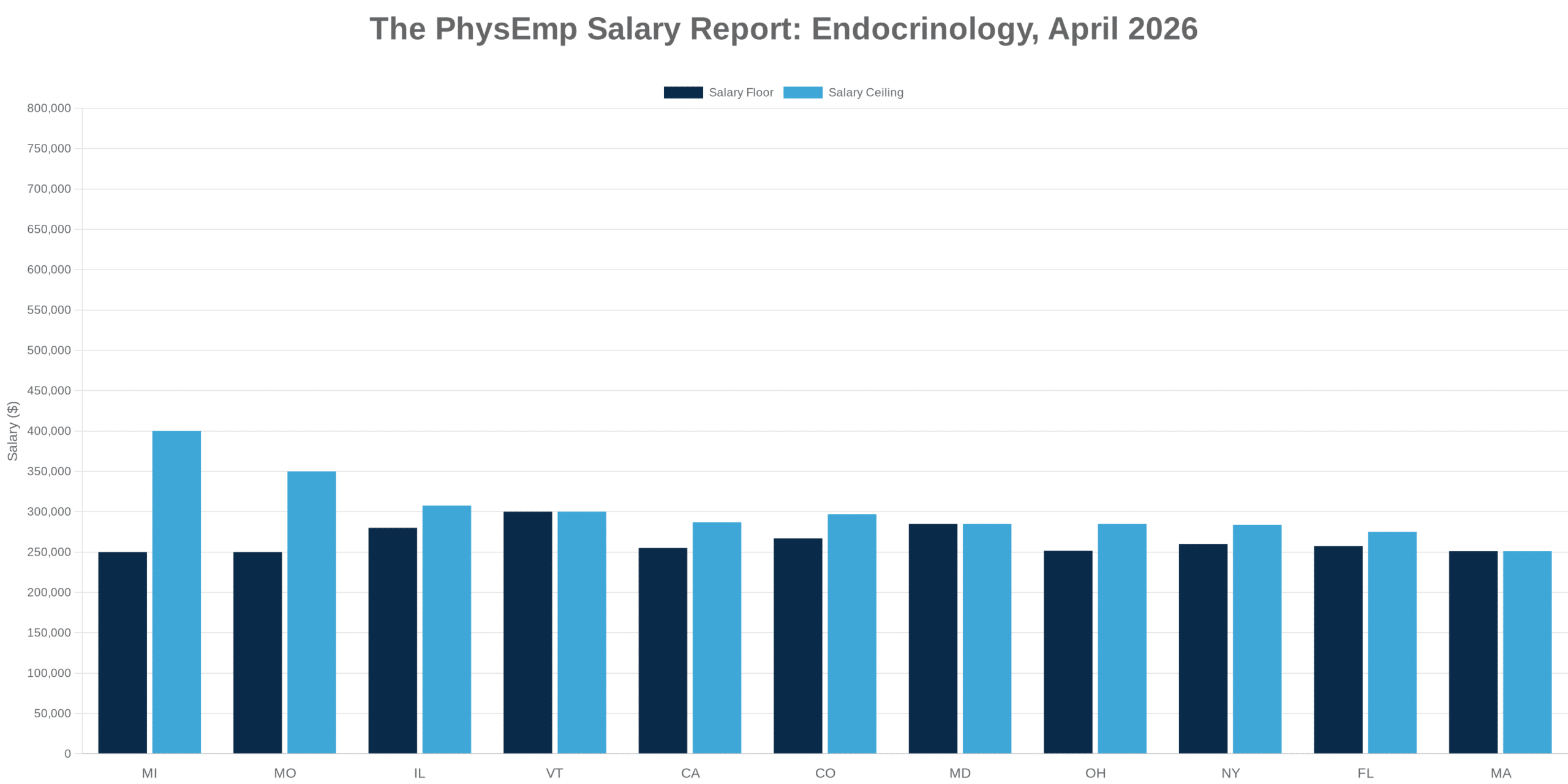
Michigan averages $250,000 to $400,000, a range so wide it suggests either exceptional flexibility or a single outlier listing that doubles as the state’s entire compensation strategy. Vermont offers a flat $300,000 on both ends, which is either admirably transparent or the result of a single data point being treated as gospel. Illinois averages $280,000 to $307,563, combining a high floor with a respectable ceiling. Maryland posts $285,000 on both ends, a steady if unexciting figure. Colorado averages $267,000 to $297,000, landing comfortably above the national mean.
Near-Average Performers:
New York averages $260,000 to $283,750, nearly identical to the national baseline and entirely predictable for a state with 30 listings. California averages $255,046 to $286,972, a range that reflects its usual posture of paying slightly less than its cost of living would suggest. Florida averages $257,500 to $275,000, a narrow band that offers little upside but also little risk. Missouri averages $250,000 to $350,000, a deceptively wide range built on a single listing.
Underperformers:
Massachusetts averages $251,000 on both ends, a figure that would be acceptable in most states but feels inadequate given Boston’s housing market. Ohio averages $251,667 to $285,000, a range that includes the national low and never quite recovers from it.
Volume Leaders:
New York leads with 30 listings, followed by Texas with 10, Massachusetts with 8, Florida and Wisconsin with 7 each, and California and Illinois with 5 each. Texas, despite ranking second in volume, disclosed zero salary figures. Wisconsin, tied for fourth, also reported none. New York’s dominance in volume does not translate to dominance in pay (it sits near the national average). Illinois is the rare high-volume state that also compensates above average.
👉 Compare Endocrinology compensation and opportunities by region
What This Means If You’re a Physician
If your priority is maximum compensation: the Michigan listing at $400,000 represents the top of the market. No city is specified, but the figure alone is sufficient to warrant a closer look. If your priority is maximum optionality: New York offers 30 listings with average compensation of $260,000 to $283,750. The volume provides leverage. The salary provides a living. If your priority is balance: Vermont’s $300,000 flat rate and Illinois’ $280,000 to $307,563 average offer strong compensation without the geographic or cultural compromises of the coasts.
The lowest-paying listing sits in Cleveland, Ohio, at $175,000 to $225,000. That is $75,000 below the national average floor and $175,000 below the Michigan ceiling. It is unclear what this role offers in exchange for that discount, but it would need to be significant.
👉 Search Endocrinology jobs by location and compensation
What This Means If You’re a Recruiter
The salary transparency rate is 25.2 percent (34 listings with data divided by 135 total listings). That means three out of four Endocrinology job postings are asking candidates to express interest without knowing what they will be paid. This is a functional strategy only in markets with severe candidate shortages, and even then it is barely functional.
The candidate pipeline implications are straightforward: physicians will apply to the listings that disclose competitive salaries first, and the silent listings will receive interest only after those options are exhausted. New York and California benefit from brand recognition and volume, which allows them to get away with near-average pay. Texas and Wisconsin, both high-volume states, disclosed no salary data and will need to lead with geography, lifestyle, or organizational reputation instead. Massachusetts has 8 listings and disclosed salary for only one of them, at $251,000. That is below the national average in a high-cost state. Recruiters there will need to sell something other than money.
👉 Post Endocrinology positions on PhysEmp
What’s Driving the Numbers
Scope and leadership do not appear to command a meaningful premium in this dataset. The $400,000 Michigan listing is an outlier, but there is no indication it involves administrative duties, research, or specialized procedural skills. It may simply reflect a rural or underserved placement where scarcity drives price. The $175,000 Ohio floor, conversely, may represent a part-time role, though no such designation is noted. If it is full-time, it is difficult to justify.
Part-time roles do not appear to distort the floor in any systematic way, though the lack of detail in the dataset makes this difficult to confirm. The $175,000 low is so far removed from the cluster that it warrants skepticism, but without additional context it must be taken at face value.
Underserved markets do appear to price in scarcity, at least in Michigan’s case. Vermont’s $300,000 figure may reflect a similar dynamic, though with only one listing it is impossible to say whether this is a trend or an anomaly. What is clear is that physicians willing to work in less competitive geographic markets can command a premium, assuming they can find the listings that disclose it.
The volume-pay relationship breaks decisively in this market. New York has the most listings and pays near the national average. Texas has the second-most listings and discloses no salary data. Illinois, with only 5 listings, pays better than both. The traditional assumption that high-volume markets pay more does not hold. In Endocrinology, volume signals demand, but it does not signal generosity.
The Bottom Line
The Endocrinology job market is geographically broad, moderately well-compensated, and frustratingly opaque. Physicians who prioritize salary transparency and maximum earnings should focus on Michigan, Illinois, and Vermont. Those who prioritize volume and optionality should focus on New York. Those who apply to the 101 listings without salary data should do so with modest expectations and a high tolerance for ambiguity.
There is a $225,000 gap between the lowest and highest offers in a specialty that treats the same diseases everywhere.
👉 Browse all Endocrinology physician jobs
👉 Upload your CV to get matched with opportunities
👉 Set alerts for new Endocrinology roles
Salary data based on 34 listings with disclosed compensation. Figures may reflect part-time or specialized roles. This report is informational and should not replace professional judgment or financial planning.