The national ceiling for Emergency Medicine compensation is $707,200 annually. The floor is $250,000. That is a $457,200 spread for doing the same job in different zip codes. The Emergency Medicine job market comprises 763 active listings spanning 48 states, with only 48 disclosing salary data. The data reveals a market defined by extreme geographic variance, robust demand, and a troubling opacity problem.
👉 Explore Emergency Medicine job market insights and trends
The Emergency Medicine Job Market at a Glance
Total listings: 763. Listings with salary data: 48. Full salary range: $250,000 to $707,200. Average salary range: $472,750 to $512,713.
This is a high-volume, high-variance market. The average range sits comfortably in the mid-six figures, but the extremes tell a more complicated story. A physician in Washington state earns 2.8 times what a peer in Pennsylvania might make (assuming the Pennsylvania figure is not an outlier, which it almost certainly is). The data skews toward the coasts and select Midwest markets, with Missouri, Illinois, and Ohio providing the rare trifecta of volume, transparency, and competitive pay.
States with active listings include: Texas, Florida, Tennessee, Ohio, South Carolina, Alabama, North Carolina, Indiana, Illinois, California, Pennsylvania, New Mexico, Georgia, Minnesota, Wisconsin, Kentucky, Missouri, New York, Hawaii, Washington, Oklahoma, Arizona, Kansas, Massachusetts, South Dakota, Virginia, Louisiana, Iowa, Arkansas, North Dakota, Oregon, Vermont, New Jersey, Maine, New Hampshire, Nebraska, Nevada, Rhode Island, West Virginia, Michigan, Colorado, Idaho, Wyoming, Montana, Maryland, Alaska, Delaware, and Mississippi.
👉 Browse Emergency Medicine physician job opportunities
How States Stack Up
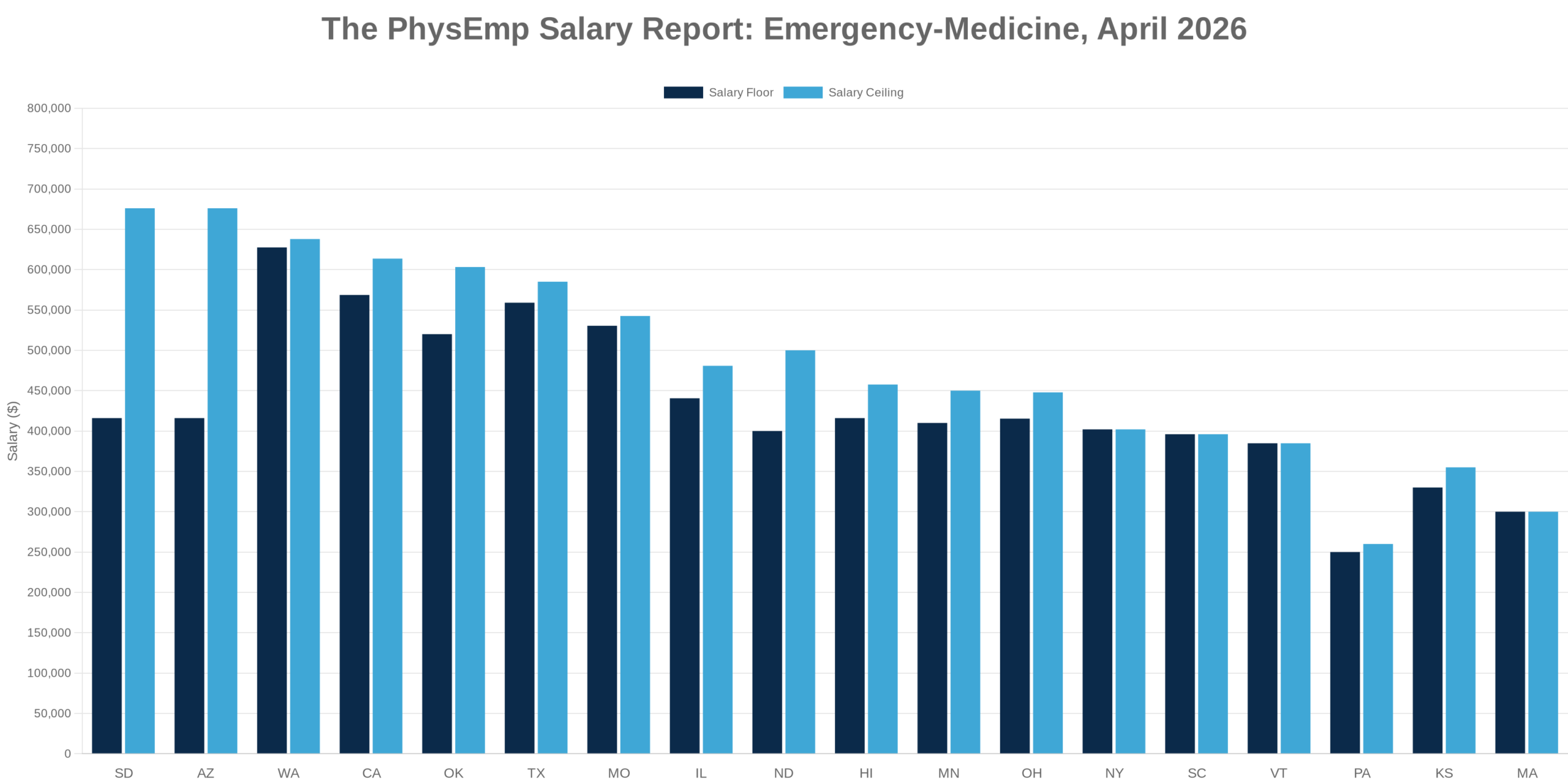
Overperformers: Washington leads the nation at $627,467 to $637,867 across three listings, proving the Pacific Northwest pays a premium for emergency stabilization. California follows at $568,567 to $613,633 with six listings, combining high pay and meaningful volume. Texas delivers $559,000 to $585,000 across four listings and leads all states in total job count (62), making it the rare market where supply meets compensation. Missouri posts $530,400 to $542,533 across six listings, a quiet Midwest powerhouse. Oklahoma offers $520,000 to $603,200 on a single listing, so tread carefully but optimistically.
Near-average: Illinois reports $440,583 to $480,787 across twelve listings, the most data-rich state in the analysis and a reliable benchmark. Ohio sits at $415,333 to $447,867 with three listings and 37 total postings, offering volume but modest pay. Minnesota delivers $410,000 to $450,000 across two listings. North Dakota ranges from $400,000 to $500,000 on one listing, with upside potential for the geographically flexible. New York posts $402,000 on a single listing, underwhelming for a high-cost-of-living state.
Underperformers: Pennsylvania reports $250,000 to $260,000 on one listing, a figure so low it demands skepticism or an explanation involving part-time work and limited scope. Massachusetts offers $300,000 on one listing, a number that does not survive contact with Boston rent. Kansas shows $330,000 to $355,000, and Vermont posts $384,800, both well below the national average. South Carolina averages $396,000 across two listings despite ranking fifth in total volume (35 listings), a troubling mismatch.
Volume leaders: Texas (62 listings, high pay), Florida (53 listings, no salary data), Tennessee (45 listings, no salary data), Ohio (37 listings, near-average pay), South Carolina (35 listings, below-average pay), Indiana (31 listings, no salary data), Alabama and North Carolina (30 each, no salary data). Florida and Tennessee lead in volume but offer no compensation transparency, forcing candidates to negotiate blind.
👉 Compare Emergency Medicine compensation and opportunities by region
What This Means If You’re a Physician
If your priority is maximum compensation: Washington, California, and Texas are the clear targets. The highest disclosed salary in the dataset is $707,200 (location unspecified but anchoring the national average high). Washington’s $627,467 to $637,867 range is the most reliable top-tier figure with multiple listings. California’s $568,567 to $613,633 offers similar upside with more geographic diversity. Avoid Pennsylvania, Massachusetts, and Kansas unless the lifestyle trade-off is worth a six-figure pay cut.
If your priority is maximum optionality: Texas offers 62 listings at above-average pay ($559,000 to $585,000), the best combination of volume and compensation in the country. Florida (53 listings) and Tennessee (45 listings) provide geographic options but no salary transparency, requiring aggressive due diligence. Ohio (37 listings) and South Carolina (35 listings) offer volume but near-average or below-average pay.
If your priority is balance: Illinois delivers $440,583 to $480,787 across twelve listings, the most transparent near-average market. Missouri offers $530,400 to $542,533 with six listings and lower cost of living than coastal alternatives. North Dakota’s $400,000 to $500,000 range provides upside in an underserved market, though the sample size is limited. Physicians should flag the cost-of-living mismatch in New York ($402,000) and the compensation gap in South Carolina (high volume, low pay).
👉 Search Emergency Medicine jobs by location and compensation
What This Means If You’re a Recruiter
The salary transparency rate is 6.3% (48 listings with salary data divided by 763 total listings). This is a crisis of information asymmetry. Candidates are flying blind in 94% of the market, and recruiters in non-disclosing states are fighting an uphill battle against Washington, California, and Texas, all of which lead with numbers.
The candidate pipeline will consolidate around the transparent, high-paying markets. Texas, California, and Missouri are advertising both opportunity and compensation. Florida, Tennessee, and Indiana are advertising only opportunity, which is a losing strategy when competing for the same talent pool. South Carolina’s volume-pay misalignment (35 listings, $396,000 average) suggests either a cost-of-living advantage that is not being communicated or a structural undervaluation of emergency physicians in the region.
Recruiters in low-transparency, high-volume states will need to lead with lifestyle, geography, practice model, and cost of living. Pennsylvania, Massachusetts, and Kansas will need to explain their below-average figures or risk being dismissed outright. New York’s $402,000 average does not clear the credibility threshold for a high-cost state and will require significant non-monetary value propositions.
👉 Post Emergency Medicine positions on PhysEmp
What’s Driving the Numbers
Emergency Medicine does not command a scope or leadership premium in any consistent way. The highest-paying markets (Washington, California, Texas) do not appear to correlate with academic centers, trauma designations, or leadership roles based on available data. Compensation appears driven by regional supply-demand imbalances and cost of living, not scope differentiation. This is a shift-work specialty, and the market prices it as such.
Part-time and hourly roles distort the floor but not the average. Several listings reference $200/hour rates, which annualize to $416,000 at 2,080 hours per year. These figures appear in Missouri and Hawaii and sit below the national average, suggesting they represent part-time, PRN, or locum arrangements. The $250,000 Pennsylvania figure almost certainly reflects part-time work. The average range of $472,750 to $512,713 is more reliable than the extremes.
Underserved markets do not consistently price in scarcity. Vermont ($384,800), Kansas ($330,000 to $355,000), and South Dakota ($416,000 to $676,000, with a suspiciously wide range) are rural or underserved but do not break into the top tier of compensation. Meanwhile, Missouri ($530,400 to $542,533) and Oklahoma ($520,000 to $603,200) do, suggesting that scarcity premiums are inconsistent and may depend on state-level reimbursement structures or health system consolidation.
The volume-pay relationship breaks in predictable and frustrating ways. Texas is the exception: high volume (62 listings), high pay ($559,000 to $585,000). Florida (53 listings) and Tennessee (45 listings) offer volume but no transparency. South Carolina (35 listings) offers volume and below-average pay ($396,000). The inverse is also true: Washington (16 listings) and Missouri (19 listings) offer lower volume but top-tier compensation. Physicians chasing both volume and pay should focus on Texas. Everyone else is making a trade-off.
The Bottom Line
The Emergency Medicine job market is geographically vast, financially opaque, and defined by a small number of transparent, high-paying outliers. Texas is the only state that offers both robust opportunity and above-average compensation with disclosed salary data. Washington and California pay more but offer fewer opportunities. The remaining 94% of the market requires candidates to negotiate without information, and recruiters to sell without their strongest tool.
Emergency Medicine pays well for making high-stakes decisions under time pressure. The job market, ironically, requires the same skill set.
👉 Browse all Emergency Medicine physician jobs
👉 Upload your CV to get matched with opportunities
👉 Set alerts for new Emergency Medicine roles
Salary data based on 48 listings with disclosed compensation. Figures may reflect part-time or specialized roles. This report is informational and should not replace professional judgment or financial planning.