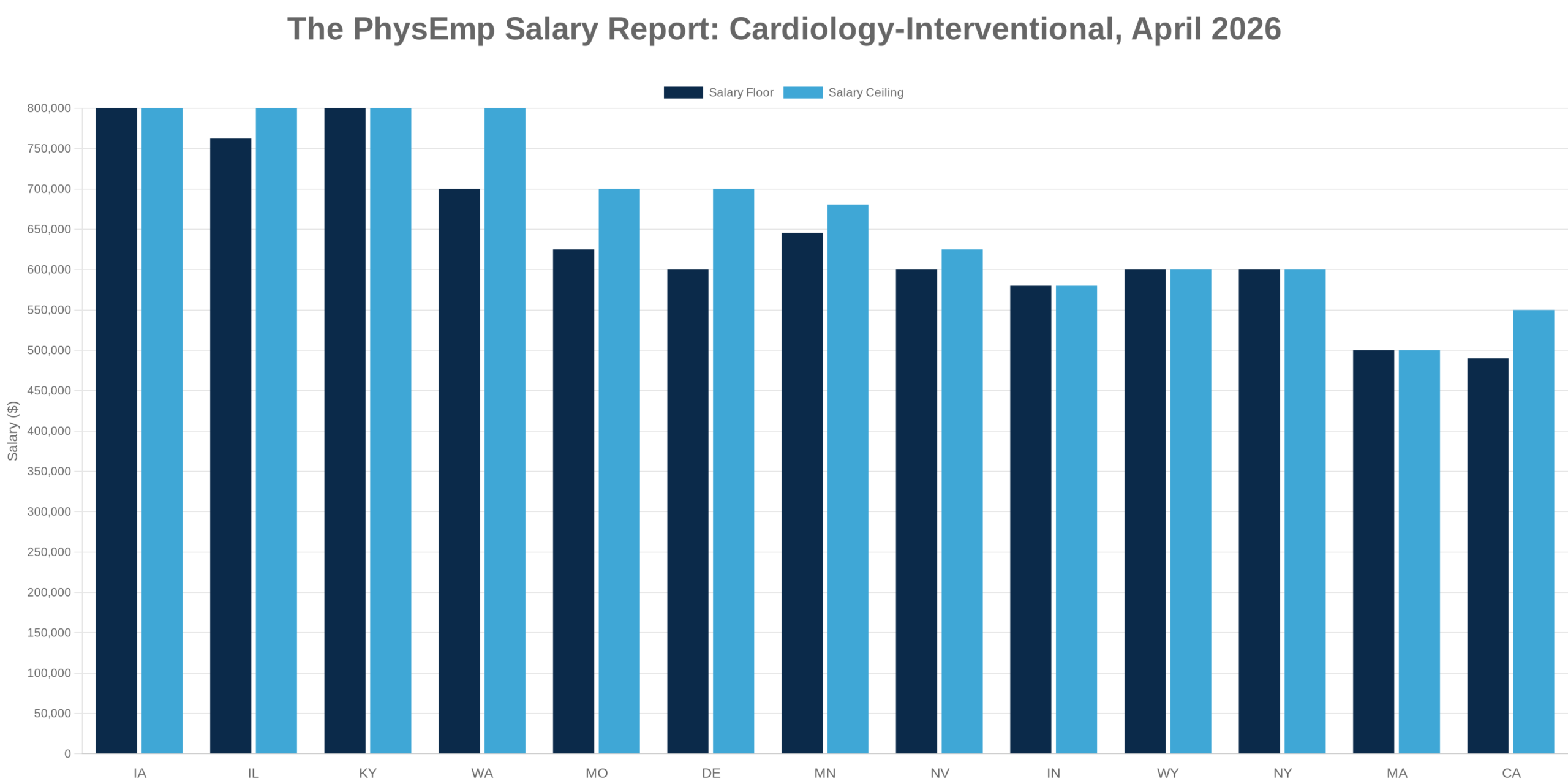
Iowa is paying interventional cardiologists $875,000 on average. California is paying $490,000 to $550,000. Both states have a coastline problem, though only one is geographic. The national job market for Cardiology Interventional physicians currently includes 177 active listings spread across 41 states, with salary data disclosed in just 20 of them. The data reveals a market where geography dictates compensation far more than volume, and where the willingness to leave major metros can be worth a third of a million dollars annually.
👉 Explore Cardiology-Interventional job market insights and trends
The Cardiology-Interventional Job Market at a Glance
Total listings: 177
Listings with salary data: 20
National salary range: $455,000 to $990,000
National average range: $663,810 to $714,060
The half-million-dollar spread between floor and ceiling tells the story of a specialty where scarcity pricing dominates. Most positions cluster between $500,000 and $700,000, but outliers on both ends stretch the distribution wide. The top quartile breaks $800,000, driven largely by Midwestern and smaller-market premiums. The bottom quartile dips below $550,000, anchored by coastal metros where prestige apparently substitutes for $200,000 in annual income.
The 20 listings with disclosed compensation span 14 states, offering a representative (if incomplete) view of the market. The remaining 157 listings operate in the dark, a transparency gap that reshapes how this market functions.
States with active listings: Alabama, Alaska, Arizona, Arkansas, California, Connecticut, Delaware, Florida, Georgia, Idaho, Illinois, Indiana, Iowa, Kansas, Kentucky, Louisiana, Maryland, Massachusetts, Michigan, Minnesota, Mississippi, Missouri, Montana, New Mexico, Nevada, New York, North Carolina, North Dakota, Ohio, Oklahoma, Oregon, Pennsylvania, South Carolina, South Dakota, Tennessee, Texas, Utah, Virginia, Washington, Wisconsin, Wyoming.
👉 Browse Cardiology-Interventional physician job opportunities
How States Stack Up
Overperformers: Iowa leads nationally at $875,000 (1 listing), a figure that reflects what happens when demand meets limited supply in a low-density market. Kentucky follows at $825,000 flat (2 listings), paying a premium that rivals or exceeds most coastal academic centers without the cost structure to match. Illinois averages $762,500 to $872,500 (4 listings), with the high end driven by Sterling’s $990,000 cap—small-town scarcity pricing at its finest. Washington rounds out the top tier at $700,000 to $800,000 (1 listing), the only West Coast state to crack the high-compensation club.
Near-average: Missouri sits at $625,000 to $700,000 (2 listings), a textbook benchmark market that also happens to lead the nation in job volume. Minnesota offers $645,596 to $680,596 (2 listings), a narrow band that suggests pricing discipline or limited variation in practice models. Delaware posts $600,000 to $700,000 (1 listing), Nevada comes in at $600,000 to $625,000 (1 listing), New York offers $600,000 flat (1 listing), and Wyoming matches at $600,000 flat (1 listing)—all hovering near the national midpoint without drama.
Underperformers: California averages $490,000 to $550,000 (2 listings), paying roughly $200,000 below the national average low despite housing costs that would suggest the opposite. Massachusetts offers a flat $500,000 (1 listing), nearly $164,000 below the national average floor, a discount that even Ivy League proximity cannot justify. Indiana sits at $580,000 flat (1 listing), underperforming the national average by over $80,000 without the coastal cachet to explain it away.
Volume leaders: Texas and Missouri tie for first with 12 listings each, followed by Florida and Wisconsin with 10 apiece, Georgia and Arizona with 9 each, and Pennsylvania and Illinois with 8 each. Texas, Florida, Georgia, Arizona, Pennsylvania, and Wisconsin—six of the eight highest-volume states—published zero salary data, a transparency failure that forces candidates to negotiate blind. Missouri bucks the trend, combining high volume with disclosed compensation near the national average. Illinois does the same, but pays well above it.
👉 Compare Cardiology-Interventional compensation and opportunities by region
What This Means If You’re a Physician
If your priority is maximum compensation: Target Iowa, Kentucky, Illinois, and Washington, where averages exceed $700,000 and top-end listings approach $990,000. The highest-paying listing in the dataset is located in Sterling, Illinois, offering $800,000 to $990,000 annually for an Interventional Cardiology role. Sterling is a city of roughly 15,000 people, which means the premium is real and the cost of living is not. If you can tolerate a smaller market, the financial upside is immediate and substantial.
If your priority is maximum optionality: Focus on Texas (12 listings), Missouri (12 listings), Florida (10 listings), and Wisconsin (10 listings), where job volume is highest. Missouri and Illinois are the only high-volume states with disclosed salary data, and both pay competitively. The rest require more legwork, but the sheer number of openings increases your leverage and the likelihood of finding the right fit.
If your priority is balance: Missouri and Illinois offer the rare combination of high job volume, transparent compensation, and pay that meets or exceeds the national average. Minnesota provides a predictable salary band close to the national midpoint with a strong quality-of-life reputation. Avoid California and Massachusetts unless non-financial factors dominate your calculus—both states pay $150,000+ below the national average, and neither offers a cost-of-living advantage to justify the gap.
👉 Search Cardiology-Interventional jobs by location and compensation
What This Means If You’re a Recruiter
The salary transparency rate is 11.3% (20 listings with disclosed data divided by 177 total listings). That is not a typo. Nearly 90% of the market operates without published compensation, which means candidates are either negotiating blind or filtering you out before the first conversation. In a specialty this lucrative and this competitive, that is a pipeline problem.
For high-volume states without salary data—Texas, Florida, Pennsylvania, Wisconsin, Georgia, Arizona—you will need to lead with something other than pay: leadership opportunities, procedural volume, partnership track, or lifestyle. If compensation is competitive, say so early. If it is not, prepare to explain why a physician should take $490,000 in Sacramento when Sterling, Illinois is offering $990,000.
The volume-pay relationship is broken. Missouri has 12 listings and pays near the national average. Illinois has 8 listings and pays well above it. Texas has 12 listings and discloses nothing. Florida has 10 and does the same. High supply does not suppress wages here; it just correlates with silence. That silence has a cost, and it shows up in your time-to-fill.
👉 Post Cardiology-Interventional positions on PhysEmp
What’s Driving the Numbers
Premium pricing in underserved markets is the dominant force shaping this data. Iowa, Kentucky, and Sterling, Illinois are not paying $825,000 to $990,000 because of procedural complexity or academic prestige. They are paying it because interventional cardiologists have options, and convincing one to move to a smaller market requires a significant financial incentive. Scarcity is expensive, and rural and exurban health systems are pricing that in.
Coastal metros are underpricing relative to cost of living, and the gap is glaring. California and Massachusetts pay $490,000 to $550,000 and $500,000 respectively, figures that would be competitive in Missouri or Kentucky but border on punitive in San Francisco or Boston. The implicit assumption—that prestige, weather, or proximity to elite institutions justifies a $200,000 discount—may not hold in a market where Midwestern systems are offering near-million-dollar packages. Physicians are doing the math.
High job volume does not correlate with high pay, but it does correlate with opacity. The eight highest-volume states account for 78 listings, but only Missouri and Illinois disclose salary data. The rest are either avoiding transparency for competitive reasons or assuming that volume alone will drive applications. Neither strategy serves the candidate well, and both extend the recruitment cycle.
Salary transparency is a competitive advantage, not a liability. The 14 states that published compensation data are giving candidates the information they need to prioritize geography, negotiate effectively, and move quickly. The 27 states that did not are forcing candidates to guess, wait, or walk. In a market where the top listing pays more than double the bottom, that guessing game has consequences.
The Bottom Line
The interventional cardiology job market is geographically vast, financially polarized, and selectively transparent. Physicians willing to consider non-coastal and smaller markets can access compensation that exceeds major metro offers by $300,000 or more, while those anchored to traditional prestige markets will pay for that preference in annual income. The volume of opportunity is high, but the clarity of compensation is not, and that gap defines how this market operates.
There is a lot of money available for opening arteries, but where you open them matters more than almost anything else.
👉 Browse all Cardiology-Interventional physician jobs
👉 Upload your CV to get matched with opportunities
👉 Set alerts for new Cardiology-Interventional roles
Salary data based on 20 listings with disclosed compensation. Figures may reflect part-time or specialized roles. This report is informational and should not replace professional judgment or financial planning.