Why this theme matters now
AI in healthcare has spent much of the past decade in pilots: niche models tested in controlled settings, promising results in papers, and cautious rollouts in a handful of departments. That phase is ending. Organizations are increasingly demanding reproducible benefit, transparent decision-making, and systems that integrate into complex clinical workflows. This transition marks a new phase in AI in healthcare adoption, shifting the conversation from possibility to measurable performance.
From hypothesis to measurable outcomes
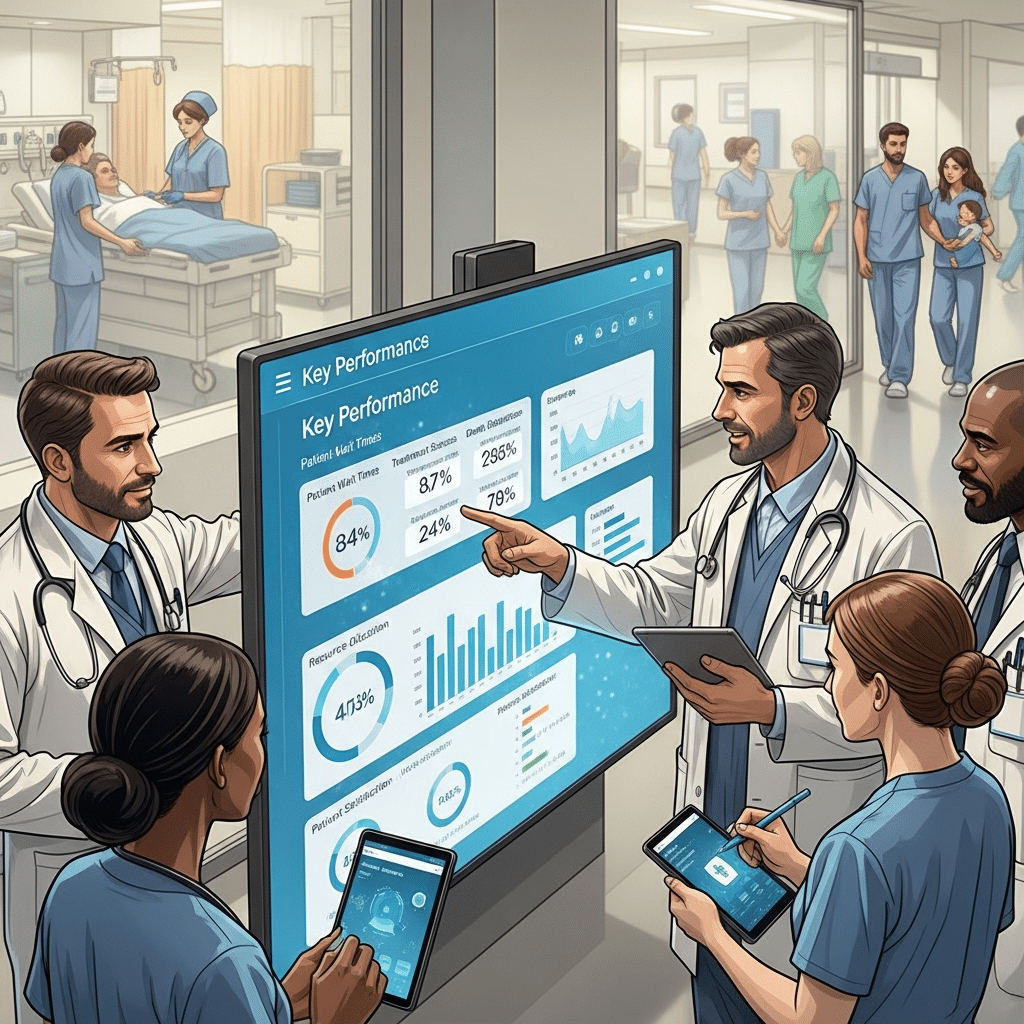
Early pilots emphasized feasibility: can an algorithm identify a pattern or make a prediction? The next stage requires evidence that AI materially improves care. Health systems now require outcome-level metrics—reduced diagnostic delays, measurable improvements in care pathways, fewer unnecessary tests, or demonstrable time savings for clinicians. Procurement decisions are increasingly tied to these operational KPIs rather than model accuracy reported on held-out datasets.
What changes when results must be reproducible?
Reproducibility compels new infrastructure: robust data pipelines, monitoring to detect model drift, and controlled A/B or stepped-wedge deployments that isolate algorithm effects from other quality initiatives. Product teams must instrument models with real-world performance dashboards and connect them to clinical outcomes rather than surrogate endpoints. That elevates roles such as ML reliability engineers, clinical informaticists, and implementation scientists in health systems.
Call Out: Real-world proof pivots investments from R&D experiments to operational engineering—teams that can run controlled deployments, track outcome KPIs, and iterate on models in production will determine which AI efforts scale.
Accountability: auditability, explainability, and governance
Maturity brings scrutiny. Providers, payers, and regulators expect not only that models work, but that they can be inspected, explained, and audited. Accountability implications span technical, legal, and clinical domains: provenance of training data, fairness assessments across subgroups, and traceable decision logs for care actions influenced by AI. Institutions must define who signs off when a model recommends changes to diagnosis or treatment paths.
Operational governance
Governance programs now include multidisciplinary review boards, continuous monitoring for bias or safety signals, and escalation processes when model behavior diverges from expectations. This requires both human oversight (clinicians able to evaluate AI output) and tooling (explainability techniques, versioned model registries, and automated risk-detection). The shift elevates compliance and oversight roles and demands that vendors provide transparent performance data under operational conditions.
Scaling: embedding AI into workflows and the workforce impact
Scaling involves more than technology; it is a socio-technical challenge. Successful implementations tailor AI outputs to clinician workflows, reduce cognitive burden, and fit within existing EHR interactions. That requires implementation science—usability testing, change management, and measurable clinician acceptance. Organizations that treat AI as a clinical service rather than a point tool create support structures: training programs, on-call data science support, and feedback loops between frontline users and model owners.
Call Out: Scaling AI demands cross-functional teams that combine clinical domain knowledge, product engineering, and operational leadership—hiring strategies must prioritize people who can translate clinical needs into production-grade ML systems.
Comparative lessons from leaders
Industry leaders show common patterns: start with clinically important problems that have clear outcome measures; instrument deployments for continuous evaluation; and invest early in governance. Where pilots failed to scale, the barriers were often non-technical: insufficient integration with clinician workflow, lack of clear accountability, or absence of sustained operational funding. Where AI has delivered value at scale, organizations treated models as part of the care delivery infrastructure, not as stand-alone research artifacts.
Implications for healthcare organizations and recruiting
For health systems, the shift from pilot to proof reframes procurement and hiring. Procurement teams need contract terms that require real-world performance data and support for explainability and auditing. Recruiting must prioritize hybrid profiles—people who straddle clinical knowledge and production engineering. Roles in demand will include clinical ML engineers, reliability engineers familiar with healthcare data governance, and implementation specialists who can operationalize AI within care teams.
For vendors and startups, the bar is higher. Buyers will favor solutions with documented production performance, robust monitoring capabilities, and clear governance frameworks. Startups should demonstrate operational playbooks and provide transparent evidence of safety, fairness, and outcome impact in diverse settings to clear the transition to mainstream adoption.
Conclusion: practical next steps
AI in healthcare is no longer just an innovation pipeline item; it is becoming part of routine clinical operations. Systems that want to move from promising pilots to proven, accountable deployments should: (1) define outcome-based KPIs tied to patient care, (2) invest in monitoring and governance from day one, and (3) hire cross-functional teams that can translate clinical problems into resilient production systems. These practical shifts determine whether AI will reshape care delivery sustainably and equitably.
Sources
AI Moves From Pilot To Proof In Healthcare – Forbes
AI in healthcare is entering a new era of accountability – Fast Company
Robert Wachter: AI Is Already Remaking Healthcare – Yale SOM Health Veritas