
Why this matters now
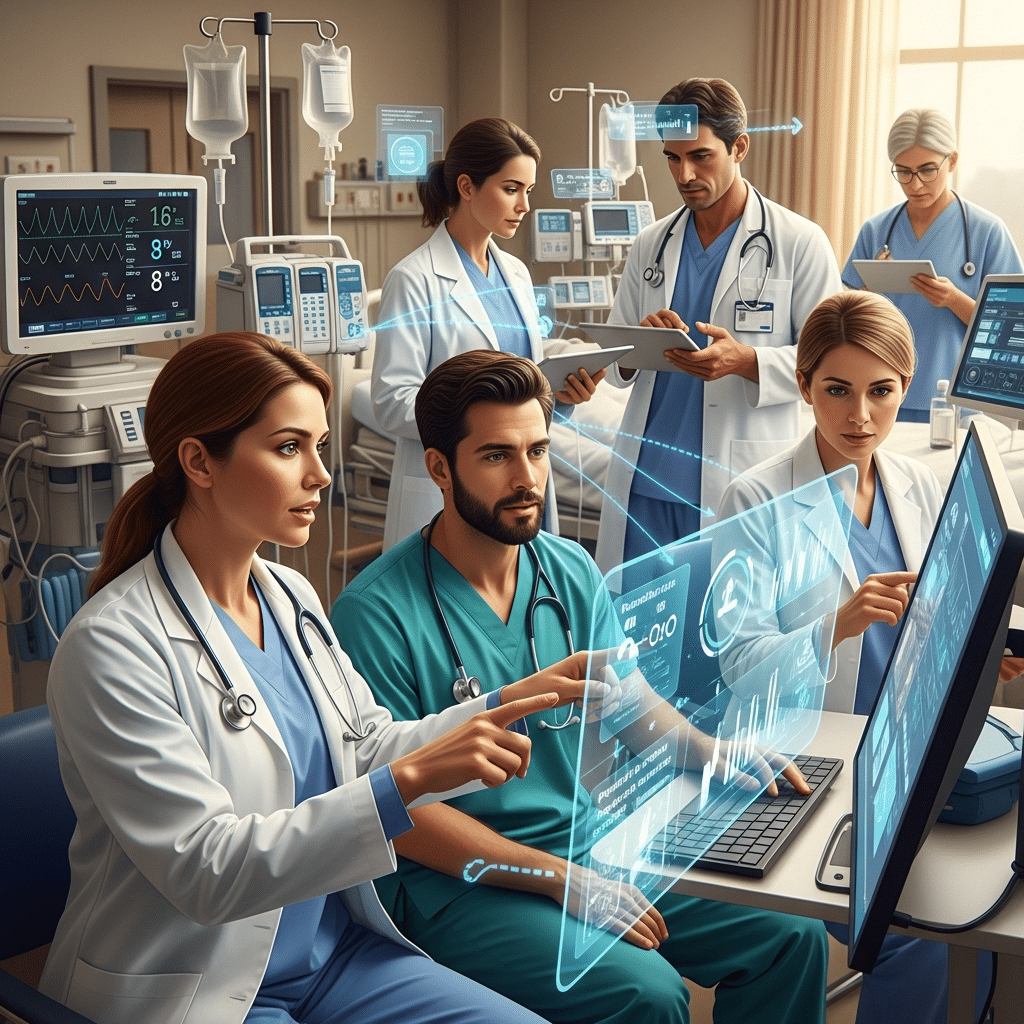
Major health systems are actively moving from isolated AI pilots to embedded algorithmic tools that operate inside clinician workflows. This transition matters because it shifts AI from an experimental add-on to an operational capability that shapes everyday decisions at the bedside and in the clinic. At the center of this evolution is the AI in healthcare pillar: technologies that connect clinical data, analytic inference, and care processes to reduce uncertainty and accelerate intervention.
For leaders in hospitals and health systems, and for clinical staffing teams, these deployments are not just technology projects — they demand redesign of roles, governance, and training. To illustrate what that entails, this post compares how systems are applying AI for continuous physiologic monitoring, procedural risk prediction, and broad decision-support integration, and draws practical implications for operations and recruiting.
Real-time neurologic monitoring: converting streams into actionable signals
Continuous physiologic monitoring generates dense, high-frequency data that no clinician can review exhaustively. AI excels at detecting temporal patterns in these streams and can surface events that warrant immediate attention. The practical value depends on more than algorithm performance; it hinges on how outputs are presented, routed, and escalated within clinical teams.
Operationally, real-time monitoring tools must balance sensitivity and specificity to avoid alarm fatigue while preserving safety. That requires rigorous threshold setting, contextual filters (e.g., patient state or concurrent medications), and clear escalation protocols that define who receives alerts and what interventions follow. Technical integration with EHRs, telemetry platforms, and unit-level dashboards is necessary but insufficient without accompanying workflow redesign and training.
Call Out: Fast inference is only valuable when paired with triage rules and defined clinician responses; otherwise, high-sensitivity algorithms risk creating noise rather than improving outcomes.
Predictive risk: making perioperative and post-transplant care anticipatory
Predictive models that estimate patient-specific complication risk change the temporal frame of care from reactive to anticipatory. For scheduled procedures like transplants, risk scores can inform resource allocation, monitoring intensity, and early interventions. But translating probabilistic outputs into consistent clinical actions requires explicit pathways: what bundle of care accompanies a high-risk label, who reviews and signs off on changes, and how frequently is the model recalibrated?
Model usefulness depends on calibration across subpopulations and transparent presentation so clinicians understand limitations and confidence intervals. Integrating model outputs into preoperative huddles, order sets, and nursing workflows ensures that risk information leads to measurable changes, such as adjusted immunosuppression protocols or prioritized ICU beds for those most likely to deteriorate.
Embedding decision support across workflows
Beyond singular applications, systems are building platforms that host multiple AI services—alerts, prognostic calculators, and documentation assistants—that must interoperate with clinical systems and processes. The engineering challenges include data standardization, latency management, and audit trails for model outputs. Equally important are human factors: interfaces that present succinct, interpretable guidance and respect clinician autonomy.
Governance is central. Continuous performance monitoring, processes for retraining models as practice patterns shift, and mechanisms for clinician feedback close the loop between deployed models and evolving clinical reality. Legal, ethical, and regulatory oversight must be integrated into governance to manage accountability when algorithmic guidance influences care decisions.
Call Out: Sustainable AI adoption requires technical interoperability, human-centered interfaces, and governance processes that ensure ongoing performance, explainability, and clinician trust.
Comparative lenses: speed, interaction, and governance
Across use cases, three comparative dimensions determine design choices. First, temporal requirements: continuous monitoring demands low-latency inference and rapid escalation, while risk stratification supports planning and structured follow-up. Second, clinician interaction: monitoring tools push alerts that require immediate triage; predictive tools typically inform care planning and resource decisions. Third, governance emphasis: monitoring prioritizes alarm management and safety, whereas predictive analytics stress fairness, calibration, and validation across cohorts.
These differences shape implementation tactics. Rapid-alert systems need unit-level ownership and SMART escalation pathways. Predictive models benefit from multidisciplinary review boards that connect informaticians, clinicians, and quality teams to translate risk into standard orders and care bundles.
Implications for healthcare organizations and recruiting
Operationalizing AI at scale changes the skill mix health systems need. New roles include clinical AI implementers, data-literate nurse champions, model ops engineers, and clinicians versed in probabilistic reasoning. Existing roles will require upskilling: frontline staff should understand alert triage; physicians and physician leaders should be comfortable interpreting model outputs and setting thresholds.
Recruiters and workforce planners must update job descriptions to reflect hybrid competencies: clinical experience plus familiarity with data workflows, quality improvement, or informatics. Onboarding should combine technical orientation with scenario-based training that embeds algorithmic guidance into clinical simulations. To connect with candidates who bridge data and care, consider advertising interdisciplinary roles and curated pathways on AI-centered clinical positions and recruitment pathways.
Conclusion: turning capability into reliable practice
Leading health systems are demonstrating that AI can move from pilot projects into routine clinical operations. The measurable benefits—earlier detection of acute events, targeted monitoring for high-risk patients, and streamlined decision pathways—depend on disciplined operationalization: interoperable systems, clinician-centered interfaces, continuous validation, and workforce development. Organizations that invest in governance, clear escalation rules, and recruitment for hybrid skill sets will be better positioned to convert analytic capability into consistent clinical value.
Sources
Sutter Health adds AI decision support to healthcare workflows – Healthcare IT News
NYU Langone integrates clinical AI into care operations – MedCity News
AI model predicts which transplant patients are at high risk of complications – Medical News Today
Cleveland Clinic uses artificial intelligence on brain waves to detect seizures – WKYC