Why Radiology AI Matters Now
Radiology has emerged as one of healthcare’s most fertile grounds for artificial intelligence adoption, reflecting the broader transformation unfolding across AI in healthcare. While AI-powered diagnostic tools have been available for several years, two parallel developments signal that the technology is moving from experimental to essential. On one front, hospitals are reporting tangible clinical improvements—better cancer detection rates, fewer missed diagnoses, and enhanced radiologist efficiency. On another, stakeholders are pushing regulatory bodies to modernize approval pathways that were designed for static medical devices, not adaptive algorithms that learn and evolve.
This dual momentum—clinical validation paired with regulatory evolution—suggests radiology AI is transitioning from promise to practice. For healthcare organizations, the question is no longer whether to adopt AI-assisted imaging, but how quickly they can implement it effectively. For regulators, the challenge is creating frameworks that protect patients without stifling the innovation that could save lives. And for the radiology workforce this shift represents both opportunity and adaptation as human expertise increasingly partners with machine intelligence.
Demand continues to grow for radiologists and to support competitive compensation. See current opportunities on our Radiology Physician Jobs page.
Clinical Validation: AI Delivers Measurable Results in Breast Cancer Detection
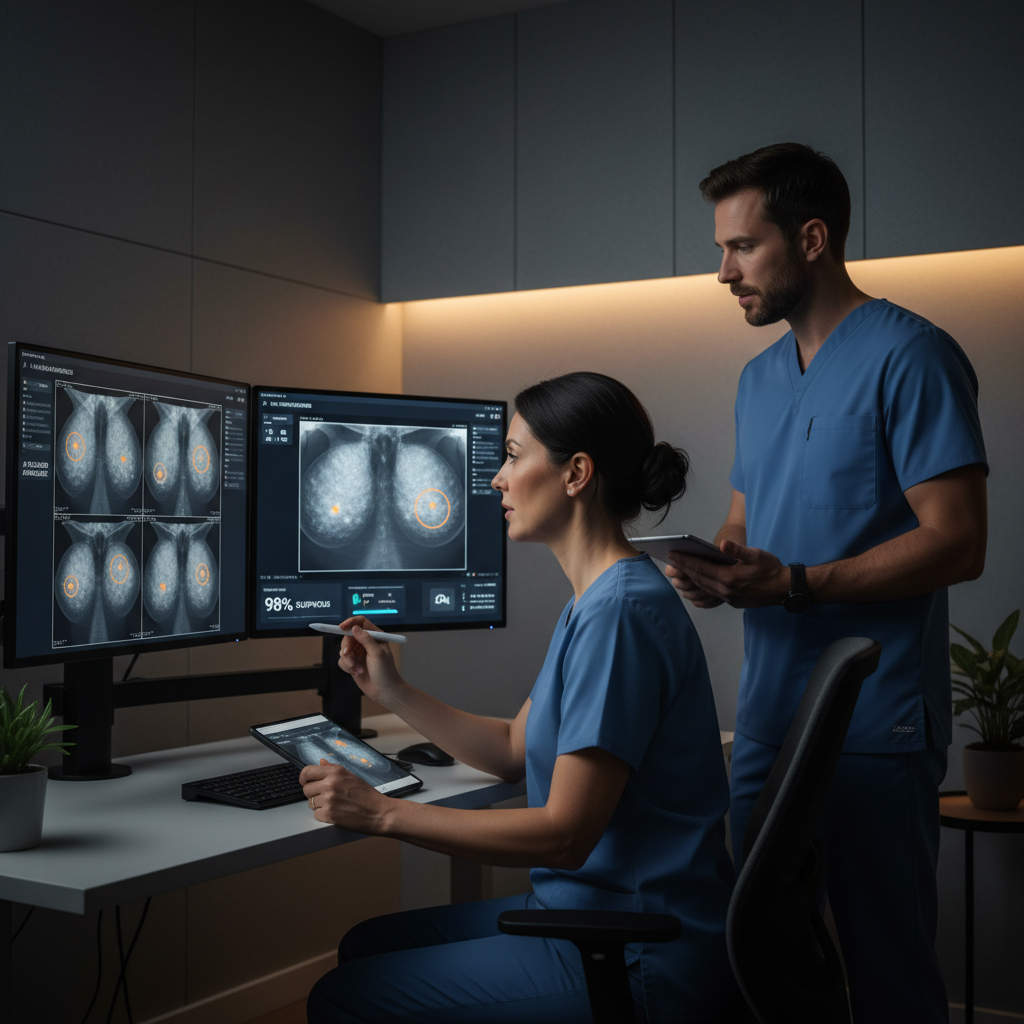
The California hospital case demonstrates what happens when radiology AI moves beyond pilot programs into routine clinical practice. By implementing AI-powered mammography analysis tools, the health system has achieved improved breast cancer detection rates alongside reduced false positives—a combination that addresses two of mammography’s most persistent challenges. This isn’t theoretical benefit; it’s measurable patient impact.
What makes this implementation particularly significant is the operational model: AI works alongside radiologists rather than replacing them. The technology serves as a second reader, flagging potential abnormalities that might escape human detection during high-volume screening workflows. This collaborative approach leverages AI’s pattern recognition capabilities while preserving the contextual judgment, clinical reasoning, and patient communication skills that define radiologist expertise.
The California hospital’s success illustrates a crucial principle: radiology AI achieves optimal results not by replacing physicians but by augmenting their capabilities, catching cases that might otherwise slip through the cracks of high-volume workflows while reducing false alarms that burden patients and systems alike.
The reduction in false positives deserves particular attention. False positives in mammography lead to unnecessary anxiety, additional imaging, biopsies, and healthcare costs. When AI helps reduce these while simultaneously improving true positive detection, it addresses quality, patient experience, and resource utilization simultaneously. This triple benefit explains why radiology AI is attracting serious investment and attention from health systems looking to improve outcomes while managing operational pressures.
Regulatory Reality: Current Frameworks Struggle with Adaptive AI
While clinical success stories accumulate, a fundamental tension has emerged between AI’s capabilities and the regulatory frameworks designed to evaluate medical devices. The citizen petition to the FDA highlights this disconnect. The current 510(k) pathway—which allows medical devices to gain clearance by demonstrating substantial equivalence to previously cleared devices—was built for static technologies that don’t fundamentally change after deployment.
AI algorithms, particularly those using machine learning, present a different paradigm. These systems can continuously learn from new data, refine their performance, and adapt to different populations and imaging equipment. An algorithm cleared based on one dataset and performance profile may evolve significantly in real-world use. This creates a regulatory puzzle: how do you ensure ongoing safety and effectiveness for a technology that, by design, changes over time?
The petition proposes an alternative pathway that would embrace AI’s adaptive nature rather than forcing it into an ill-fitting regulatory box. Such a framework would likely involve more robust post-market monitoring, ongoing validation requirements, and mechanisms for continuous oversight rather than one-time clearance. Proponents argue this approach could accelerate innovation—getting beneficial technologies to patients faster—while actually enhancing safety through ongoing scrutiny rather than a single approval checkpoint.
The Innovation-Safety Balance: Designing Regulation for Continuous Learning
The regulatory debate reflects a broader challenge facing healthcare AI: balancing innovation speed with patient protection. Move too slowly, and patients miss out on technologies that could save lives. Move too quickly, and inadequately validated algorithms could cause harm. Radiology AI sits at the center of this tension precisely because the field has advanced far enough to demonstrate real clinical value but not so far that all questions about long-term performance and generalizability have been answered.
An adaptive regulatory pathway, as proposed in the petition, would acknowledge that AI systems require different oversight than traditional devices. Instead of extensive pre-market testing followed by minimal post-market surveillance, such a framework might involve streamlined initial clearance paired with rigorous ongoing monitoring. This could include requirements for continuous performance reporting, validation across diverse patient populations, and mechanisms to detect and address algorithm drift—the phenomenon where AI performance degrades as real-world data diverges from training data.
Regulatory modernization for radiology AI isn’t about lowering standards—it’s about creating oversight mechanisms that match the technology’s unique characteristics, enabling faster innovation while potentially enhancing patient safety through continuous monitoring rather than one-time approval.
This approach would also address concerns about equity and generalizability. AI algorithms trained primarily on data from one demographic group or imaging equipment type may perform poorly when deployed more broadly. Ongoing validation requirements could catch these performance gaps and require corrections, something a one-time approval process might miss.
Workforce Implications: Redefining Radiology Expertise
The advancement of radiology AI has significant implications for the radiology workforce—and for healthcare recruiting platforms like PhysEmp that connect medical professionals with opportunities. As AI becomes standard in imaging workflows, the skills and expectations for radiologists are evolving. Tomorrow’s radiologists will need not just image interpretation expertise but also the ability to work effectively with AI tools, understand their limitations, validate their outputs, and integrate algorithmic insights into clinical decision-making.
This doesn’t diminish the need for radiologists; if anything, it elevates their role. As AI handles routine pattern recognition and serves as a safety net for missed findings, radiologists can focus on complex cases, integrate imaging findings with broader clinical context, communicate with referring physicians and patients, and oversee the AI systems themselves. The California hospital example shows this model in action: AI augments rather than replaces, and radiologist expertise remains central to the diagnostic process.
For healthcare organizations, this means recruiting strategies should emphasize comfort with technology, adaptability, and willingness to work in human-AI collaborative environments. For radiologists, it means continuous learning and skill development will be essential. And for the field overall, it suggests that AI adoption may actually help address radiologist shortages by making existing professionals more efficient and effective.
Implications for Healthcare: Innovation Requires Infrastructure
The convergence of clinical success and regulatory evolution points toward a future where radiology AI becomes standard of care rather than cutting-edge innovation. But realizing this future requires more than just better algorithms and smarter regulations. Healthcare organizations need implementation strategies, change management approaches, technical infrastructure, and workforce development programs.
The California hospital’s success didn’t happen automatically—it required careful tool selection, workflow integration, radiologist training, and ongoing performance monitoring. Other organizations looking to replicate these results will need similar commitments. This creates opportunities for healthcare leaders who can bridge clinical, technical, and operational domains, designing AI implementations that deliver results rather than just deploying technology.
From a regulatory perspective, FDA modernization of AI pathways would remove a significant barrier to innovation, but it would also place greater responsibility on healthcare organizations to participate in ongoing monitoring and validation. Health systems would become partners in the regulatory process rather than simply consumers of pre-approved technologies.
For the healthcare industry broadly, radiology AI’s momentum offers a template for AI adoption in other specialties. The lessons learned—about human-AI collaboration, regulatory frameworks, implementation strategies, and workforce adaptation—will inform AI deployment in pathology, cardiology, dermatology, and beyond. Radiology is, in many ways, the proving ground for healthcare AI.
The dual momentum in radiology AI—clinical wins and regulatory evolution—suggests the field is moving from experimentation to maturity. Organizations that understand both dimensions, investing in effective implementation while engaging with evolving regulatory frameworks, will be best positioned to deliver better outcomes for patients while supporting their clinical workforce through this transformation.
Sources
Petition to U.S. FDA proposes alternative pathway for radiology AI – AuntMinnie
California hospital uses AI to boost breast cancer detection – Becker’s Hospital Review