
Why Risk-Based AI Regulation Matters Now
The healthcare industry has reached an inflection point in its relationship with artificial intelligence. After years of experimental deployments and fragmented oversight, major industry stakeholders are now coalescing around a unified message: federal regulators need to establish clear, risk-based frameworks for AI governance. The Healthcare Leadership Council’s recent policy proposal represents more than just another position paper—it signals a fundamental shift from asking whether AI should be regulated to demanding clarity on how that regulation should work.
This push for regulatory clarity arrives at a critical moment. Healthcare organizations currently face a patchwork of state and federal rules that vary by jurisdiction and application type. Some health systems have delayed promising AI deployments due to compliance uncertainty, while others have moved forward with minimal guidance, creating potential patient safety risks and legal exposure. The resulting fragmentation undermines both innovation and safety, the two priorities that effective regulation should balance.
The emerging consensus around tiered, risk-based approaches offers a pragmatic path forward. By categorizing AI tools according to their potential impact on patient outcomes and clinical decision-making, regulators can calibrate oversight intensity to actual risk levels. This framework acknowledges a fundamental truth: not all AI applications pose equal dangers, and regulatory resources should focus where they matter most.
The Architecture of Risk-Based AI Oversight
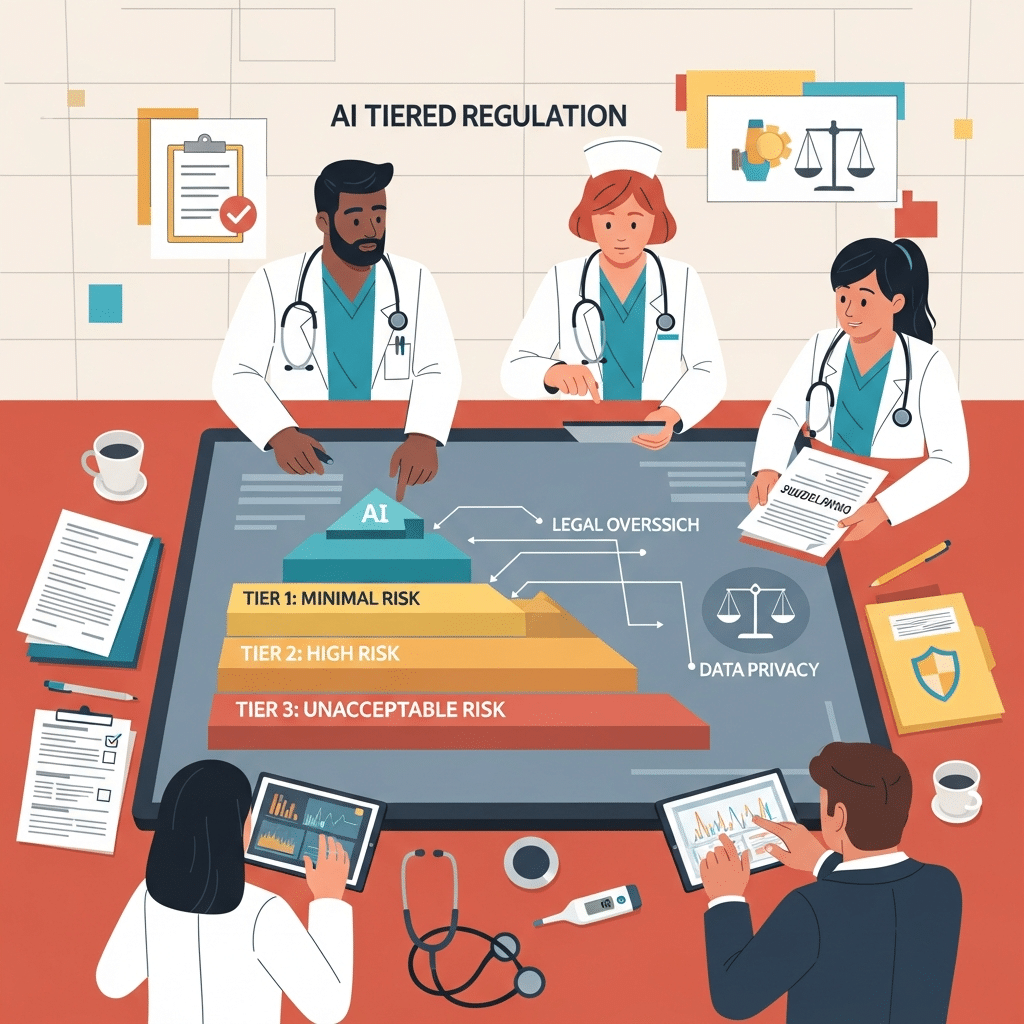
The tiered regulatory framework proposed by healthcare industry leaders establishes distinct categories based on clinical impact. At the lowest tier, administrative applications like scheduling tools and billing systems would face minimal oversight—perhaps simple notification requirements or basic transparency standards. These systems, while powered by sophisticated algorithms, don’t directly influence clinical decisions or patient safety outcomes.
Mid-tier applications might include clinical decision support tools that provide information to clinicians but don’t autonomously drive treatment decisions. These systems would require moderate validation, including evidence of clinical utility and checks for algorithmic bias, but wouldn’t necessarily need the rigorous premarket approval process reserved for higher-risk applications.
At the highest tier sit AI systems that directly influence diagnosis, treatment selection, or other critical clinical decisions. These applications would face stringent requirements: extensive clinical validation across diverse patient populations, FDA premarket approval, ongoing post-market surveillance, and clear protocols for managing updates and algorithmic drift. The framework recognizes that when AI systems make or heavily influence life-or-death decisions, regulatory scrutiny must be proportionally intense.
The shift from fragmented state-by-state rules to unified federal oversight represents more than administrative convenience—it’s essential infrastructure for scaling AI innovation while maintaining consistent patient safety standards across healthcare delivery systems nationwide.
This tiered approach also addresses one of AI’s most challenging regulatory puzzles: systems that learn and evolve over time. Traditional medical device regulation assumes static products that remain unchanged after approval. AI systems, by contrast, may continuously update their algorithms based on new data. The concept of predetermined change control plans—allowing developers to make certain updates without new FDA submissions—offers a potential solution, enabling beneficial improvements while maintaining regulatory oversight of substantive changes.
From Experimentation to Responsible Implementation
The healthcare industry’s maturation in AI deployment is evident in the language leaders now use. The focus has shifted from breathless enthusiasm about AI’s potential to measured discussion of governance structures, validation protocols, and equity considerations. As one chief medical informatics officer noted, healthcare has moved past the experimentation phase into an era where safety, effectiveness, and equity are non-negotiable prerequisites.
This evolution toward responsible AI reflects several converging pressures. Regulatory scrutiny has intensified as AI moves from research settings into routine clinical practice. High-profile failures—including AI diagnostic tools that performed poorly on underrepresented populations—have demonstrated the real-world consequences of inadequate validation. Clinicians themselves are demanding greater transparency about how AI systems generate recommendations, refusing to accept black-box algorithms that they cannot interrogate or understand.
Healthcare organizations are responding by establishing formal AI governance structures before deploying new tools. These frameworks typically include clinical validation requirements, bias auditing protocols, transparency standards, and mechanisms for ongoing monitoring. The shift represents a recognition that responsible AI isn’t simply about having good intentions—it requires systematic processes, clear accountability, and institutional commitment.
As healthcare organizations build AI governance capabilities, they’re simultaneously creating demand for professionals who understand both clinical workflows and algorithmic systems—a talent gap that platforms like PhysEmp are helping to bridge through AI-powered matching of specialized healthcare roles.
The Case for Federal Leadership and Coordination
Industry stakeholders are specifically calling for federal agencies—particularly the FDA—to take the lead on AI regulation rather than leaving oversight to a patchwork of state rules. This preference for federal coordination reflects practical realities of healthcare delivery in an interconnected system.
Health systems frequently operate across state lines, and AI tools deployed in one facility may be used throughout a multi-state network. When regulatory requirements vary by jurisdiction, compliance becomes exponentially more complex. Organizations must either maintain different AI configurations for different locations—undermining the efficiency gains AI promises—or navigate conflicting requirements that may be impossible to simultaneously satisfy.
Federal leadership would also address concerns about regulatory arbitrage, where organizations might gravitate toward jurisdictions with lighter oversight. Consistent national standards would level the playing field, ensuring that patient safety doesn’t depend on geography and that innovators compete on the quality of their solutions rather than their ability to find regulatory loopholes.
The proposal envisions the FDA managing clinical AI applications while other federal agencies handle administrative uses, creating clear lanes of responsibility. This division acknowledges that different AI applications implicate different regulatory concerns and expertise. Clinical algorithms require medical and scientific review, while administrative systems may primarily raise privacy or consumer protection issues better addressed by other agencies.
Implications for Healthcare Organizations and Workforce Development
The movement toward clearer AI regulation carries significant implications for healthcare organizations making deployment decisions today. Systems that invest in robust governance frameworks now will be better positioned when formal regulations arrive. Those that establish clinical validation protocols, bias auditing processes, and transparency standards are essentially future-proofing their AI programs against likely regulatory requirements.
This regulatory evolution also affects healthcare workforce needs. As AI governance becomes more sophisticated, organizations require professionals who can bridge clinical and technical domains—individuals who understand both algorithmic systems and patient care workflows. Clinical informaticists, AI ethics specialists, and data scientists with healthcare expertise are increasingly critical roles. Platforms like PhysEmp that connect healthcare organizations with specialized talent are becoming essential infrastructure as the industry builds its AI governance capabilities.
The push for responsible AI also creates opportunities for differentiation. Healthcare organizations that can demonstrate rigorous validation, transparent decision-making, and equitable performance across patient populations will earn greater trust from clinicians, patients, and regulators. As AI becomes ubiquitous in healthcare delivery, the quality of governance may become as important as the quality of algorithms.
Looking ahead, the industry’s growing consensus around risk-based regulation suggests that 2026 may indeed mark the transition from AI experimentation to mature, governed implementation. The frameworks being proposed today will likely shape healthcare AI development for years to come, determining which innovations reach patients and how quickly. For an industry built on the principle of “first, do no harm,” getting this regulatory architecture right isn’t just about enabling innovation—it’s about ensuring that AI’s tremendous potential translates into better, safer, more equitable care.
Sources
HLC proposes path to AI regulation, from simple to strenuous – Fierce Healthcare
Healthcare Sector Calls for Unified Federal Framework to Unlock AI’s Full Potential for Patients – Yahoo Finance
Developing an FDA regulatory model for health AI – Healthcare IT News
2026 will see the rise of responsible AI, as technology becomes less of a hindrance – Healthcare IT News