
We pulled this piece from what residents have actually been posting lately on Reddit and other corners of the internet where the real talk happens. AI helped us sift through the volume and flag the recurring themes. Then a human editor chose what was worth your time, and that’s what you’re about to read.
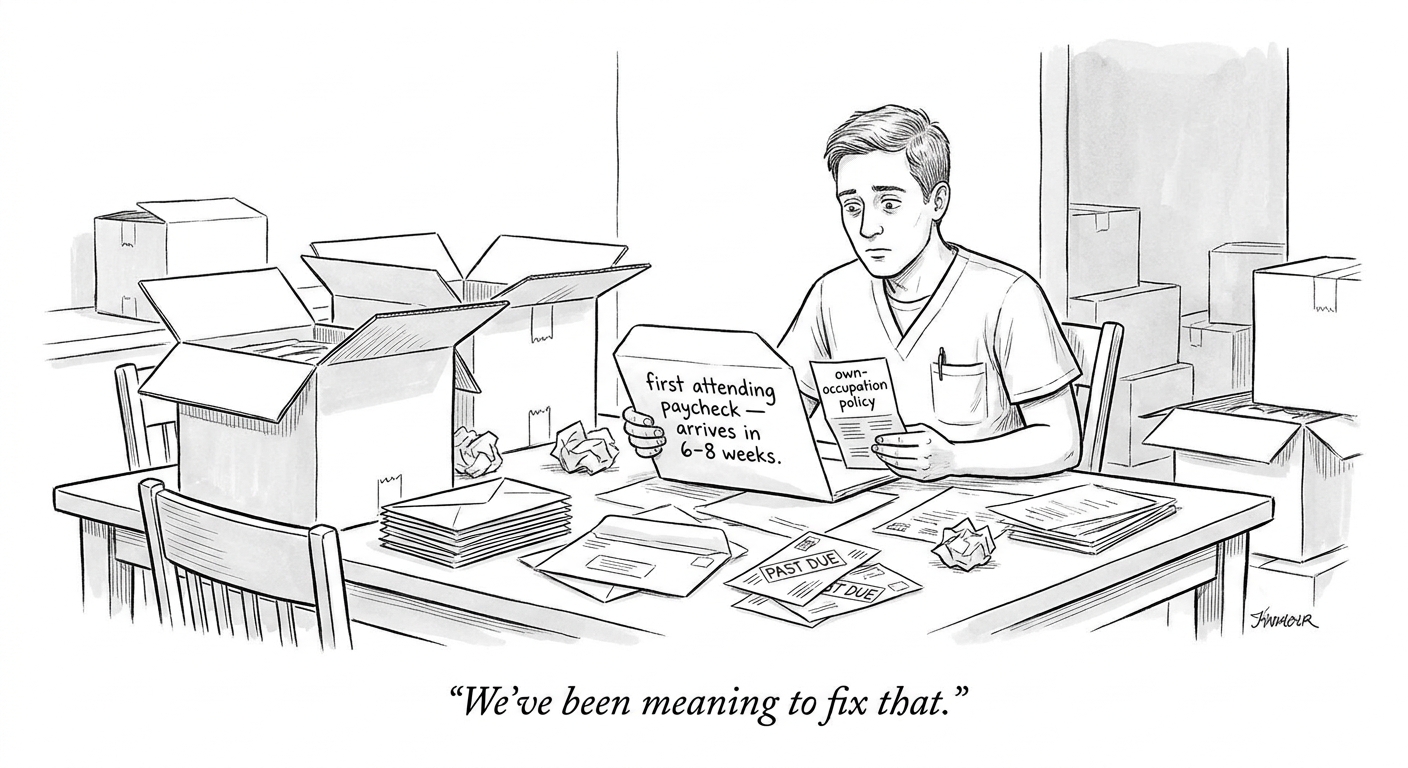
You spent a decade learning medicine, and somewhere along the way, nobody mentioned that you’d need to become a part-time financial planner. Medical school covers cardiac physiology in excruciating detail but skips the part where you learn what own-occupation disability insurance means or why your first attending paycheck might leave you broke for three months despite being ten times larger than your resident salary. This isn’t an accident—it’s a systemic gap that costs physicians thousands of dollars in their first few years of practice.
The frustration is real. You’re making $60K while carrying $300K in debt, watching your non-medical friends buy houses, and trying to figure out whether to prioritize an HSA or a Roth IRA with money that barely covers rent. Let’s fix that.
Disability Insurance: The Decision That Actually Matters
Here’s the uncomfortable truth: disability insurance is more important than life insurance for most residents. You’re far more likely to become disabled than to die during your working years, and if you can’t practice medicine, your income disappears entirely.
The key term is own-occupation coverage. This means the policy pays out if you can’t perform your specific specialty—not just any job. For proceduralists (surgeons, interventional cardiologists, dermatologists doing Mohs), this distinction is critical. A policy that only covers any occupation disability could deny your claim if you develop a hand tremor that ends your surgical career but leaves you technically able to work as a consultant.
The major carriers for physicians are Guardian, MassMutual, Principal, Ameritas, and The Standard. Each has different strengths: Guardian and MassMutual are generally considered the gold standard for own-occupation definitions, while others may offer better rates but with more restrictive language. Get quotes from at least three carriers and compare the actual policy language, not just the premium.
Buy during residency if you can. Premiums are locked based on your age and health at purchase, and you can usually get a future increase option rider that lets you increase coverage as your income grows without additional medical underwriting. A healthy 28-year-old resident will pay significantly less than a 35-year-old attending for the same coverage.
HSA vs. Roth on a Resident Salary: The Math
On a $60K salary, every dollar of tax optimization matters. Here’s the priority order that most financial advisors recommend for residents:
First: Get any employer 401(k) match. This is free money. If your program offers a 3% match, contribute at least 3%.
Second: Max out your HSA if you have a high-deductible health plan. In 2024, that’s $4,150 for individuals or $8,300 for families. The HSA is the only triple-tax-advantaged account in existence: contributions are pre-tax, growth is tax-free, and withdrawals for medical expenses are tax-free. You can also invest HSA funds and let them grow for decades, then use them for any medical expenses in retirement.
Third: Roth IRA, up to the $7,000 annual limit. Your income is low enough in residency that you’re in a lower tax bracket than you’ll ever be again. Pay taxes now at 22% rather than later at 32% or higher.
The common mistake is skipping the HSA because you need the money for medical expenses now. You can pay current medical expenses out of pocket, save the receipts, and reimburse yourself from the HSA years later—letting the money grow tax-free in the meantime.
Term Life Insurance: When It Actually Makes Sense
Term life insurance is simple: if you die during the term, your beneficiaries get paid. If you don’t, the policy expires worthless. This is what you want.
You need term life insurance if someone depends on your income—a spouse, children, or aging parents you support. You don’t need it if you’re single with no dependents. The insurance industry will try to sell you permanent life insurance (whole life, universal life) as an investment. For the vast majority of physicians, this is a bad deal. The fees are high, the returns are mediocre, and you’d be better off buying cheap term coverage and investing the difference.
For older residents—those starting training in their mid-30s or later—locking in term coverage early matters more. Premiums increase with age, and health conditions that develop during residency can make you uninsurable or dramatically increase costs. A 20-year term policy purchased at 35 will be significantly cheaper than the same policy at 40.
Physician Mortgages: The Real Tradeoff
Physician mortgage loans let you buy a house with little or no down payment and no private mortgage insurance (PMI), based on your future earning potential rather than your current resident salary. Sounds great. Here’s the catch.
The interest rates are typically 0.25% to 0.5% higher than conventional mortgages. On a $400K house, that’s an extra $1,000 to $2,000 per year in interest. You’re also buying a house before you know where your career will take you—and selling a house within 3-5 years usually means losing money to transaction costs.
The physician mortgage makes sense if you’re confident you’ll stay in the area for at least 5 years, you’ve found a house that’s reasonably priced, and the alternative is paying rent that’s comparable to or higher than a mortgage payment. It doesn’t make sense if you’re buying because renting is throwing money away (it’s not—it’s paying for flexibility) or because you want to feel like a real adult.
Your First Attending Paycheck: The Cash Flow Gap
Here’s what nobody tells you: when you start your attending job, you might not get paid for 6-8 weeks. You’ll have moving expenses, possibly a new house down payment, new professional wardrobe costs, and state licensing fees—all before your first paycheck arrives.
The solution is boring but essential: build a cash reserve of 2-3 months of expenses before you finish training. This might mean living like a resident for an extra few months after you could technically afford to upgrade your lifestyle. It’s not glamorous, but neither is putting moving expenses on a credit card at 24% interest.
Your first year of attending income should follow this priority: build a 3-6 month emergency fund, max out retirement accounts, pay down high-interest debt, then—and only then—start upgrading your lifestyle. The residents who go from $60K to $300K and immediately buy a $80K car are the same ones who are still broke five years later.
Financial literacy isn’t taught in medical school because the curriculum is already overloaded and because, frankly, the people designing medical education aren’t thinking about your personal finances. That gap costs physicians real money. The decisions you make in residency and your first attending year—disability insurance, retirement account prioritization, housing—compound over decades. Get them right early, and what kind of physician will you be a decade from now?