
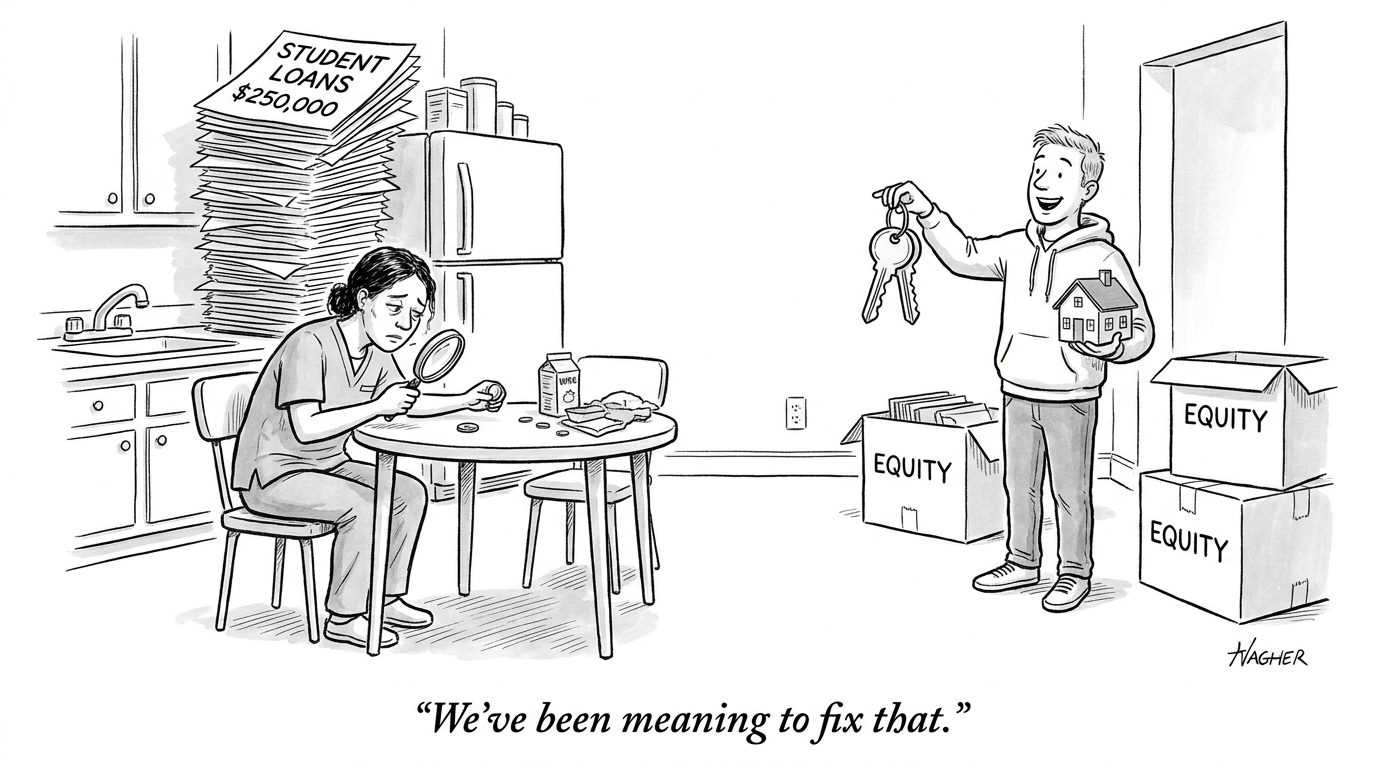
You’re making $60,000 a year with $250,000 in student loans, watching your college roommate who went into tech buy a house while you’re sharing a two-bedroom apartment with another resident. The financial reality of residency is that you’re effectively broke despite being called doctor, and nobody in medical school taught you what to do about it.
Here’s the uncomfortable truth: the financial decisions you make in the next three to seven years will shape your wealth trajectory more than your eventual attending salary. Most residents either ignore this entirely (too overwhelmed) or obsess over optimizing every dollar (also a mistake when you’re working 70-hour weeks). The goal is to get the big things right and not stress about the rest.
The Loan Decision That Actually Matters
Your student loan strategy comes down to one question: Are you going for Public Service Loan Forgiveness (PSLF) or not?
If you’re training at a 501(c)(3) hospital (most academic centers qualify) and plan to work at a nonprofit or government employer afterward, PSLF is likely your best path. Enroll in an income-driven repayment plan—SAVE, PAYE, or IBR—and your payments during residency will be based on your resident salary, not your loan balance. At $60K income with a family of one, you’re looking at payments around $300-400/month. After 120 qualifying payments (10 years), the remaining balance gets forgiven tax-free.
If you’re planning to go into private practice or a for-profit hospital system, PSLF isn’t an option. Your choices are refinancing to a lower interest rate or staying on income-driven repayment and paying off aggressively once you’re an attending. During residency, refinancing rarely makes sense – you’d lose access to income-driven plans and federal protections for a marginally better rate while you can’t afford higher payments anyway.
The mistake most residents make: treating loans like a moral failing that must be paid off immediately. At 6-7% interest, your loans are expensive but not an emergency. The math often favors minimum payments during training and aggressive payoff (or PSLF forgiveness) afterward.
Disability Insurance: The One Thing You Can’t Skip
During residency, own-occupation disability insurance matters. The own-occupation designation means if you can’t do your specific specialty, you get paid — even if you could technically work another job. A surgeon who loses fine motor control in their hands needs this coverage; a policy that pays only if you can’t work any job is nearly worthless for physicians.
Why buy during residency when you’re broke? Two reasons. First, you’re young and healthy, so premiums are lower. Second, most policies let you increase coverage later without new medical underwriting. If you develop a health condition during training, you’re locked out of coverage when you need it most.
Expect to pay $100-200/month for a solid policy. Yes, that hurts on a resident salary. It hurts less than having no income if you get sick or injured. Your program may offer group disability coverage, but it’s usually not own-occupation and not portable when you leave.
Retirement Accounts: Start Small, Think Long
The standard advice is to maximize your 401(k) contributions. That’s great advice for someone making $300K. For residents, it’s often unrealistic.
Here’s what actually makes sense: If your program offers a 401(k) or 403(b) with an employer match, contribute at least enough to get the full match. That’s free money—typically 3-6% of your salary. If there’s no match, a Roth IRA is usually better. You can contribute up to $7,000/year (2024 limit), and since your income is low during residency, you’re paying taxes at a lower rate than you will as an attending.
The power of starting early is real. Contributing $500/month during a four-year residency, assuming 7% average returns, gives you roughly $28,000 by the time you finish training. Let that sit untouched for 25 years and it becomes $135,000—from money you invested when you were not able to invest.
If you genuinely can’t afford any retirement contributions, don’t beat yourself up. Paying rent and keeping the lights on takes priority. But if you’re spending $200/month on food delivery because you’re too tired to cook, that’s a choice worth examining.
Budgeting: The 30-Second Version
You don’t need a complicated budget system. You need to know three numbers: your monthly take-home pay, your fixed costs (rent, loans, insurance, utilities), and what’s left.
For most residents, the math looks something like this: $4,500 take-home, $2,500 in fixed costs, $2,000 for everything else. That everything else covers food, transportation, entertainment, and savings. If you’re spending more than $2,000 on discretionary expenses, something’s off. If you’re spending less, you’re doing fine.
The biggest budget killers for residents are usually housing (especially in expensive cities), car payments, and lifestyle creep from trying to keep up with attending colleagues. A $400/month car payment on a resident salary is a choice that costs you $20,000+ over residency that could have gone toward loans or retirement.
What You Can Safely Ignore (For Now)
You don’t need to worry about backdoor Roth conversions, taxable brokerage accounts, real estate investing, or complex tax strategies. Those are attending problems. You also don’t need to feel guilty about not maximizing every financial opportunity. The goal during residency is to avoid catastrophic mistakes, not to optimize every dollar.
The catastrophic mistakes are: carrying high-interest credit card debt, not having disability insurance, choosing the wrong loan repayment strategy, and spending like an attending when you’re earning like a resident. Avoid those, and you’ll come out of training in reasonable financial shape ready to actually build wealth when your income catches up to your education.