
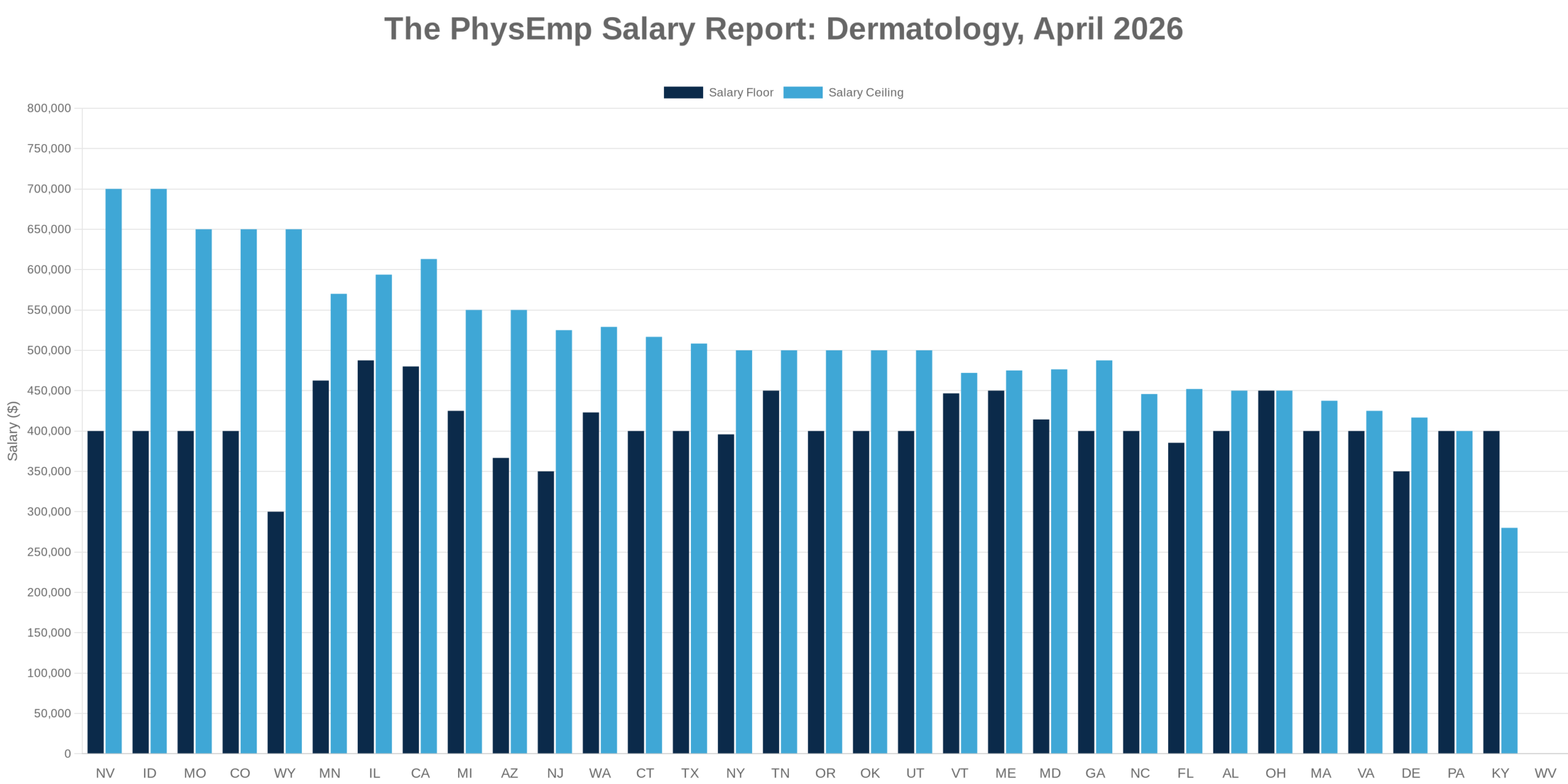
West Virginia will pay you $270,000 to treat skin conditions. Nevada will pay you $700,000 to do the same thing. The $430,000 gap between them is not a typo, nor is it explained by scope of practice, call burden, or volume expectations. It is simply what the market will bear. The Dermatology job market features 348 active listings across 40-plus states, with 117 reporting salary data. What the numbers reveal is a specialty where geography is destiny, volume does not guarantee value, and the ceiling is higher than most physicians realize.
👉 Explore Dermatology job market insights and trends
The Dermatology Job Market at a Glance
Total listings: 348. Listings with salary data: 117. Full compensation range: $225,000 to $800,000. Average range: $416,957 to $514,684.
The spread is enormous, but most of the market lives in the $400,000 to $550,000 band. The floor of $225,000 likely reflects part-time or limited-scope work, though the data does not specify. The $800,000 ceiling is real, reported, and attainable. The average top-end figure of $514,684 undersells the market slightly, as several states routinely clear $600,000 on the high end. Dermatology remains one of the best-compensated specialties in medicine, and the data suggests demand is broad-based: many listings explicitly welcome 2026 graduates, signaling that this is not a market reserved for the experienced.
States represented: Alabama, Alaska, Arizona, California, Colorado, Connecticut, Delaware, Florida, Georgia, Idaho, Illinois, Indiana, Iowa, Kentucky, Louisiana, Maine, Maryland, Massachusetts, Michigan, Minnesota, Missouri, Nebraska, Nevada, New Hampshire, New Jersey, New York, North Carolina, North Dakota, Ohio, Oklahoma, Oregon, Pennsylvania, Rhode Island, South Carolina, South Dakota, Tennessee, Texas, Utah, Vermont, Virginia, Washington, West Virginia, Wisconsin, Wyoming.
How States Stack Up
Overperformers:
Illinois averages $487,500 to $593,750 and offers 23 listings, making it a rare high-volume, high-pay market. California averages $480,000 to $613,125 across 42 listings, combining scale with top-tier compensation. Vermont averages $446,667 to $472,000 with just three salary-reported listings, a quiet overperformer. Minnesota averages $462,500 to $570,000 and delivers both pay and optionality. Tennessee averages $450,000 to $500,000 with limited transparency but strong numbers where disclosed. Ohio averages $450,000 flat across two listings, a narrow but above-average band. Maine reports $450,000 to $475,000 on a single listing, modest volume but solid pay. Michigan averages $425,000 to $550,000 across four listings, a respectable spread. Washington averages $423,000 to $529,000 with three salary-reported positions. Maryland averages $414,286 to $476,429 and has full transparency across seven listings, a model for the market.
Near-average performers:
North Carolina averages $400,000 to $445,833 with six salary listings out of 17 total, a benchmark market. Pennsylvania averages $400,000 flat across two listings, limited data but stable. Massachusetts averages $400,000 to $437,500 with four salary-reported positions out of 19 total. Georgia averages $400,000 to $487,500 across four listings. Missouri averages $400,000 to $650,000 with a wide ceiling but limited sample size. Connecticut averages $400,000 to $516,667 across six listings. Texas averages $400,000 to $508,333 with just three salary-reported positions out of 12 total. Virginia averages $400,000 to $425,000 across four listings, steady but unexciting. Kentucky, Oklahoma, Oregon, Utah, and Alabama all hover near the $400,000 to $500,000 range with minimal transparency.
Underperformers:
Florida averages $385,417 to $452,083 across 12 salary-reported listings, a high-volume state with below-average pay. Arizona averages $366,667 to $550,000, a wide range that starts low. New Jersey averages $350,000 to $525,000, another state with a weak floor despite decent upside. Delaware averages $350,000 to $416,667, well below the national baseline. Wyoming averages $300,000 to $650,000 on a single listing, a floor that lags badly. West Virginia averages $270,000 to $280,000, the lowest in the nation by a significant margin.
Volume leaders:
California leads with 42 listings, Florida has 24, Illinois has 23, and New York has 22. Massachusetts follows with 19, North Carolina with 17, and Pennsylvania with 16. Florida is the only top-volume state with materially below-average compensation. California and Illinois combine volume and pay, a rare and valuable pairing.
What This Means If You’re a Physician
If your priority is maximum compensation: Target Nevada, Idaho, Missouri, and Colorado, where salary ceilings reach $650,000 to $700,000. The single highest-paying listing offers $400,000 to $700,000 and is posted in Reno, Nevada and Arroyo Grande, California. These are not urban coastal markets, and that is the point. Scarcity pricing is real.
If your priority is maximum optionality: California offers 42 listings with an average top-end of $613,125. Illinois offers 23 listings with an average top-end of $593,750. Both states provide volume, variety, and above-average pay. You will not need to choose between opportunity and compensation.
If your priority is balance: Vermont, Maryland, and Washington offer above-average pay in markets with lower cost-of-living and fewer listings. Vermont averages $446,667 to $472,000, Maryland averages $414,286 to $476,429, and Washington averages $423,000 to $529,000. These are not bidding wars, but they are fair deals in livable places.
One cost-of-living mismatch deserves attention: Florida ranks second in job volume but pays materially below the national average, with an average range of $385,417 to $452,083. The state’s tax advantages do not close the gap. If you are moving to Florida for the weather, understand the trade-off.
👉 Search Dermatology jobs by location and compensation
What This Means If You’re a Recruiter
Salary transparency rate: 33.6 percent. Only 117 of 348 listings disclosed compensation. That is a problem. Dermatology is a seller’s market, and candidates know their worth. Listings without salary data will be skipped, not speculated upon.
The candidate pipeline is strong, with many listings explicitly targeting 2026 graduates. But the volume-pay misalignment in Florida, New York, and Pennsylvania will create friction. Florida has 24 listings and below-average pay. New York has 22 listings and a middling average of $395,833 to $500,000. Pennsylvania has 16 listings and a flat $400,000 average. In these states, recruiters will need to lead with lifestyle, partnership track, or geography, because compensation will not close the deal on its own.
Nevada, Idaho, Missouri, and Colorado have low listing volume but top-tier pay. These markets will fill quickly, and the employers posting them understand the assignment. Everyone else is competing for attention in a crowded field with incomplete information.
👉 Post Dermatology positions on PhysEmp
What’s Driving the Numbers
Scarcity pricing is alive and well in Dermatology.
Nevada, Idaho, and Missouri offer compensation at or near the top of the national range despite minimal listing volume. These are not major metropolitan markets, and they are not academic hubs. They are underserved regions willing to pay a premium to attract talent. The strategy works. Physicians willing to trade location for compensation will find the best deals outside the usual suspects.
High volume does not guarantee high pay, and low transparency makes it worse.
Florida has 24 listings but pays below average. New York has 22 listings but hovers near the middle. Pennsylvania has 16 listings and offers a flat $400,000. Meanwhile, California and Illinois prove that volume and pay can coexist when markets are transparent and competitive. The lesson for employers: if you want to compete in a high-volume state, you need to pay like it.
The $800,000 ceiling is not a myth, but it is not common either.
The highest reported salary in the dataset is $800,000, and it is an outlier. Most top-end offers cluster between $500,000 and $650,000, with a handful breaking into the $700,000 range. The $800,000 figure likely reflects a specialized role, a productivity-based model, or an especially aggressive retention offer. It is attainable, but it is not the baseline. Physicians chasing the ceiling should expect to negotiate, relocate, or take on additional scope.
Part-time and limited-scope roles distort the floor, but the middle is stable.
The $225,000 floor is almost certainly a part-time or reduced-scope position, though the data does not confirm it. Even the next tier up, $270,000 to $280,000 in West Virginia, is an extreme outlier. The true full-time floor appears to be closer to $350,000, and the market’s center of gravity is $400,000 to $550,000. Dermatology is a high-paying specialty with a narrow band of typical outcomes. The extremes exist, but they are not representative.
The Bottom Line
The Dermatology job market is geographically vast, financially generous, and selectively transparent. Physicians who prioritize compensation will find it in underserved markets willing to pay for scarcity. Physicians who prioritize optionality will find it in California and Illinois, where volume and pay align. Physicians who prioritize lifestyle will find it in Vermont, Maryland, and Washington, where the cost-of-living math works in their favor. The market rewards flexibility, punishes indecision, and pays well regardless.
There is a lot of money available for ensuring people do not develop melanoma. Choose wisely.
👉 Browse all Dermatology physician jobs
👉 Upload your CV to get matched with opportunities
👉 Set alerts for new Dermatology roles
Salary data based on 117 listings with disclosed compensation. Figures may reflect part-time or specialized roles. This report is informational and should not replace professional judgment or financial planning.