
A single listing in Kentucky is offering up to $900,000 annually to read echocardiograms and stress tests without threading a single catheter. The Cardiology Noninvasive job market spans 112 active listings across 32 states, but only 15 of those positions disclose what they’re willing to pay. The national salary range stretches from $300,000 to $900,000, with an average range between $540,800 and $581,578. This is a market defined less by scarcity than by opacity, where compensation varies wildly and transparency remains the exception.
The Cardiology-Noninvasive Job Market at a Glance
Total listings: 112
Listings with salary data: 15
Full salary range: $300,000 to $900,000
Average salary range: $540,800 to $581,578
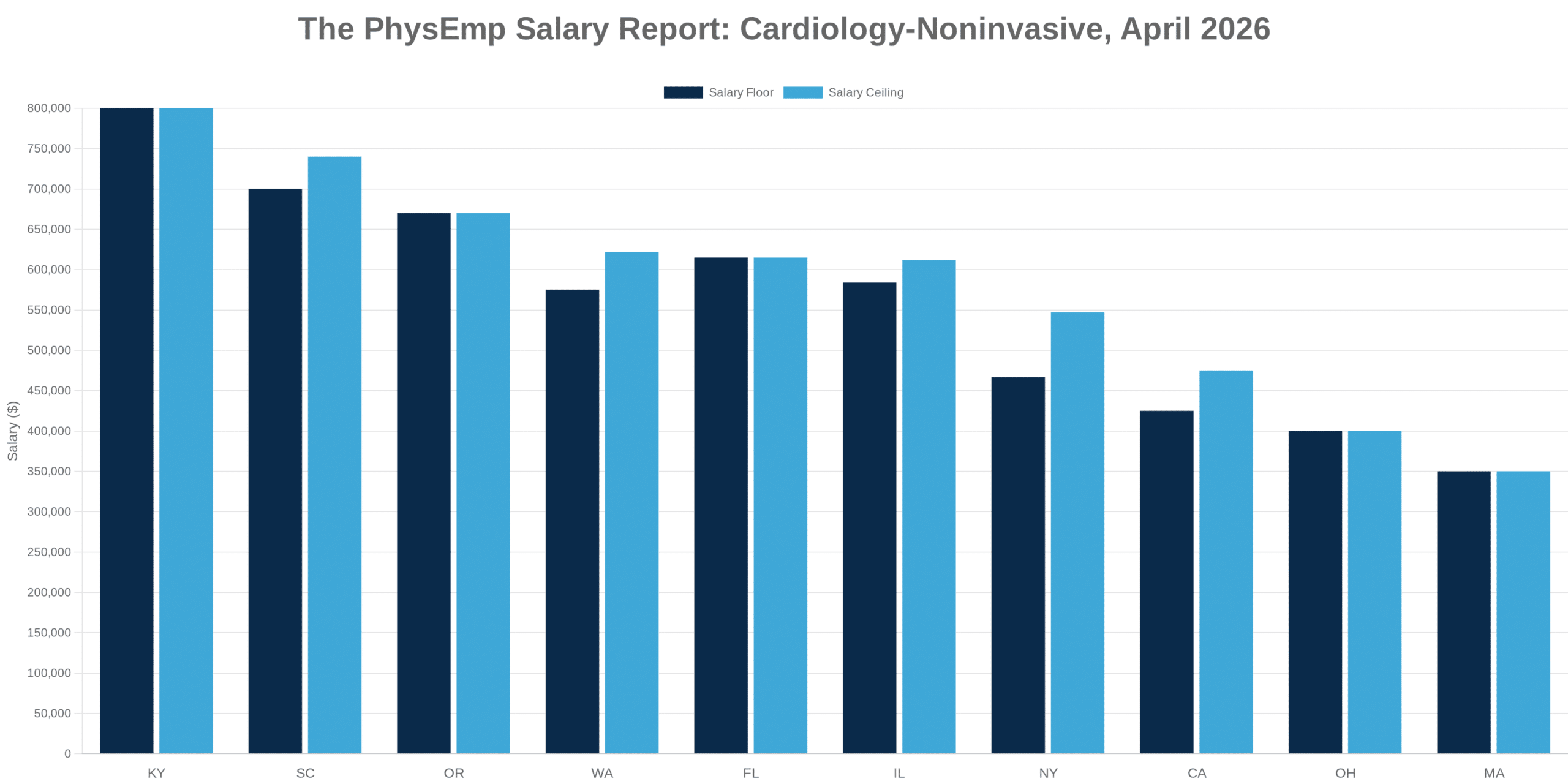
The $600,000 spread between floor and ceiling suggests this specialty rewards geography and negotiation leverage in equal measure. States with disclosed data cluster into three distinct tiers: elite markets paying $670,000 and above, mid-tier markets hovering near the national average, and underperformers struggling to break $475,000. The latter group includes California (where $450,000 buys significantly less house than it does in Kentucky) and Massachusetts (where academic prestige apparently substitutes for actual dollars).
Active listing states: Ohio, Massachusetts, New York, Illinois, North Carolina, Alaska, South Dakota, Indiana, Florida, Missouri, Wisconsin, Pennsylvania, Texas, South Carolina, Georgia, Arizona, Colorado, New Hampshire, West Virginia, Iowa, New Mexico, Alabama, California, Washington, Connecticut, Minnesota, Michigan, Oregon, Tennessee, Oklahoma, Mississippi, Kentucky.
How States Stack Up
Overperformers: Kentucky leads the nation with an average range of $800,000 to $900,000, proving that sometimes the best financial decision is moving to a place most people leave. South Carolina offers $700,000 to $740,000, delivering coastal proximity without coastal salary compression. Oregon averages $670,000, which buys a lot of fleece vests and coffee. Illinois ranges from $584,000 to $611,667, rewarding physicians willing to endure winter. Washington state posts $575,000 to $622,000, taxing income but not enthusiasm.
Near-average: New York averages $466,667 to $547,222, straddling the lower national average with characteristic ambivalence. Florida reports $615,000 as a single-listing average, suggesting either an outlier or a deliberate bid to attract talent to a state already drowning in retirees with atrial fibrillation.
Underperformers: Massachusetts averages $350,000, nearly $191,000 below the national average low (presumably the proximity to Harvard is considered part of the compensation package). Ohio offers $400,000, undershooting the national benchmark despite posting seven total listings. California ranges from $425,000 to $475,000, a figure that might cover rent in some markets and a down payment in none.
Volume leaders: North Carolina dominates with 13 listings but discloses zero salary figures, making it the market equivalent of a blind date. Massachusetts follows with 9 listings, Pennsylvania with 8, and Ohio and Florida with 7 each. Florida is the only high-volume state to report compensation data. High volume does not guarantee high pay, and in many cases guarantees nothing at all.
👉 Compare Cardiology-Noninvasive compensation and opportunities by region
What This Means If You’re a Physician
If your priority is maximum compensation: Target Kentucky, South Carolina, or Oregon. The highest-paying listing is in Kentucky at $800,000 to $900,000 annually. This represents the market ceiling and likely reflects either rural scarcity, hospital desperation, or both. South Carolina and Oregon follow closely, each offering north of $670,000 without requiring you to practice in a cornfield (though that remains an option).
If your priority is maximum optionality: Focus on North Carolina (13 listings), Massachusetts (9 listings), or Pennsylvania (8 listings). Volume creates leverage, even if those states aren’t leading on disclosed pay. North Carolina’s refusal to publish salary data is a negotiation red flag, but the sheer number of openings suggests demand is real.
If your priority is balance: Illinois and Washington offer strong compensation ($584,000+ and $575,000+, respectively) in metro-accessible markets with reasonable cost-of-living dynamics outside the urban core. New York’s $466,667 to $547,222 range sits near the national average but comes with the tax and housing burden you’d expect. California’s $425,000 to $475,000 is a cost-of-living mismatch worth scrutinizing unless you’re optimizing for weather over wealth.
👉 Search Cardiology-Noninvasive jobs by location and compensation
What This Means If You’re a Recruiter
The salary transparency rate is 13.4% (15 listings with data divided by 112 total listings). This is abysmal. In a market where fewer than one in seven postings disclose compensation, candidate pipelines will thin quickly as physicians self-select out of opaque opportunities. The days of “competitive salary, please inquire” are over for a specialty that can command $900,000 in the right zip code.
Volume-pay misalignments are pronounced. North Carolina leads in listings but offers zero transparency. Massachusetts posts nine jobs and pays $191,000 below the national average. Ohio lists seven positions at $400,000, trailing Florida’s single disclosed listing by $215,000. Recruiters in high-volume, low-transparency states will need to lead with lifestyle, partnership track, or procedural autonomy, because they certainly can’t lead with the number in the offer letter (which they aren’t showing anyway).
Employers in Kentucky, South Carolina, and Oregon have figured out that compensation clarity is a competitive advantage. Everyone else is hoping physicians won’t notice.
👉 Post Cardiology-Noninvasive positions on PhysEmp
What’s Driving the Numbers
Scarcity pricing dominates in underserved and rural markets. Kentucky’s $800,000 to $900,000 listing and South Carolina’s $700,000+ range reflect the premium required to attract subspecialty talent to regions with thinner physician density. Oregon’s $670,000 suggests similar dynamics, though the state’s lifestyle appeal may soften the scarcity signal. These figures aren’t outliers—they’re the market working exactly as designed when supply is constrained and demand is urgent.
High-volume states underperform on transparency and pay. North Carolina, Massachusetts, and Pennsylvania collectively represent 30 listings but contribute almost nothing to the salary data pool. Massachusetts in particular combines high volume with low compensation ($350,000), a pairing that works only in markets where prestige, academic affiliation, or geographic inertia do the heavy lifting. Physicians with mobility should treat volume as a negotiation opportunity, not a salary indicator.
Cost-of-living mismatches create hidden compensation gaps. California’s $425,000 to $475,000 range ranks it among the lowest-paying states despite housing costs that dwarf those in Kentucky or South Carolina. Massachusetts pays $350,000 in a state where property taxes and private school tuition are contact sports. These gaps are not subtle, and physicians who ignore them will spend their careers wondering why their peers in Louisville are retiring early.
The volume-pay relationship has collapsed. Florida, with seven listings, discloses $615,000. Ohio, also with seven listings, discloses $400,000. North Carolina posts 13 listings and discloses nothing. Volume no longer predicts pay, and in many cases predicts the opposite. The implication for physicians: prioritize compensation data over listing count. The implication for recruiters: start publishing numbers or start losing candidates.
The Bottom Line
The Cardiology Noninvasive market is geographically broad, financially opaque, and structurally bifurcated between states that pay for scarcity and states that assume physicians will come anyway. Compensation ranges from respectable to borderline obscene, but only 13.4% of employers are willing to say so in writing. For physicians, this is a market that rewards research, negotiation, and a willingness to consider Kentucky.
There is a $600,000 gap between the top and bottom of this market, and the only thing separating you from it is a moving truck.
👉 Browse all Cardiology-Noninvasive physician jobs
👉 Upload your CV to get matched with opportunities
👉 Set alerts for new Cardiology-Noninvasive roles
Salary data based on 15 listings with disclosed compensation. Figures may reflect part-time or specialized roles. This report is informational and should not replace professional judgment or financial planning.