
An hourly-rate Anesthesia position in Plattsburgh, New York pays up to $600 per hour, which annualizes to $1,248,000. Meanwhile, a Manhattan listing offers as little as $300,000 annually (because apparently keeping people unconscious in one of the world’s most expensive cities should come with a side of financial masochism). The national Anesthesia market currently holds 350 active listings, spanning 43 states and a compensation range so wide it suggests we are looking at several different jobs that happen to share the same title. The data shows a robust, geographically scattered market where pay varies wildly by state, volume does not guarantee premium compensation, and the gap between top and bottom is large enough to fit an entire career’s worth of student loan payments.
The Anesthesia Job Market at a Glance
Nationally, 350 Anesthesia listings are active. Of those, 49 disclosed salary data. The full compensation range runs from $250,000 to $1,248,000 annually. The national average salary range sits at $500,878 to $560,766.
That average, however, is doing heavy lifting. Strip out the Plattsburgh hourly outlier and most full-time positions cluster between $400,000 and $650,000. The floor belongs to South Dakota at $250,000. The ceiling belongs to a locum-style hourly gig in upstate New York that pays more than some small hospitals’ entire anesthesia department budgets. In between, there is everything from underpaid Manhattan roles to $750,000 Missouri contracts that make the coasts look stingy.
States represented: New York, California, Texas, Florida, Virginia, Pennsylvania, Illinois, New Jersey, Connecticut, Maryland, Hawaii, Ohio, Massachusetts, Missouri, Wisconsin, Indiana, Colorado, Georgia, South Carolina, North Carolina, Nebraska, South Dakota, Kentucky, New Hampshire, Michigan, Alabama, Oklahoma, North Dakota, Iowa, Louisiana, West Virginia, Delaware, Tennessee, Washington, Oregon, Maine, Arizona, Minnesota, New Mexico, Alaska, Vermont, Kansas, and Arkansas.
How States Stack Up
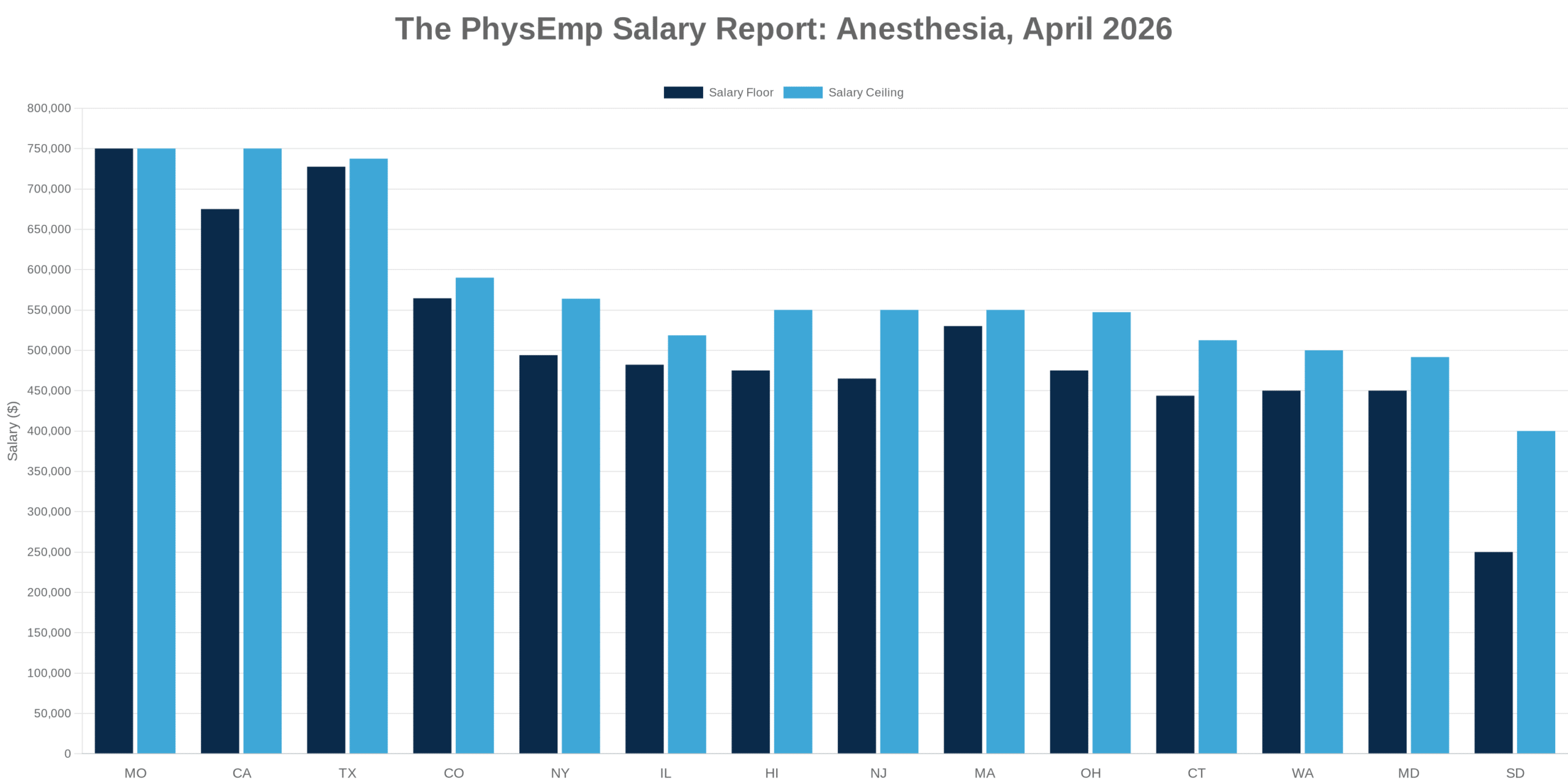
Overperformers: Missouri leads with an average of $750,000 (one listing, but what a listing). Texas follows at $727,500 to $737,500 across two postings, proving that everything is bigger in Texas, including anesthesia checks. California averages $675,000 to $750,000, though only two listings disclosed numbers. Colorado clocks in at $564,500 to $590,000, a respectable premium over the national midpoint.
Near-average: New York averages $494,000 to $563,938 across 16 salary-disclosing listings, a solid benchmark with depth. Illinois posts $482,143 to $518,571 over seven listings, steady and unremarkable. New Jersey lands at $465,000 to $550,000 across five postings. Massachusetts reports $530,000 to $550,000 from a single listing. Hawaii and Ohio both hover near $475,000 to $550,000, dependable but not dazzling.
Underperformers: South Dakota bottoms out at $250,000 to $400,000, a range that raises questions about scope, hours, or both. Connecticut averages $443,750 to $512,500 across four listings, below the national midpoint despite its proximity to high-cost metros. Maryland sits at $450,000 to $491,667 over three postings. Washington state reports $450,000 to $500,000, modest for the Pacific Northwest.
Volume leaders: New York (30 listings), California (28), Texas (22), Florida (22), Virginia (18), Pennsylvania (17), and Illinois (17). Florida and Virginia disclosed zero salary data despite their volume, a transparency gap that will cost recruiters credibility. New York leads in volume but pays near the national average, suggesting saturation. Texas and California prove that high volume and high pay can coexist.
👉 Compare Anesthesia compensation and opportunities by region
What This Means If You’re a Physician
If your priority is maximum compensation: Target the Plattsburgh, New York hourly position paying $550 to $600 per hour ($1,144,000 to $1,248,000 annualized). For standard full-time roles, Missouri’s $750,000 listing and Texas positions averaging $727,500 to $737,500 represent the top tier. California’s $675,000 to $750,000 range also commands attention.
If your priority is maximum optionality: New York offers 30 listings, California 28, and Texas and Florida each provide 22. New York and Illinois combine volume with disclosed salary data, giving you negotiating visibility. Florida and Virginia offer volume but zero transparency, which means more legwork.
If your priority is balance: Colorado delivers above-average pay ($564,500 to $590,000) in a lower-cost-of-living environment. Ohio and Hawaii offer near-national-average compensation with lifestyle trade-offs. Avoid the Manhattan listing at $300,000 to $400,000 unless you enjoy paying $4,000 a month in rent while earning what your peers make in Omaha.
What This Means If You’re a Recruiter
The salary transparency rate is 14% (49 listings with data divided by 350 total listings). That is not a typo. Eighty-six percent of Anesthesia job postings expect candidates to engage without knowing what the job pays, a strategy that works only when supply is desperate or candidates are uninformed. Neither condition applies to Anesthesia.
Candidate pipeline implications: Physicians will filter for disclosed salaries first, meaning your undisclosed listings are competing for attention with 14% of the market that has already answered the first question every candidate asks. High-volume states with zero transparency (Florida, Virginia, Pennsylvania) will need to lead with location, lifestyle, partnership track, or operational autonomy, because compensation is off the table as a hook.
Volume-pay misalignments: New York leads in listings but pays near the national average, a sign that supply may be softening demand. Florida and Virginia offer no salary data despite high volume, which signals either strategic opacity or a compensation story they would rather not tell up front. Texas and California demonstrate that volume does not require a pay discount, making the silence elsewhere more conspicuous.
👉 Post Anesthesia positions on PhysEmp
What’s Driving the Numbers
Scope and leadership do not appear to command a visible premium in this dataset. The highest-paying listing is an hourly position in a small upstate New York market, not a directorship in a major metro. Missouri’s $750,000 offer and Texas’s $727,500 average reflect geography and scarcity, not administrative scope. If leadership roles are paying more, they are not disclosing it, which means the premium is either modest or reserved for backdoor negotiations.
Part-time and hourly roles distort the floor and ceiling. The $1,248,000 annualized figure comes from an hourly rate, not a salaried position, and likely reflects locum or contract terms that include no benefits, no partnership, and no stability. On the low end, the $250,000 South Dakota listing and $300,000 Manhattan posting may be part-time, subspecialty training roles, or simply bad deals. Without scope details, these figures warp the range but tell us little about the standard full-time market.
Underserved markets are pricing in scarcity, but inconsistently. Missouri, Texas, and parts of California are paying premiums that reflect either low supply or high procedural volume. South Dakota, by contrast, is underserved and underpaying, a combination that will not solve its staffing problem. Geography alone does not determine pay; market strategy and institutional desperation do.
The volume-pay relationship is broken. New York has the most listings and pays near the average. Florida has 22 listings and discloses nothing. Texas has 22 listings and pays near the top. Volume signals demand, but it does not predict compensation. In Anesthesia, pay is set by local competition, institutional margin, and whether the recruiter has the courage to post a number.
The Bottom Line
The Anesthesia job market is highly lucrative, widely variable, and full of opportunity. Or more simply: There is a lot of money available for ensuring people do not feel things. Choose wisely. Missouri and Texas offer the highest standard full-time pay. New York and California offer the most options. South Dakota and Connecticut offer the most questions. The market rewards physicians who know their worth and punish hospitals that hide theirs.
👉 Browse all Anesthesia physician jobs
👉 Upload your CV to get matched with opportunities
👉 Set alerts for new Anesthesia roles
Salary data based on 49 listings with disclosed compensation. Figures may reflect part-time or specialized roles. This report is informational and should not replace professional judgment or financial planning.