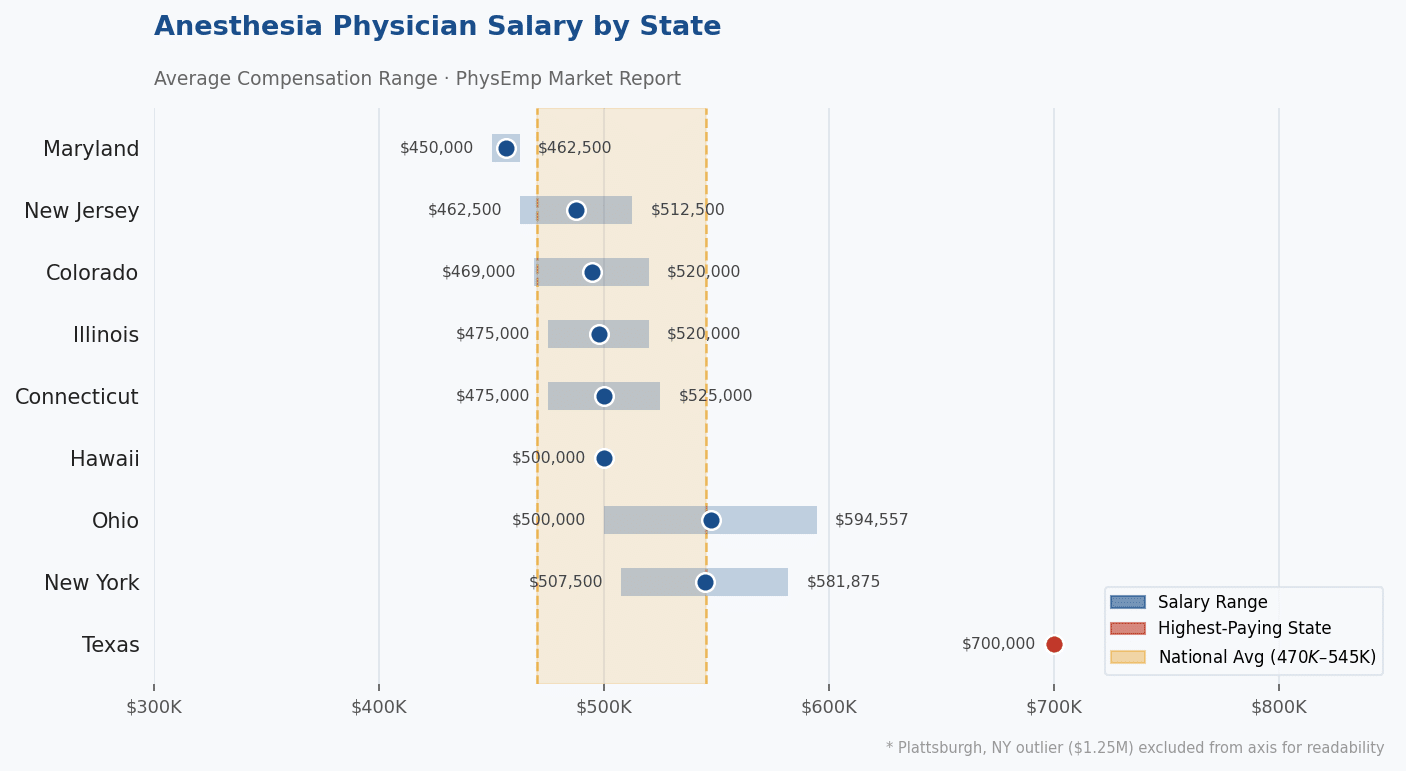

An hourly anesthesia position in Plattsburgh, New York is currently offering up to $600 per hour, which annualizes to $1,248,000 — more than the Medical Director role in Beaumont, Texas, and roughly five times what a South Dakota anesthesiologist might earn for doing the exact same thing. The national Anesthesia market currently holds 361 active listings across 43 states, with disclosed compensation data available for 50 positions. The data reveals a market where geography, contract structure, and leadership responsibilities create compensation swings so wide they might require their own anesthesia.
👉 Explore Anesthesia job market insights and trends
The Anesthesia Job Market at a Glance
Total listings: 361. Listings with salary data: 50. Full salary range: $250,000 to $1,248,000. Average salary range: $495,240 to $565,451.
The spread between floor and ceiling is extraordinary, even for physician compensation. The majority of standard full-time positions cluster in the $450,000 to $550,000 range, which means the national average captures the market’s center of gravity reasonably well. But the outliers tell the real story: hourly and leadership roles push the top end past $1,200,000, while a handful of positions in underserved or lower-cost markets dip as low as $250,000. This is not a market defined by consistency. It is defined by optionality, structure, and whether you are willing to work in South Dakota.
Active listings span New York, California, Texas, Florida, Pennsylvania, Virginia, Illinois, Indiana, New Hampshire, Nebraska, Georgia, Ohio, Colorado, Hawaii, Massachusetts, New Jersey, Connecticut, Maryland, Wisconsin, Alabama, West Virginia, Missouri, Iowa, Washington, Oregon, Maine, South Carolina, Michigan, Kentucky, North Carolina, Louisiana, New Mexico, Arizona, Arkansas, Kansas, Delaware, Utah, South Dakota, Minnesota, North Dakota, Tennessee, Vermont, Alaska, and Oklahoma.
👉 Browse Anesthesia physician job opportunities
How States Stack Up
Overperformers: Texas leads the nation with an average range of $727,500 to $737,500, driven by leadership roles that treat half a million as a starting point. California follows at $675,000 to $750,000, proving that even in a high-cost state, anesthesia pays enough to afford the rent. Missouri clocks in at a flat $650,000 based on one disclosed listing, a figure that significantly outpaces most of its Midwest peers. Colorado averages $532,667 to $566,667, placing it comfortably above the national mean. New Jersey ranges from $458,333 to $620,833, with enough ceiling to make the Turnpike tolls feel less personal.
Near-average: New York averages $488,600 to $561,533 across 15 salary-disclosed listings, a solid mid-market showing for the second-highest-volume state. Massachusetts posts $530,000 to $550,000, tight and predictable. Illinois sits at $482,143 to $518,571, just under the national average but still respectable for the Midwest. Hawaii averages $475,000 to $550,000, which may or may not offset the cost of shipping your furniture across the Pacific. Ohio comes in at $475,000 to $547,279, and Maryland averages $450,000 to $491,667, both hovering near the lower boundary of the national average.
Underperformers: Connecticut averages $443,750 to $512,500, a surprisingly modest range for a state that borders New York and charges New York prices. Washington state lists $450,000 to $500,000, near the bottom of disclosed markets despite its reputation for competitive physician pay. South Dakota anchors the national floor at $250,000 to $400,000, a range that reflects either part-time work, rural scarcity pricing gone wrong, or both.
Volume leaders: California leads with 28 listings, followed by New York with 26, Texas with 21, Florida and Pennsylvania with 19 each, and Illinois and Virginia with 18 each. Florida, Pennsylvania, and Virginia disclosed no salary data, which makes them invisible to compensation analysis despite their volume. California and Texas prove that high activity and high pay can coexist. South Dakota and Washington prove the opposite.
👉 Compare Anesthesia compensation and opportunities by region
What This Means If You’re a Physician
If your priority is maximum compensation: Target the hourly Anesthesia position in Plattsburgh, NY, offering $550 to $600 per hour ($1,144,000 to $1,248,000 annualized), or the Medical Director role in Beaumont, TX, offering $775,000. Both significantly exceed standard full-time packages and reflect the premium placed on flexibility or leadership scope.
If your priority is maximum optionality: California, New York, and Texas offer the highest listing volumes with disclosed salary data, giving you the ability to compare multiple offers within a single state. Illinois and New Jersey also provide meaningful choice, with 7 and 6 salary-disclosed listings respectively.
If your priority is balance: Colorado, Massachusetts, and New York offer above-average or near-average pay in states with strong quality-of-life reputations and reasonable listing volumes. Avoid Connecticut and Washington unless you have other compelling reasons to be there — both underperform relative to their cost of living and regional peers.
👉 Search Anesthesia jobs by location and compensation
What This Means If You’re a Recruiter
Salary transparency rate: 13.9% (50 listings with disclosed compensation out of 361 total). This is a low-transparency market, which means most candidates are flying blind until they engage directly with recruiters or hiring managers.
Pipeline implications: In a market where fewer than one in seven listings disclose salary, candidates will prioritize responsiveness and clarity from recruiters who can provide compensation data early in the process. High-volume states like Florida, Pennsylvania, and Virginia disclosed zero salary figures, which creates a significant informational disadvantage. Recruiters in those states will need to lead with geography, practice structure, and lifestyle rather than compensation — or risk losing candidates to Texas and California, where the numbers are public and compelling.
The volume-pay relationship is inconsistent. Texas and California prove that high demand and high pay can align. Florida and Pennsylvania prove that high demand does not guarantee transparency or competitive disclosed compensation. South Dakota and Washington show that low volume does not automatically command scarcity pricing.
👉 Post Anesthesia positions on PhysEmp
What’s Driving the Numbers
Leadership and scope command a significant premium. The Medical Director role in Beaumont, TX, pays $775,000, and the hourly position in Plattsburgh, NY, annualizes above $1,200,000. Both exceed standard full-time offers by 40% or more, signaling that administrative responsibility and contract flexibility are worth paying for. Anesthesiologists willing to take on leadership or accept hourly arrangements will find a different market entirely — one where seven figures is not theoretical.
Hourly and part-time roles distort the floor. South Dakota’s $250,000 figure almost certainly reflects part-time or limited-scope work, not a standard full-time anesthesia position. The same is likely true for the lower end of Connecticut’s range. This creates noise in the data and makes direct state-to-state comparisons difficult without additional context. Physicians evaluating offers should confirm FTE status and expected clinical hours before assuming a listing represents full-time compensation.
Underserved markets do not consistently price in scarcity. South Dakota, Washington, and Connecticut all sit below the national average despite being lower-volume or rural markets where anesthesia coverage is typically hard to recruit. This suggests either part-time roles, lower reimbursement environments, or health systems unwilling to pay market rate. Scarcity pricing exists in this market, but it is not universal.
The volume-pay relationship breaks in predictable ways. High-volume states with disclosed salary data (California, Texas, New York) pay at or above the national average. High-volume states without disclosed salary data (Florida, Pennsylvania, Virginia) remain question marks. Low-volume states span the entire spectrum, from Missouri’s $650,000 to South Dakota’s $250,000. Volume alone does not predict pay. Transparency does.
The Bottom Line
The Anesthesia job market is highly lucrative, widely variable, and full of opportunity. Or more simply: There is a lot of money available for ensuring people do not feel things. Choose wisely. Texas and California offer the best combination of disclosed pay and job volume. New York provides mid-market stability with the occasional seven-figure hourly outlier. And South Dakota offers $250,000, which is either a part-time gig or a cautionary tale, depending on how you read the fine print.
👉 Browse all Anesthesia physician jobs
👉 Upload your CV to get matched with opportunities
👉 Set alerts for new Anesthesia roles
Compensation data based on disclosed salary information is available for only 13.9% of the market, which means most of this analysis rests on a small but meaningful sample.
Salary data based on 50 listings with disclosed compensation. Figures may reflect part-time or specialized roles. This report is informational and should not replace professional judgment or financial planning.